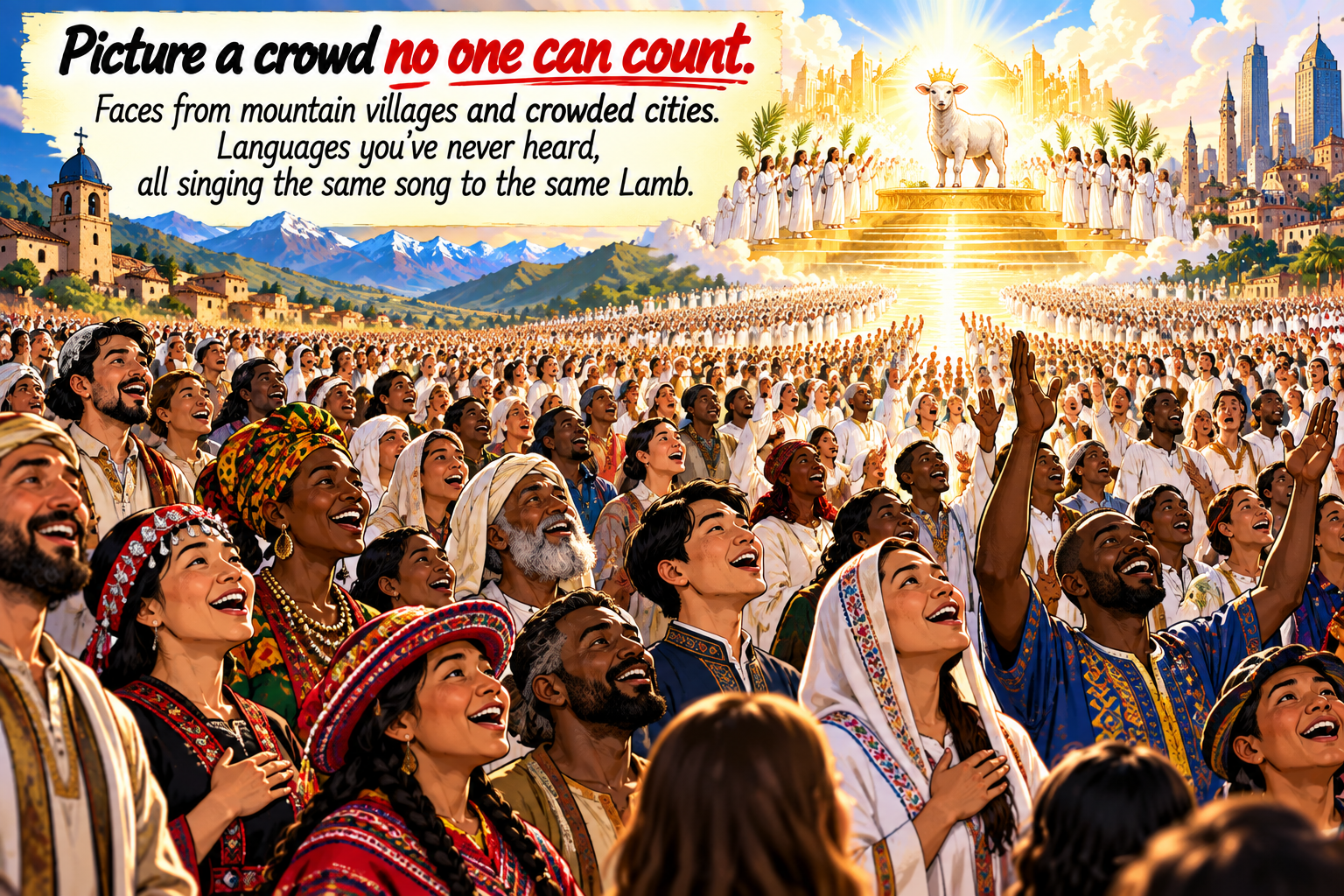
when the average preacher takes a text it reminds him of an insect trying to carry a bale of cotton
Today's gleanings

Contrary to man’s definition, God centers sainthood in Christ alone. Sinful, lost man becomes a saint through faith in the Savior as his sin-bearer. Saved by grace through faith (Ephesians 2:8–9), the believer is placed “in Christ” by the Holy Spirit. This becomes the believer’s position, or sphere, in which God sees him.
Sainthood, as God sees it, is based on position, not experience.
God declares us saints on the basis of what He has done for us, not on what we do for Him or for others.
Merrill Frederick Unger, What Demons Can Do to Saints (Chicago, IL: Moody Publishers, 1991), 36.
God deals with the sinning saint as a child in the divine family. He corrects and chastens (1 Corinthians 11:32), and in severe cases He “scourges” (Hebrews 12:6). The Greek word means “to flog” or “to whip severely.”4 The Father lays the lash on the wastrel son who plays the prodigal. The lash He uses may be physical weakness, sickness, or, in severest cases, premature physical death (1 Corinthians 11:30). He employs Satan and the powers of darkness as His whip (1 Corinthians 5:5).
4 William F. Arndt and F. Wilbur Gingrich, A Greek-English Lexicon of the New Testament, p. 496.
Merrill Frederick Unger,
What Demons Can Do to Saints (Chicago, IL: Moody Publishers, 1991), 39.
***************************
It is concluded, then, that sinning saints never lose their salvation (1 Corinthians 11:30–32). Nor will they ever land in hell (1 Corinthians 5:5). However, by their sin they do open up themselves to the powers of darkness to harass, despoil, and enslave them, besides doing them other harm, even to killing their physical bodies (1 John 5:16; cf. Matthew 10:28).
Merrill Frederick Unger, What Demons Can Do to Saints (Chicago, IL: Moody Publishers, 1991), 40.
Sin, Satan, demons, and wicked men are powerless to destroy what Jesus Christ accomplished by His death and resurrection.
Merrill Frederick Unger,
What Demons Can Do to Saints (Chicago, IL: Moody Publishers, 1991), 47.
***************************
Confidence that one is saved and forever safe in the Beloved is the only sound ground for victory over the world, the flesh, and the devil. Believing that we are what we are in Christ assures a triumphal life that redounds to the glory of God and the blessing of man.
Merrill Frederick Unger,
What Demons Can Do to Saints (Chicago, IL: Moody Publishers, 1991), 48.
***************************
The first lesson taught here is that of a forgiving disposition. We pray, ‘‘Forgive, even as we have forgiven.’’ Scripture says, ‘‘Forgive each other, just as in Christ God forgave you’’ (Ephesians 4:32). God’s full and free forgiveness is to be our rule with others. Otherwise, our reluctant, halfhearted forgiveness, which is not forgiveness at all, will be God’s rule with us. Every prayer rests upon our faith in God’s pardoning grace. If God dealt with us according to our sins, not one prayer would be heard.
Pardon opens the door to all God’s love and blessing. Because God has forgiven our sins, our prayer can prevail to obtain what we need. The deep, sure ground of answers to prayer is God’s forgiving love. When it possesses our heart, we pray in faith and we live in love. God’s forgiving disposition, revealed in His love to us, becomes our disposition as well. As the power of His forgiving love penetrates our heart and dwells within us, we forgive as He forgives. If there is any great injury or injustice done to us, we first try to possess a Christlike disposition; to be kept from a sense of wounded honor, from a desire to maintain our rights, or from rewarding the offender as he deserves.
***************************
My prayer is measured not according to what I try to be when I am praying but by what I am when I am not praying.
Andrew Murray,
Teach Me to Pray (Grand Rapids, MI: Bethany House, 2002).
***************************
The famous preacher Sam Jones (who was a Billy Sunday before Billy Sunday’s time) said that when the average preacher takes a text it reminds him of an insect trying to carry a bale of cotton. And when I take my text and try to talk about God I feel like that insect; only God can help me.
A. W. Tozer and David E. Fessenden,
The Attributes of God: Deeper into the Father’s Heart, vol. 2 (Camp Hill, PA: WingSpread, 2001–), 2.
***************************
I’d like to say, with no attempt at morbid humility, that without a pure heart and a surrendered mind, no man can preach worthily about God and no man can hear worthily. No man can hear these things unless God touches him and illuminates him.
A. W. Tozer and David E. Fessenden,
The Attributes of God: Deeper into the Father’s Heart, vol. 2 (Camp Hill, PA: WingSpread, 2001–), 2.
***************************
All that came about because man lost his confidence in God. He didn’t know God’s character. He didn’t know what kind of God God was. He got all mixed up about what God was like. Now the only way back is to have restored confidence in God. And the only way to have restored confidence in God is to have restored knowledge of God.
A. W. Tozer and David E. Fessenden,
The Attributes of God: Deeper into the Father’s Heart, vol. 2 (Camp Hill, PA: WingSpread, 2001–), 4.
***************************
But today the preaching to a large extent is cheap, frivolous, coarse, shallow and entertaining. We in the gospel churches think that we’ve got to entertain the people or they won’t come back. We have lost the seriousness out of our preaching and have become silly.
A. W. Tozer and David E. Fessenden,
The Attributes of God: Deeper into the Father’s Heart, vol. 2 (Camp Hill, PA: WingSpread, 2001–), 8–9.
***************************
The essence of sin is independent self.
A. W. Tozer and David E. Fessenden, The Attributes of God: Deeper into the Father’s Heart, vol. 2 (Camp Hill, PA: WingSpread, 2001–), 27.
***************************
No matter how many manifestations sin may have, remember that the liquid essence in the bottle is always self.
That’s why it’s not always easy to get people to become real Christians. You can get them to sign a card, or make a decision, or join a church, or something like that. But to get people delivered from their sin is a pretty hard deal because it means that I’ve got to get off that throne. God belongs on that throne but sin has pushed God off and taken over.
A. W. Tozer and David E. Fessenden, The Attributes of God: Deeper into the Father’s Heart, vol. 2 (Camp Hill, PA: WingSpread, 2001–), 29.