Planting Indigenous Churches
A Work That Outlives the Worker
A man can preach for forty years and still not leave behind what one healthy local church leaves behind in a single generation. Programs end when the man is through. Personalities fade when the man moves on or goes home to be with the Lord. Only the church continues the ministry long after a man is finished.
That single truth should reshape how every missionary, every church planter, and every pastor thinks about legacy.
God's Plan Was Never a Program
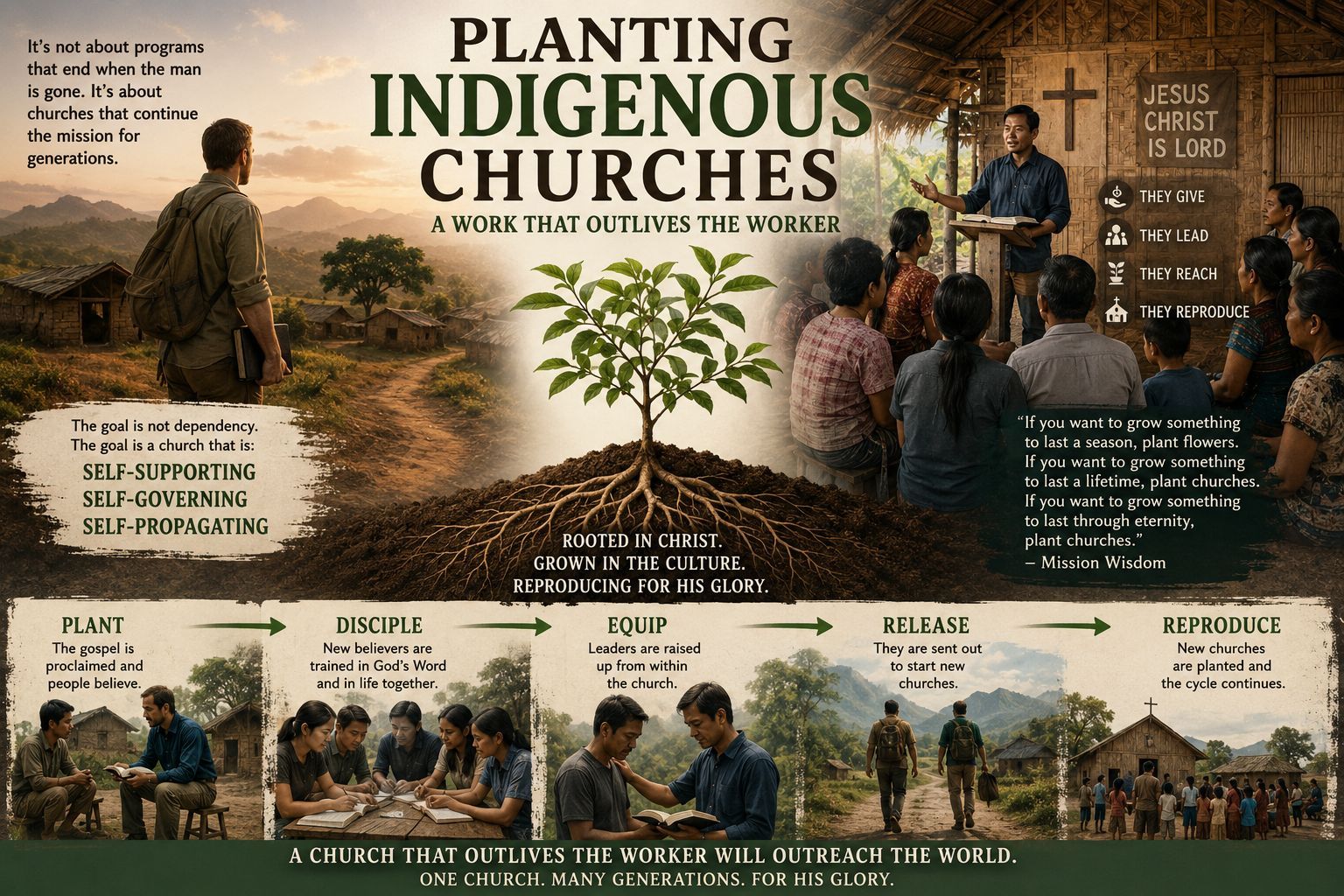
God's plan is not a network of parachurch ministries scattered across the globe. His plan is a local church for every man, woman, and family in this world. Not a satellite campus controlled from somewhere else. Not a mission station forever dependent on foreign funds. A real church, rooted in real soil, worshiping and reaching and reproducing on its own.
Ephesians 4:11-16 makes the goal unmistakable. God gave apostles, prophets, evangelists, pastors, and teachers for one purpose: to develop the saints into active, effective servants of God. The passage does not describe a handful of professionals doing ministry while everyone else watches. It describes a whole body, every joint supplying what is needed, growing itself up in love. That growth happens in a local church or it does not happen at all.
Colossians 1:28 shows us Paul's own target. His goal was to present every man mature before the Lord. Not converted and left alone. Mature. Paul did not measure success by decisions made at an altar. He measured it by lives formed into the likeness of Christ, and that formation takes place over years, inside a community that disciples its own people. The greatest discipling, maturing body in the world is the local church. No conference, no book, no online course can replace what happens when believers walk together in the same body over time.
Whose Job Is the Great Commission
Here is something worth saying plainly. The Great Commission was not committed to a mission board. It was not handed to a Bible college. It was not entrusted to a group of gifted men operating independently. It was given to the church.
Mission boards, Bible colleges, and parachurch ministries can serve the church well. They can train, send, and support. But they were never meant to replace the church as the body responsible for reaching the world and maturing believers. When we forget that, we build structures that can outlast their usefulness, while the local churches they were meant to serve stay dependent and small.
Reproduction Is the Proof of Life
Like produces like. If you are truly a local churchman, sent out by a local church, you will be forced by your own nature to produce local churches. A ministry that gathers converts but never plants churches has not finished its assignment. A ministry that plants a church, and that church goes on to plant others, has passed the test that matters most.
An indigenous church will carry on the work long after the man who starts it is gone. It will provide its own funds. It will raise up its own workers. It will not wait on a check from overseas or a visiting speaker from another country to keep functioning. That is what indigenous means. Not foreign in appearance, not dependent in practice, but genuinely at home in its own culture and self-sustaining in its own strength, under God.
Someone once described the shift happening across missions this way. There is a new wind blowing, and it is wafting our way, soon to turn into a gale. Its theme is reflected in a simple epigram. If you want to grow something to last a season, plant flowers. If you want to grow something to last a lifetime, plant churches. If you want to grow something to last through eternity, plant churches.
Flowers fade by autumn. Churches, planted well, outlast the planter by generations.
What History Teaches Us
This is not a new conversation. In the nineteenth century, two missionary statesmen, Henry Venn of the British Church Missionary Society and Rufus Anderson, a North American Congregationalist, wrestled with the same problem we still wrestle with. Too many mission churches were not viable on their own. Working independently, they arrived at what became known as the three-self formula: self-support, self-government, and self-propagation.
It was a bold attempt, and it often failed in practice. Historian Stephen Neill observed that the mission's early withdrawal, leaving the church in Sierra Leone in the hands of the native pastorate in 1860, inflicted on that church a paralysis from which a full century could not deliver it. The formula was right. The application was premature, and perhaps the roles handed to national preachers did not fit the culture they were meant to serve.
The lesson is not that indigenous principles fail. The lesson is that indigenous churches must be formed with patience and wisdom from the very beginning, not rescued after the fact by pulling out too soon.
The Real Question
Most churches, even in America, are not truly indigenous. They depend on hired staff, borrowed models, and outside funding far more than they realize. Dependency is not only a mission field problem. It is a human problem, and it shows up wherever churches are planted without the discipline of self-support, self-government, and self-propagation built in from day one.
So the real question was never whether we believe in an indigenous church. Most of us would say yes without hesitation. The real question is how to produce one.
That question cannot be answered by slogans. It is answered by the way a church is planted from its very first meeting: who is trained to lead, who is taught to give, who is released to reproduce, and how quickly the founder steps back so that the church learns to stand on Christ rather than lean on him. It is answered by remembering that the goal was never a crowd gathered around a gifted man, but a body of mature believers who no longer need that man to keep going.
That is the work worth giving a life to. Not a legacy of seats filled, but a legacy of churches sent out, each one carrying the same DNA, each one able to do it again.
Called and sent, W. Austin Gardner
This piece carries themes that travel well across cultures and languages. If church planting and missions burden your heart,
subscribe here and consider sharing this with a pastor or missionary who needs to hear it today. Audience of One.