A Plan Big Enough for the Nations
Why the Great Commission needs a strategy, not just a suitcase
I have been on a lot of mission fields in fifty-plus years. I have watched churches send their best young couple overseas with a plane ticket, a support letter, and a prayer and not much else. I have watched other churches write a check to a national pastor and call it missions. Both come from good hearts. Neither one finishes the job Jesus gave us.
Jesus never told us to feel something for the nations. He told us to reach them.
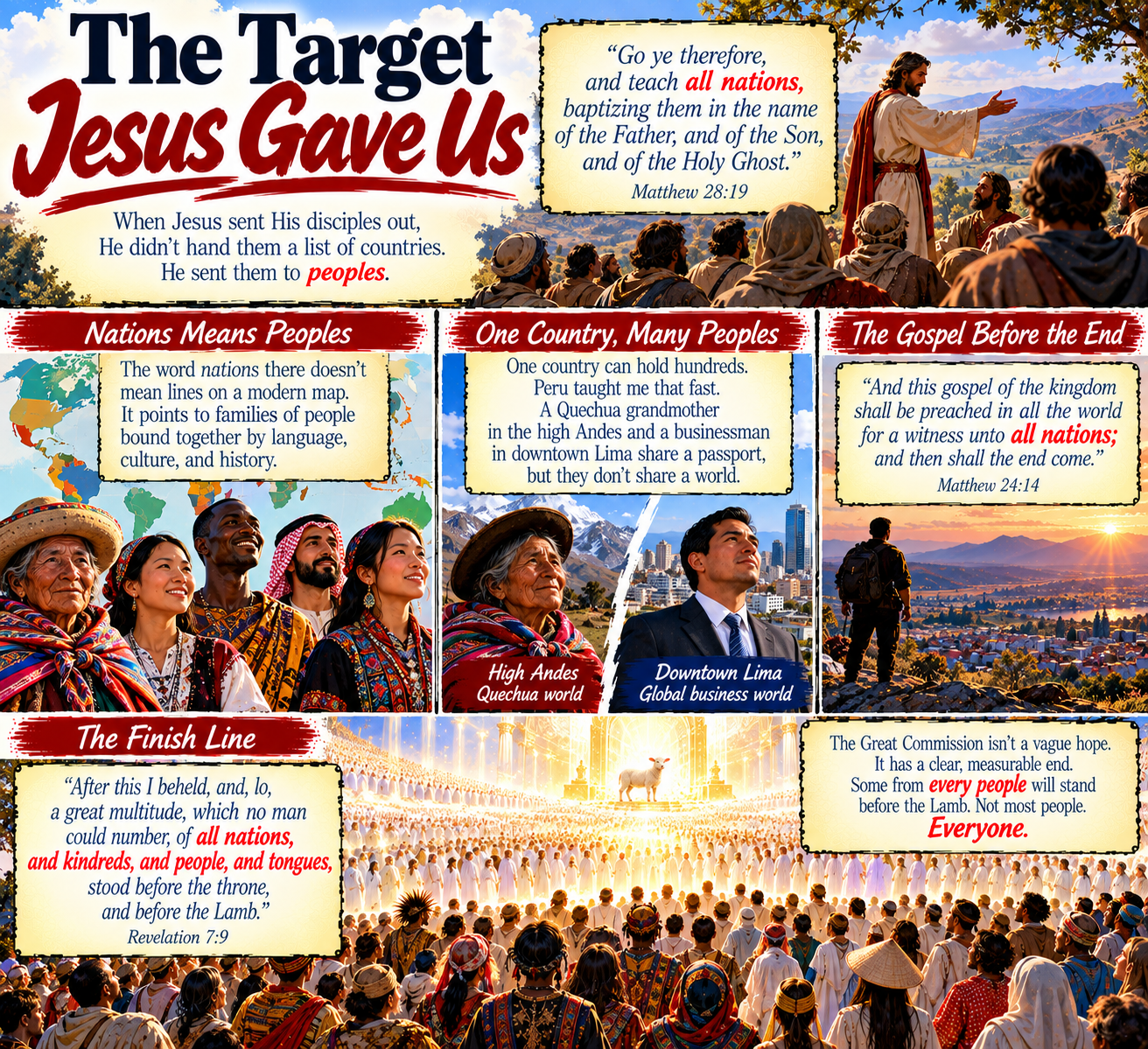
Go ye therefore, and teach all nations, baptizing them in the name of the Father, and of the Son, and of the Holy Ghost: Teaching them to observe all things whatsoever I have commanded you: and, lo, I am with you alway, even unto the end of the world. Amen. Matthew 28:19-20
That is not a suggestion. It is not a slogan for a banner in the fellowship hall. It is a command, and a command that big deserves a plan that big. Habakkuk was told the same thing about vision:
"Write the vision, and make it plain upon tables, that he may run that readeth it" (Habakkuk 2:2).
God is not against planning. He is against planning without Him.
So let's talk about what a real strategy looks like.
We Will Never Send Enough Americans
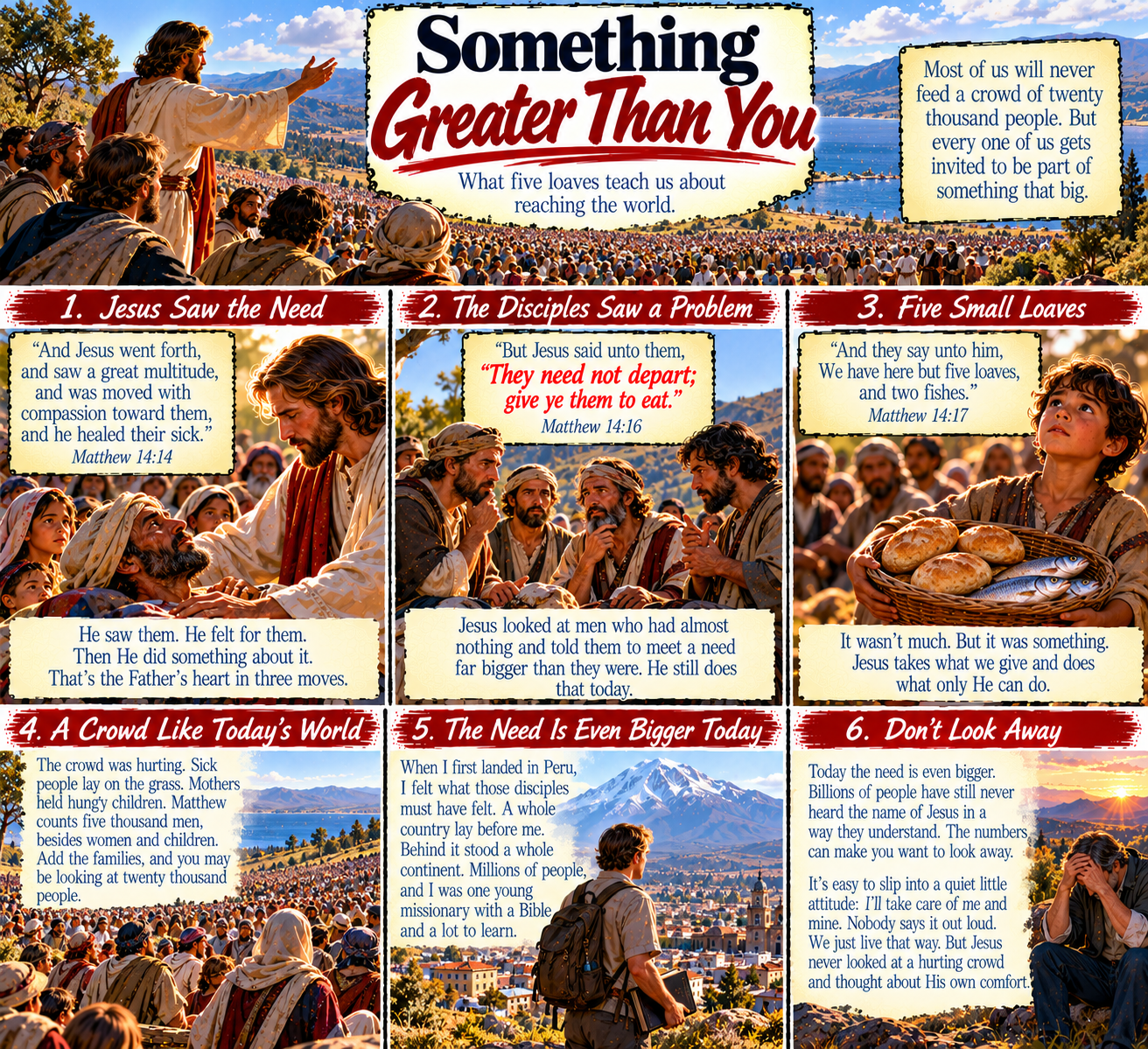
Here is something that took me years on the field to admit: we are never going to raise up enough American missionaries to finish this job. Not because Americans lack courage. Because the math doesn't work. There are whole nations with more people than there are churches in all of America to send.
Jesus saw the same problem two thousand years ago and gave us the answer.
The harvest truly is plenteous, but the labourers are few; Pray ye therefore the Lord of the harvest, that he will send forth labourers into his harvest. Matthew 9:37-38
Notice He didn't say pray that He'd send more Americans. He said pray for laborers plural, and from everywhere. The missionary's job was never to be the whole harvest crew. It was to raise one up. Paul knew this too. He didn't try to personally plant a church on every corner of the Roman Empire. He trained men who trained men.
And the things that thou hast heard of me among many witnesses, the same commit thou to faithful men, who shall be able to teach others also. 2 Timothy 2:2
That verse has four generations in one sentence: Paul, Timothy, faithful men, and the others they will teach. That is the whole strategy in miniature. A missionary who never multiplies himself out of a job hasn't really started the work yet.
Money Without Training Isn't a Strategy; It's a Guess
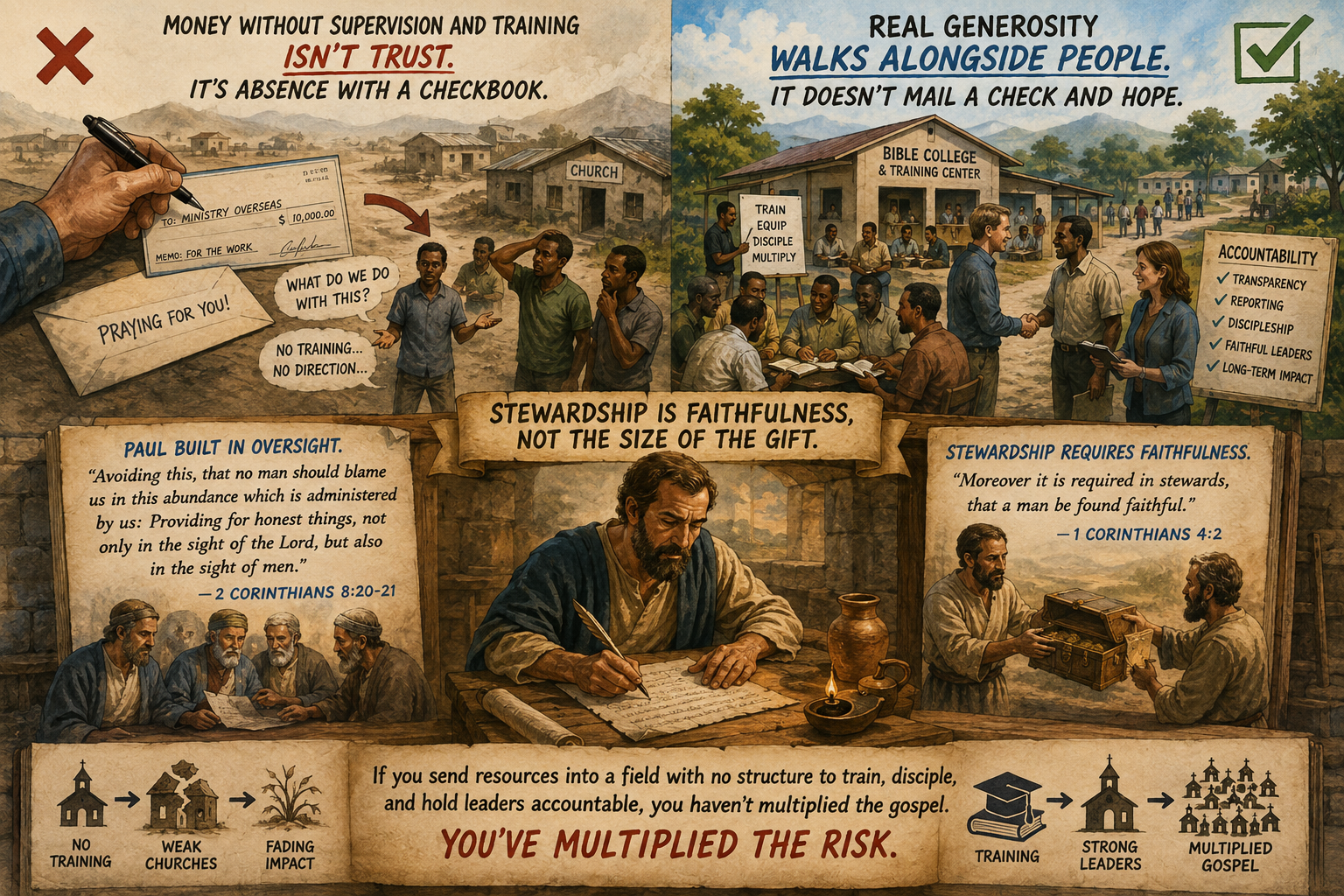
I understand the appeal of just sending money. It feels fast. It feels generous. And sometimes it feels like the humble thing to do: "let the nationals lead, we'll just fund it." But money without supervision and training isn't trust. It's absence with a checkbook.
Paul was careful about this. When the churches took up an offering for Jerusalem, he didn't just wire it and walk away. He built in oversight.
Avoiding this, that no man should blame us in this abundance which is administered by us: Providing for honest things, not only in the sight of the Lord, but also in the sight of men. 2 Corinthians 8:20-21
And stewardship, biblically, was never about the size of the gift. It was about faithfulness with what was given.
Moreover it is required in stewards, that a man be found faithful. 1 Corinthians 4:2
If you send resources into a field with no structure to train, disciple, and hold leaders accountable, you haven't multiplied the gospel. You've multiplied the risk. Real generosity walks alongside people. It doesn't mail a check and hope.
Start the Bible College on Day One
This is the part of the plan I feel most strongly about, because I have watched what happens when it's ignored. If you wait until year ten to think about training national leaders, you have already lost nine years you cannot get back.
From the very first day on a field, the plan needs to include a school, a Bible college, a preacher training program, something that takes raw, hungry men and women and turns them into pastors who can stand on their own two feet without you.
Paul modeled this everywhere he went. He didn't plant a church and leave it leaderless.
And when they had ordained them elders in every church, and had prayed with fasting, they commended them to the Lord, on whom they believed. Acts 14:23
He told Titus the same thing about Crete an entire island, and the instruction wasn't "go preach a lot of sermons." It was:
For this cause left I thee in Crete, that thou shouldest set in order the things that are wanting, and ordain elders in every city, as I had appointed thee. Titus 1:5
Elders in every city. Not elders someday. Not elders once the missionary retires. The training structure has to exist from the beginning, because the goal was never for the missionary to be the church's pastor forever. It was to leave behind men who could do it without him.
And he gave some, apostles; and some, prophets; and some, evangelists; and some, pastors and teachers; For the perfecting of the saints, for the work of the ministry, for the edifying of the body of Christ. Ephesians 4:11-12
The missionary's job is to equip the equippers. A school does that. A single preacher, no matter how gifted, cannot.
Set Goals You Can Actually Measure
This is where a lot of good-hearted missions work gets fuzzy, and I say this gently because I've been guilty of it myself. We love to count baptisms. We love to report converts. But those numbers, by themselves, can lie to us.
Converts and baptisms aren't the finish line
You can baptize thousands of people in a country and still leave it functionally unreached, because a name in a baptism registry isn't the same as a functioning, reproducing church. Paul understood that planting was only the beginning of the work, not the sum of it.
I have planted, Apollos watered; but God gave the increase. 1 Corinthians 3:6
Growth belongs to God. But planning belongs to us. If your only goal is decisions for Christ, you can hit that goal and still leave a nation without enough churches to disciple the people you reached.
Count churches against population, not just against your budget
A better measure: how many churches exist for how many people, cities, towns, and villages. Jesus' plan in Acts 1:8 wasn't vague either; it had geography built into it.
But ye shall receive power, after that the Holy Ghost is come upon you: and ye shall be witnesses unto me both in Jerusalem, and in all Judaea, and in Samaria, and unto the uttermost part of the earth. Acts 1:8
Jerusalem, then Judaea, then Samaria, then the uttermost part. That's a map. If you don't know how many towns and villages are still without a single church, you don't actually know how the work is going no matter how good last Sunday's altar call felt.
Decide, in writing, what a church actually is
Before you can count churches, you need to define one. Is it twelve believers meeting under a tree with a national leader teaching them the Word? Is it a building with a paid pastor? Different answers produce wildly different numbers and wildly different strategies. This isn't a small detail; it's the foundation everything else gets built on. Get your leadership together and settle it before you start counting.
Count the leaders you'll need to get there
Once you know how many churches you're aiming for, you can work backward to the number of trained leaders required to shepherd them. That number becomes the real target of your Bible college, not vague encouragement to "raise up leaders," but an actual figure you are training toward, region by region.
For which of you, intending to build a tower, sitteth not down first, and counteth the cost, whether he have sufficient to finish it? Luke 14:28
Jesus told that parable about discipleship, but it applies just as well here. Sit down. Count. Know the number of leaders your goal actually requires before you're three years in and wondering why the field feels unreached.
The Plan Serves the God Who Sends
I want to close where I started. None of this replaces dependence on God. Hudson Taylor used to say the same thing in different words: his whole life's plans are only as good as the God behind them, and confidence has to rest in Christ, never in the method itself.
A man's heart deviseth his way: but the LORD directeth his steps. Proverbs 16:9
Make the plan. Count the churches. Define your terms. Train your leaders from day one. But hold it all with open hands, because the increase was never ours to produce.
Where there is no vision, the people perish. Proverbs 29:18
A nation without a plan for the gospel is a nation left waiting. You don't have to be the one who reaches every village yourself. You just have to be faithful enough to train the ones who will.