
Every Nation Already Paid For
Setting mission priorities that match the Father’s heart
Most churches I know love missions. Very few have ever sat down and asked what their missions giving is actually aiming at.
That’s not a criticism. It’s just how things grow. A missionary comes through, preaches a good Sunday night, and the church adds him to the support list. Ten years later the list has forty names on it, and nobody can tell you why those forty and not forty others.
Jesus gave us a target. It’s clearer than most of us realize, and it comes wrapped in grace.
The Target Jesus Gave Us
When Jesus sent His disciples out, He didn’t hand them a list of countries. He sent them to peoples.
Go ye therefore, and teach all nations, baptizing them in the name of the Father, and of the Son, and of the Holy Ghost. Matthew 28:19
The word nations there doesn’t mean lines on a modern map. It points to families of people bound together by language, culture, and history. One country can hold hundreds. Peru taught me that fast. A Quechua grandmother in the high Andes and a businessman in downtown Lima share a passport, but they don’t share a world.
Jesus also told us how history wraps up.
And this gospel of the kingdom shall be preached in all the world for a witness unto all nations; and then shall the end come. Matthew 24:14
Then John looked at the finish line.
After this I beheld, and, lo, a great multitude, which no man could number, of all nations, and kindreds, and people, and tongues, stood before the throne, and before the Lamb. Revelation 7:9
Think about what that means for a pastor or a missions committee. The Great Commission isn’t a vague hope. It has a clear, measurable end. Some from every people will stand before the Lamb. Not most people. Everyone.
It Starts With What Jesus Already Did
Here’s the verse that changed how I think about missions. Read it slowly.
And they sung a new song, saying, Thou art worthy to take the book, and to open the seals thereof: for thou wast slain, and hast redeemed us to God by thy blood out of every kindred, and tongue, and people, and nation. Revelation 5:9
Look at the tense. Hast redeemed. The price is already paid. Somewhere in a mountain village nobody in your congregation can pronounce, Jesus has already bought people with His own blood. They just haven’t heard the news yet.
That takes the pressure off and brings the joy back. We don’t send missionaries to earn God’s approval. We don’t go to rescue a God who’s running behind schedule. His love got there first. We carry news of a finished work. We aren’t trying to finish it.
A church that grasps this gives differently. Guilt gives a little and resents every dollar. Love gives freely because it has already received so much.
For the love of Christ constraineth us. 2 Corinthians 5:14
Where Christ Has Not Been Named
Paul knew exactly where he wanted to spend his life.
Yea, so have I strived to preach the gospel, not where Christ was named, lest I should build upon another man’s foundation. Romans 15:20
We should keep multiplying churches among peoples who already have a gospel-preaching church. That work matters, and those churches need to grow and reproduce. But if God’s promise includes some from every people, then the peoples with no church at all deserve our special attention.
Thousands of people groups still have no living church of their own that can reach them in their own language and way of life. They aren’t rejecting the gospel. Most of them have never had the chance.
How then shall they call on him in whom they have not believed? and how shall they believe in him of whom they have not heard? and how shall they hear without a preacher? Romans 10:14
Left to ourselves, we drift toward places where the gospel already is. Flights cost less, roads are paved, and results come faster. Nobody means any harm by it. But a church that never asks where the gospel hasn’t gone will rarely send anyone there.
Three Kinds of Missionary Work
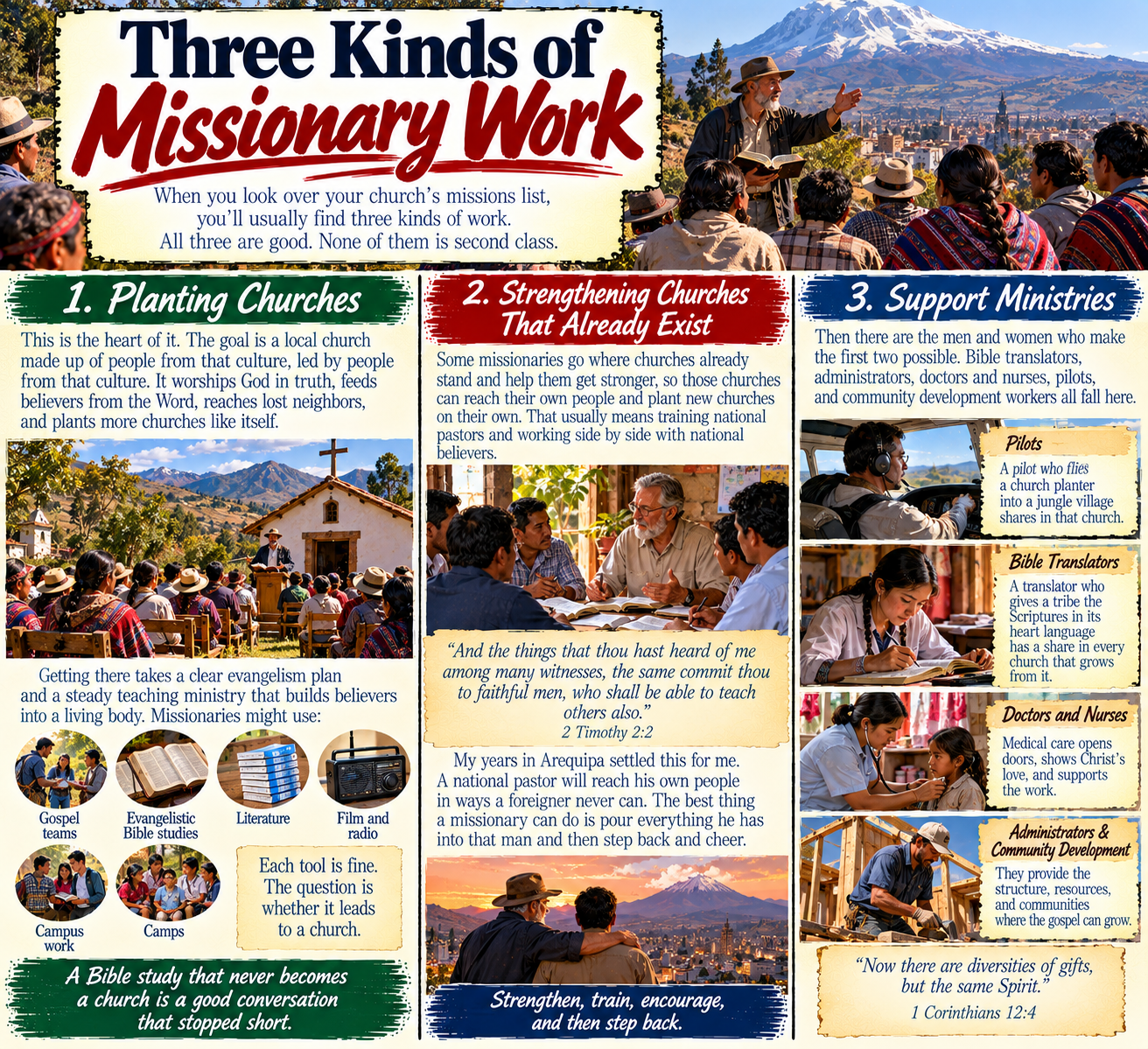
When you look over your church’s missions list, you’ll usually find three kinds of work. All three are good. None of them is second class.
1. Planting Churches
This is the heart of it. The goal is a local church made up of people from that culture, led by people from that culture. It worships God in truth, feeds believers from the Word, reaches lost neighbors, and plants more churches like itself.
Getting there takes a clear evangelism plan and a steady teaching ministry that builds believers into a living body. Missionaries might use gospel teams, evangelistic Bible studies, literature, film and radio, campus work, or camps. Each tool is fine. The question is whether it leads to a church. A Bible study that never becomes a church is a good conversation that stopped short.
2. Strengthening Churches That Already Exist
Some missionaries go where churches already stand and help them get stronger, so those churches can reach their own people and plant new churches on their own. That usually means training national pastors and working side by side with national believers.
And the things that thou hast heard of me among many witnesses, the same commit thou to faithful men, who shall be able to teach others also. 2 Timothy 2:2
My years in Arequipa settled this for me. A national pastor will reach his own people in ways a foreigner never can. The best thing a missionary can do is pour everything he has into that man and then step back and cheer.
3. Support Ministries
Then there are the men and women who make the first two possible. Bible translators, administrators, doctors and nurses, pilots, and community development workers all fall here.
Now there are diversities of gifts, but the same Spirit. 1 Corinthians 12:4
A pilot who flies a church planter into a jungle village shares in that church. A translator who gives a tribe the Scriptures in its heart language shares in every church that grows from it.
A Healthy Mix With a Clear Focus
None of this ranks missionaries by importance. The Holy Spirit gives a church a healthy blend of ministries, and we should gladly support and encourage that variety.
But a church can still aim. At this point in history, some needs stand out as critical. So a church can decide that, over time, it will give the majority of its missionary support to planting and equipping churches in unreached and critically needy places.
Notice the words over time. This isn’t about cutting faithful missionaries off the list next month. It’s about letting the Father’s promise shape every new decision you make from here on.
So What Do We Do on Monday?
If you lead a church or sit on a missions committee, here are a few simple places to start.
- Sort your list. Put each missionary you support into one of the three categories. Just seeing it on paper will teach you a lot.
- Mark the unreached. Note which ones work among people with little or no church. Many churches are surprised by how few there are.
- Ask one good question. When you talk with your missionaries, ask how their work is leading to a local church that will reproduce. Ask it kindly, and listen well.
- Let the promise guide new decisions. When a new opportunity comes, prioritize planting and equipping churches where the need is greatest.
- Pray by name. Adopt one unreached people group and pray for it out loud on Sunday mornings. Let your people learn its name.
- Teach the why. Walk your congregation through Revelation 5:9. People give and go with joy when they see what Jesus has already done.
The Finish Line Is Already Settled
Picture that crowd John saw. No one can count it. Every tongue is there, and every tribe. Somewhere in that sea of faces stands a man or woman from a people group that, today, has never heard the name of Jesus.
They’ll be there. That part isn’t in doubt. The Lamb was slain, and the purchase is complete.
Our part isn’t to make it happen. Our part is to join the Father in what He has already promised, and to enjoy Him while we do it. That’s not a burden. It’s the greatest privilege a church could ever have.
So love your missionaries. Pray for them. Send them. And keep your eyes on the One who loved every nation enough to die for it. We serve an Audience of One, and He has already written the ending.
If this helped you think about missions in your church, I’d love to keep the conversation going. Every week I write for pastors, missionaries, and church planters who want to lead from grace instead of pressure.
Subscribe to Ministry by Mercy to get the next article in your inbox, or find more at alignmentministries.com/from-austins-pen. Share it with your missions committee, too. It might start a good conversation.
#FollowedByMercy #AudienceOfOne