Every Tribe and Tongue
Priorities for Reaching the Nations
Picture a crowd too large to count. Faces from mountain villages and crowded cities. Languages you've never heard, all singing the same song to the same Lamb.
That's not a dream. It's the ending God already wrote.
"After this I beheld, and, lo, a great multitude, which no man could number, of all nations, and kindreds, and people, and tongues, stood before the throne, and before the Lamb" (Revelation 7:9).
I've spent most of my life thinking about that crowd. Decades in Peru taught me it isn't a statistic. It's real people the Father loves, and many of them still haven't heard His name.
So how should a church decide where to put its prayers, its people, and its money for the nations? Let's think it through together.
The Father Already Knows How the Story Ends
Missions doesn't start with us. It starts with a Father who so loved the world that He gave His Son (John 3:16).
Before Jesus sent anyone anywhere, He paid for the whole crowd. Heaven sings about it:
"thou wast slain, and hast redeemed us to God by thy blood out of every kindred, and tongue, and people, and nation" (Revelation 5:9).
Notice the tense. He has
redeemed. Jesus already paid the price. Our job isn't to make God willing to save the nations, because He already is. We simply get to carry the news.
That changes how we approach world evangelism. We don't go to earn His approval. We go because we already have it.
Why Peoples, Not Just People
Jesus gave us a clear commission:
"Go ye therefore, and teach all nations" (Matthew 28:19).
That word nations points to peoples, groups with their own language, culture, and identity.
He also gave us a promise:
"And this gospel of the kingdom shall be preached in all the world for a witness unto all nations; and then shall the end come" (Matthew 24:14).
Of all the goals Scripture hands us, this one is among the most measurable. It isn't only "win as many individuals as you can," as good as that is. Christ wants worshipers from every people group on earth.
Think about what that means. A city might have a hundred churches while a tribe three valleys over has none. Both matter to God. Only one of them has no one to tell them.
Where Christ Has Not Been Named
Paul understood this. He wrote,
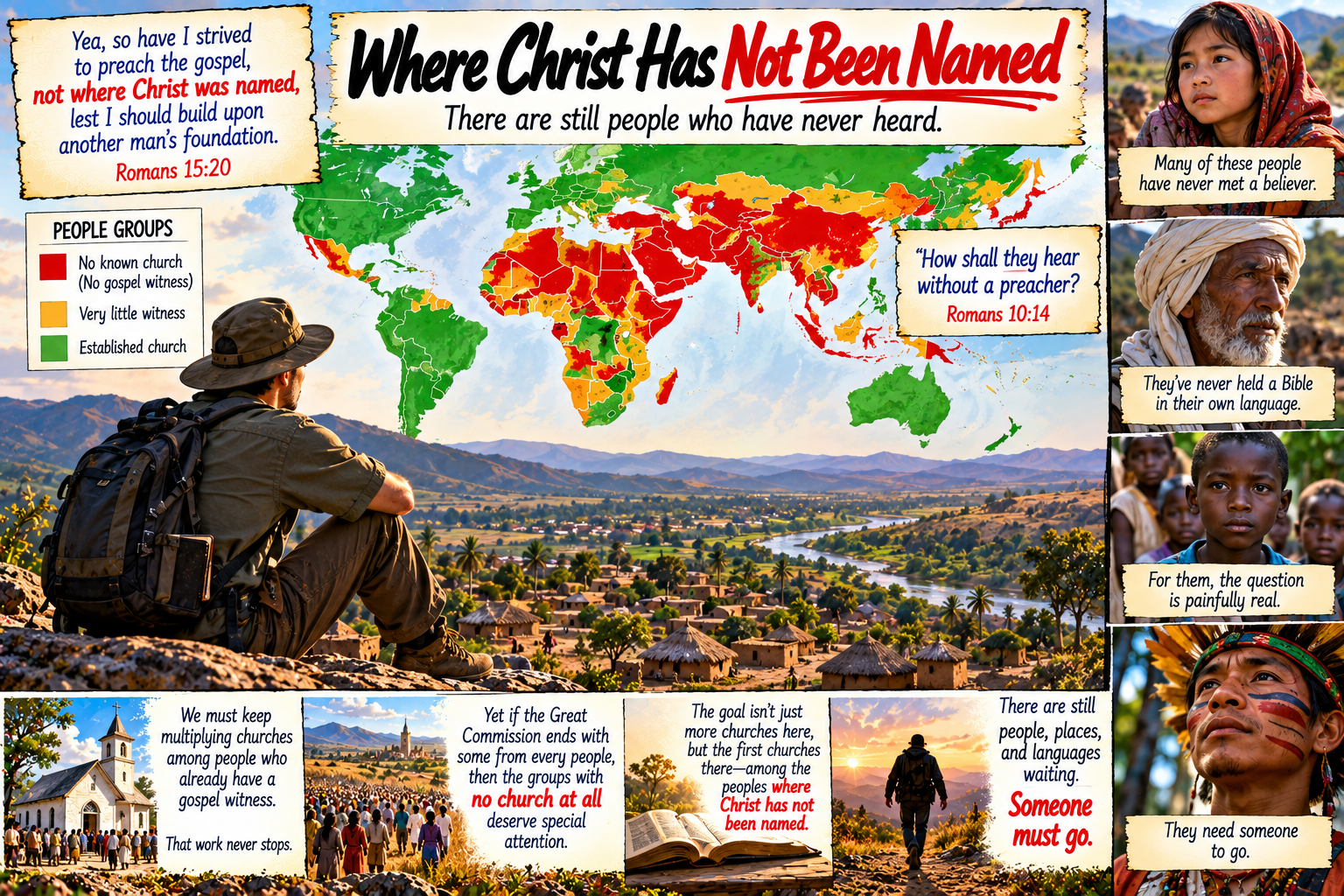
"Yea, so have I strived to preach the gospel, not where Christ was named, lest I should build upon another man's foundation" (Romans 15:20).
He wasn't looking down on established churches. He was looking out at the empty places on the map.
We must keep multiplying churches among people who already have a gospel witness. That work never stops. Yet if the Great Commission ends with some from every people, then the groups with no church at all deserve special attention.
Many of these people have never met a believer. They've never held a Bible in their own language. For them, Paul's question is painfully real:
"How shall they hear without a preacher?" (Romans 10:14).
Three Ways to Serve One Mission
Missionary work usually falls into three broad kinds. Each one serves the same goal.
Planting Churches
Church planting means starting local churches rooted among the people themselves. These churches truly worship God, feed believers from the Word, reach unbelievers, and eventually start new churches of their own.
That takes a clear gospel witness at the start and steady teaching afterward. Missionaries might use Bible studies, gospel teams, literature, radio or film, campus work, or camps. Each tool has the same aim: a living, growing body of believers.
Strengthening Existing Churches
Some places already have churches, but those churches need help to reach their own people. Missionaries here train national leaders and serve alongside local believers in outreach.
Paul modeled this:
"the things that thou hast heard of me among many witnesses, the same commit thou to faithful men, who shall be able to teach others also" (2 Timothy 2:2).
A trained national pastor can often reach his own people far better than any outsider.
Support Ministries
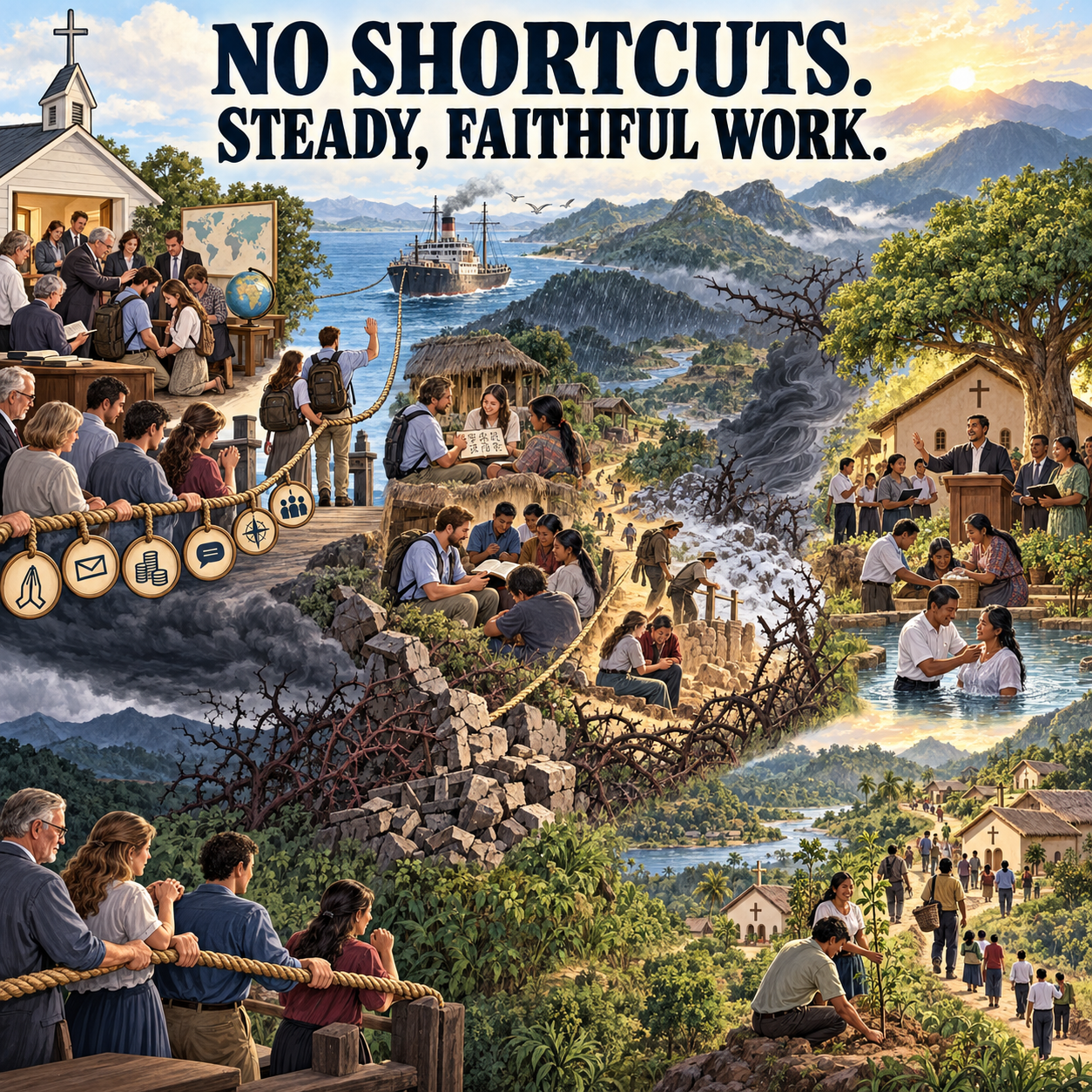
Some servants make the rest of the work possible. Bible translators, administrators, doctors and nurses, pilots, and community workers all hold the rope for those who plant and strengthen churches.
No Small Parts in God's Plan
None of these kinds of work ranks above another.
"The eye cannot say unto the hand, I have no need of thee" (1 Corinthians 12:21).
The pilot who flies a church planter into a remote village is doing mission work. So is the translator who spends twenty years on one New Testament. Paul put it plainly:
"I have planted, Apollos watered; but God gave the increase" (1 Corinthians 3:6).
A healthy missions program welcomes a blend of ministries, and the Holy Spirit directs the mix. We can trust Him with it.
Focus Without Guilt
Still, a church can't do everything. Budgets have limits. Congregations have only so many people and so many hours to pray.
So it makes sense to ask where the need runs deepest right now. The answer points again and again to two kinds of places: people groups with no gospel witness, and areas in critical need.
That's why a church can wisely choose to direct most of its missionary support toward planting and strengthening churches in those places. This doesn't mean dropping faithful missionaries elsewhere. It means that when new decisions come, we lean toward the unreached.
Let me say something gently here. This isn't a call to feel guilty about what you haven't done. Guilt makes a poor missionary, but love makes a faithful one. The Father isn't frowning at your church's budget. He's inviting you to join Him where He's already working.
What This Could Look Like for Your Church
Here are a few simple ways to put these priorities into practice:
- Know your map. List the missionaries you support and where they serve. Which ones work among unreached peoples? Which ones plant churches or train nationals?
- Pray by name. Pick one unreached people group and pray for them every week. Learn their name, their language, and where they live.
- Lean when you decide. When you add new support, give first consideration to church planting and national training in unreached or critically needy areas.
- Ask good questions. When a missionary visits, ask how their work leads to churches that reproduce themselves.
- Value every role. Thank the translators, pilots, and doctors too. They carry the same mission.
None of this requires a large church. It only requires a willing one.
He Is Already There
Years on the mission field taught me something I wish I'd learned sooner. God doesn't wait for us to arrive before He starts loving a people. He's been there all along.
When we send missionaries to the hardest places, we aren't taking God somewhere He's never been. We're following Him there.
One day the crowd will be complete, with every tribe, tongue, and people standing before the throne. Their song will be about the Lamb who paid for them all.
Until then, we get the joy of helping them hear.
If this stirred something in you, I'd love to keep thinking about the nations together.
Subscribe so the next article reaches your inbox, and share this with a pastor or missions team who might need it today.
#FollowedByMercy #AudienceOfOne