
Starting Right
The First Habits That Shape a National Church
Every parent knows that the habits formed in the first few years of a child's life carry weight far beyond childhood. The same holds true for a young church. What nationals learn to practice in the earliest months of a new work becomes the pattern they will hand to the next generation. Start them right, and you build a foundation that lasts decades.
Tithing, Attendance, and Caring for the Building
A national church member should learn to tithe from the very first offering, not after years of watching missionary money cover every bill. Faithful attendance should be taught as normal from the beginning, not as an optional extra for the especially devoted. Even sweeping the floor and cleaning the bathroom belong in this list. When nationals sweep their own building from day one, they learn a sense of ownership. When a missionary sweeps it for them for fifteen years, he teaches them that someone else is always responsible for what belongs to them.
None of this is about being strict for its own sake. It is about teaching stewardship early, when the lessons are small, and the stakes are low, rather than trying to introduce them later when bad habits have already calcified.
Do Not Set Leaders Up to Fail
Nothing damages a national leader faster than being handed tools he can never sustain. A missionary who buys expensive equipment the church could never afford to replace has not helped that leader. He has planted a landmine under his feet. A missionary who spends at a level no national income could ever match has taught the wrong lesson entirely, that ministry runs on foreign money rather than on faith and sacrifice.
Ask a simple question before introducing anything new to a young church. Can this national leader sustain what I am about to hand him after I am gone? If the honest answer is no, the kindest thing to do is find another way.
Place Nationals in Leadership from Day One
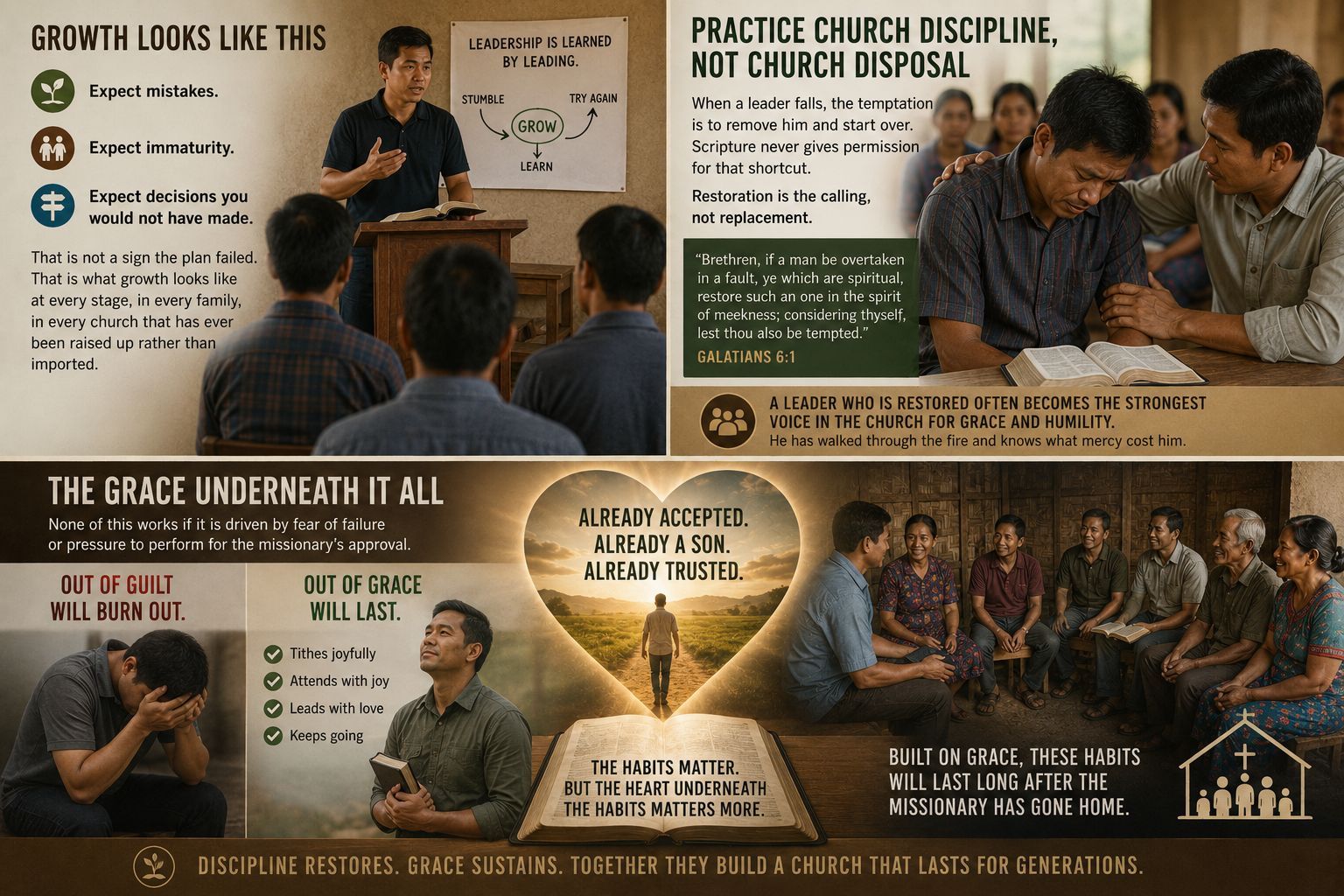
Waiting for a perfectly qualified national leader to appear before handing over responsibility guarantees an endless wait. Nationals learn leadership the same way anyone learns leadership, by leading, stumbling, and trying again. A missionary who insists on doing every task himself until a flawless replacement emerges will still be doing every task himself twenty years later.
Expect mistakes. Expect immaturity. Expect decisions you would not have made yourself. That is not a sign the plan failed. That is what growth looks like at every stage, in every family, in every church that has ever been raised up rather than imported.
Practice Church Discipline, Not Church Disposal
When a national leader falls, the temptation is to quietly remove him and start over with someone new. Scripture never gives permission for that shortcut. Restoration is the calling, not replacement. A leader who has fallen and been genuinely restored often becomes the strongest voice in that church for grace and humility going forward, because he has walked through the fire himself and knows exactly what mercy cost him.
Paul told the Galatians, "Brethren, if a man be overtaken in a fault, ye which are spiritual, restore such an one in the spirit of meekness; considering thyself, lest thou also be tempted". Restoration was never framed as an exception to church discipline. It was the entire point.
The Grace Underneath It All
Here is the truth that holds every one of these habits together. None of this works if it is driven by fear of failure or pressure to perform for the missionary's approval. A national believer who tithes, attends, and leads out of guilt will burn out or quit. A national believer who tithes, attends, and leads because he has grasped that he is already accepted, already a son, already trusted, will keep doing it long after the missionary has gone home. The habits matter. But the heart underneath the habits matters more.
A Practical Next Step
Look at your own church plant this week and list the habits nationals have picked up so far. For each one, ask whether it was built on performance or built on identity. Then ask what you can do this month to make sure the next habit you introduce is planted in the second kind of soil.
Next time, we will look at how to hand over responsibility gradually, through trips away, business meetings, and mission-minded preaching that gets nationals excited about carrying the load themselves.
Audience of One,
W. Austin Gardner
#FollowedByMercy #AudienceOfOne