The Indigenous Church:
Two Principles for Getting There
No missionary argues about the goal. Ask any group of pastors or missionaries whether we should plant indigenous churches, and every hand goes up. Everyone can recite the definition. A church that is self-governing, self-supporting, and self-propagating. That part is settled.
What is not settled is the road that gets you there. Ask ten missionaries how to arrive at an indigenous church, and you will get ten different maps. Some believe in stepping back immediately. Some believe in staying close for decades. Both groups are trying to reach the same destination, but the confusion over the path has stalled more church plants than the lack of vision ever did.
Two principles have shaped how I think about this more than any strategy paper ever has. Neither one came from a missions textbook.
The Greenhouse Principle
Walk through any nursery, and you will find plants that are, today, fully capable of standing in open ground, weathering wind, and producing fruit without any help at all. But none of them started that way. Every one of them began in a greenhouse. Someone controlled the temperature. Someone watered on a schedule. Someone protected the root system before it was strong enough to protect itself.
A young church works the same way. Nationals will one day lead, give, and reproduce without any outside support. But that day rarely arrives on day one. The mistake is not building a greenhouse. The mistake is either refusing to build one at all, or refusing to ever open the door.
Raising Children, Not Just Birthing Them
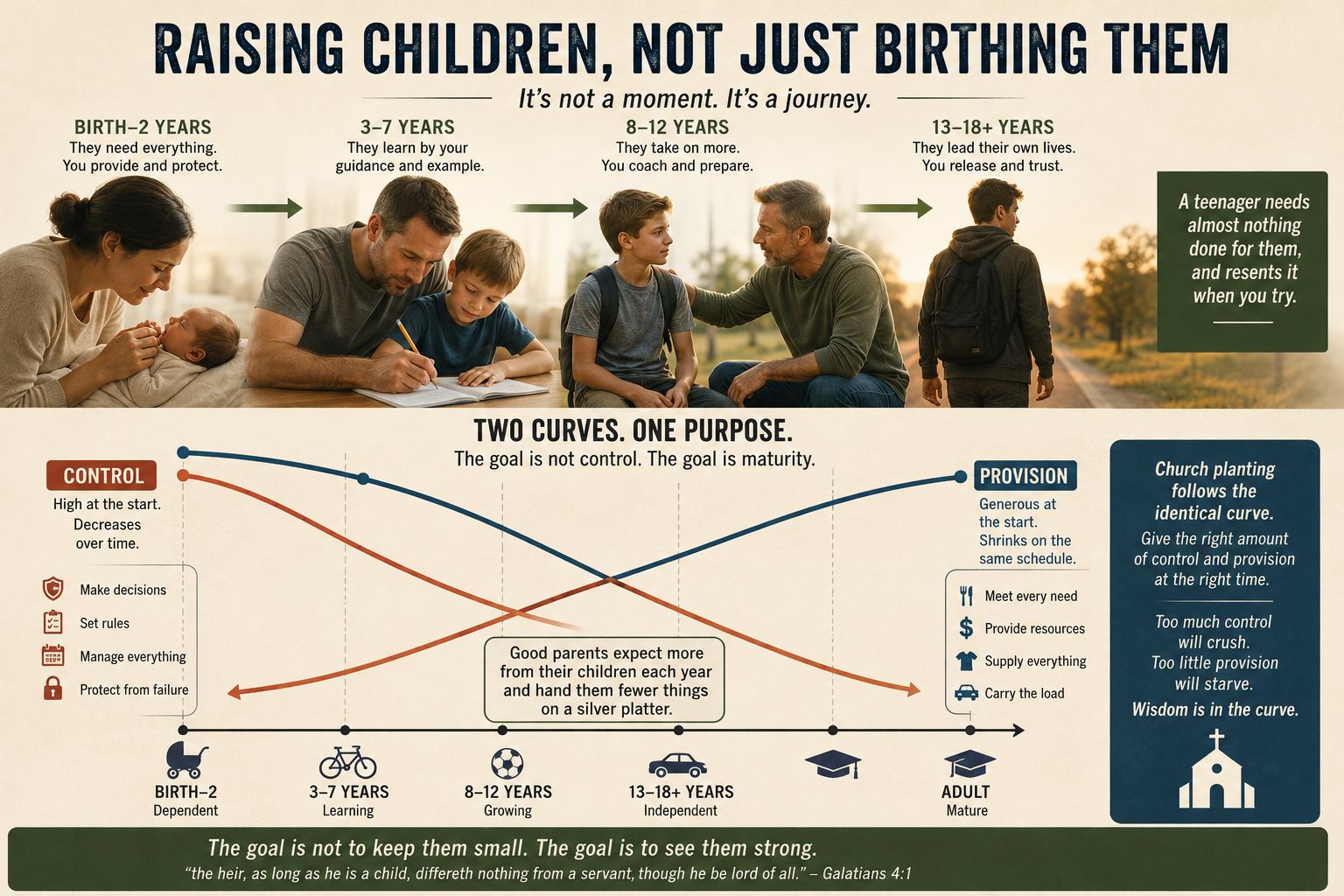
Everyone agrees that giving birth to a child is not the same thing as raising one. A newborn needs everything done for it. A teenager needs almost nothing done for them, and resents it when you try. The distance between those two seasons is not an accident. It is the entire job of a parent.
Picture a curve. On one side sits control, high at the start and dropping steadily. On the other side sits provision, generous at the start and shrinking on the same schedule. Good parents expect more from their children each year and hand them fewer things on a silver platter. Church planting follows the identical curve. The missionary who expects the same things from a two-year-old church that he expects from a twenty-year-old church will either crush it with control or starve it by walking away too soon.
Where This Meets Grace
Here is what strikes me every time I study this curve. It mirrors exactly how the Father deals with His own children. He does not abandon a new believer to figure out holiness on their own, and He does not keep a mature believer chained to training wheels forever. He moves us from dependence toward the freedom of sons, not because we earned it, but because that has always been His design for a family. Scripture puts it plainly: "the heir, as long as he is a child, differeth nothing from a servant, though he be lord of all". A child growing into an heir is not measured by performance. It is the natural unfolding of sonship over time. That is the same patience we owe the churches we plant.
A Practical Next Step
Take out a sheet of paper this week and plot your own church plant on the control curve. Write down every place you are still providing and every place you are still controlling. Then ask an honest question. Do today's level of control and provision match where this church actually stands, or where it stood three years ago? The greenhouse door does not open on its own. Someone has to decide, on purpose, that it is time.
In the next article, we will look at the first habits a new church needs to learn from day one, the ones that either set nationals up to succeed or quietly set them up to fail.
Audience of One,
W. Austin Gardner
#FollowedByMercy #AudienceOfOne