
The Missionary Who Became Chinese to Reach the Chinese
How Hudson Taylor's humility transformed missions by putting people before culture
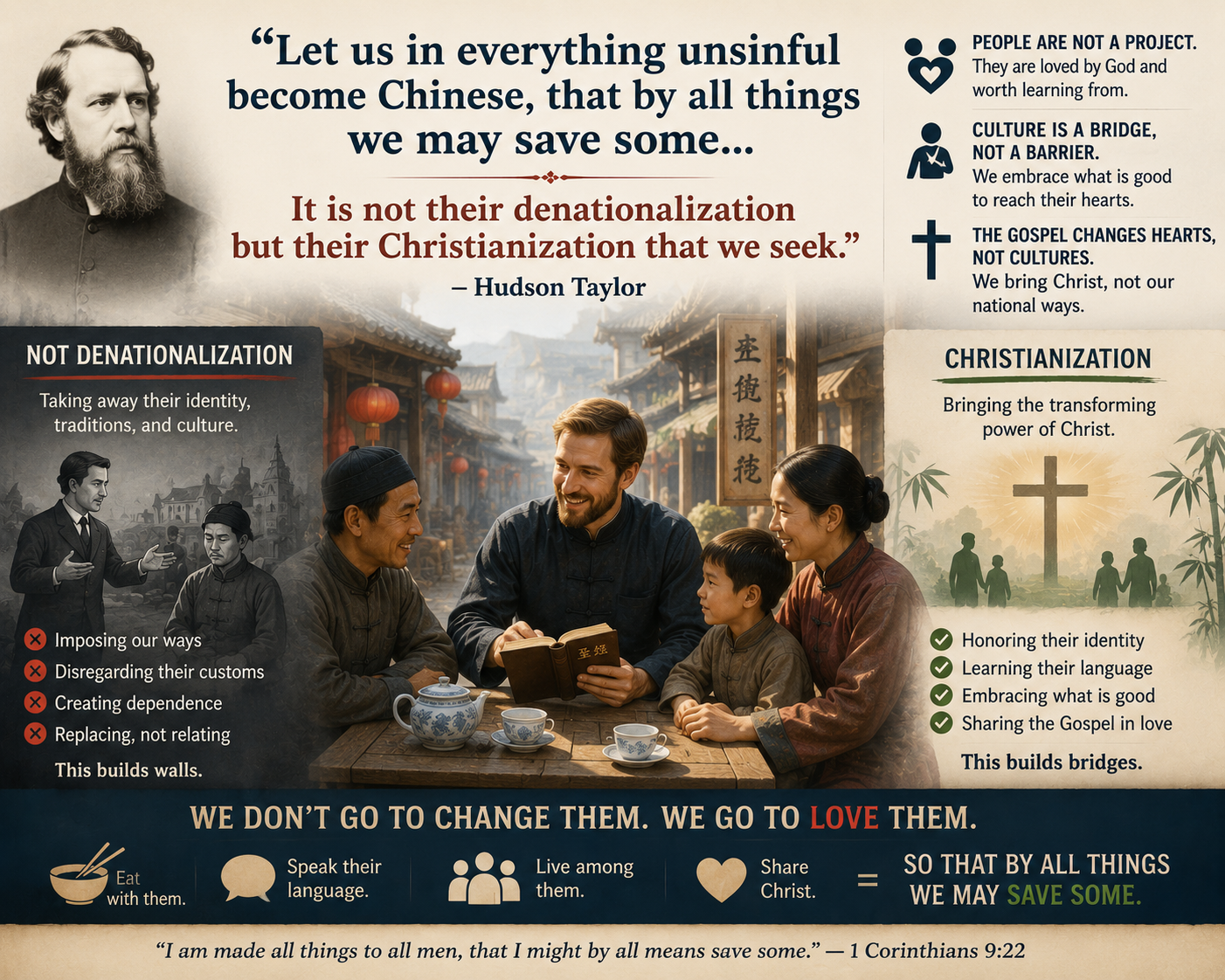
When Hudson Taylor first walked the streets of Shanghai in Chinese dress, head shaved, hair braided into a long queue down his back, his own countrymen thought he had lost his mind.
They called his little band "the pigtail mission." Newspapers mocked him. Fellow missionaries kept their distance, embarrassed to be seen near him. One of them admitted, thirty years later, "I feel ashamed of my attitude toward Mr. Taylor in those early days."
Taylor didn't dress that way to make a statement. He dressed that way because he'd figured out something most missionaries of his day never grasped: you cannot win people's hearts while looking, eating, and living like their enemy.
More Than a Costume
It would be easy to read Taylor's story and think identification is about clothes. Put on the right outfit, learn a few local phrases, and you've done the work.
That's not what happened with Taylor.
The dress was just the visible edge of something much deeper. He ate what the Chinese ate, with the utensils they used. He lived in Chinese housing, in Chinese neighborhoods, not tucked away in a comfortable foreign settlement by the coast. He learned to walk the way local people walked, because rushing or careless movement told people he thought himself above them.
He mastered four Chinese dialects well enough to help revise a New Testament translation himself. He studied Confucius, Chinese medicine, and the customs surrounding birth, marriage, and death not to win an argument, but so he could sit across from a Chinese family and actually understand what mattered to them.
None of that happens by accident. It happens because something in a man's heart shifts first.
The Heart Behind the Habits
Taylor once wrote to the young missionaries who wanted to join him:
"Let us in everything unsinful become Chinese, that by all things we may save some... It is not their denationalization but their Christianization that we seek."
Read that twice. He wasn't asking anyone to stop believing what they believed. He was asking them to stop assuming their own culture was the standard everyone else had to reach.
That's the real starting point for anyone headed to serve among a people not their own: trusting that the people you're going to are not a project. They're not behind you. They're not beneath you. They're already loved by the Father, already carrying dignity, already worth learning from before you ever open your mouth to teach them anything.
Jesus modeled this long before Taylor ever picked up a needle and thread. Philippians 2:7 says He "made himself of no reputation, and took upon him the form of a servant, and was made in the likeness of men." He didn't observe humanity from a safe distance. He moved in. He ate at their tables. He felt their weather. He buried friends the way they buried friends.
That's the pattern. Incarnation before instruction. Presence before proclamation.
Trust Before Technique
Here's where a lot of good-hearted missionaries get stuck. They want the fruit of identification, trust, open doors, a hearing without walking through the slow, humbling process of becoming a learner again.
Taylor didn't arrive in China with a strategy for cultural adaptation. He arrived willing to be the ignorant one in the room. Willing to be laughed at for how he tied his sash. Willing to ask questions instead of giving answers, for months, sometimes years, before he ever expected anyone to listen to him.
That's a hard place for anyone to sit, especially someone who crossed an ocean carrying a message they believe could save lives. But rushing that season doesn't speed up the work. It usually just confirms every suspicion the local people already had about outsiders who show up assuming they know best.
What This Looks Like on the Ground
You don't have to shave your head or grow a queue to practice what Taylor practiced. The specific habits will look different in every country and culture. But the questions underneath stay the same, wherever you go:
Are you eating what they eat, or quietly importing your own comforts?
Are you living among the people, or observing them from a distance?
Are you learning their language well enough to laugh at their jokes, or just well enough to get by?
Are you studying what they value their history, their stories, their sense of honor and shame the way Taylor studied Confucius?
Are you willing to be thought foolish by people back home, the way Taylor was mocked as "the pigtail missionary," if it means the gospel travels further among the people God sent you to?
None of this earns trust automatically. But it clears away the unnecessary obstacles of foreignness that have nothing to do with the cross and everything to do with our own comfort.
Confidence in Christ, Not the Method
One last thing worth saying plainly: none of this becomes a formula. Taylor himself would be the first to say the dress and the diet and the dialects were never the actual power behind his work. They only cleared away the noise so people could hear what mattered.
The power was always Christ living in him, going ahead of him into homes and villages that had never heard His name.
You can learn every custom perfectly and still walk into a room in your own strength, trusting your preparation instead of the One who sent you. Taylor's real secret wasn't a costume. It was a life of leaning hard on God for everything, because he knew he had nothing of his own to offer a culture that wasn't his.
That's still true for you. Learn the language. Eat the food. Ask more questions than you answer. And underneath every bit of it, rest in this: the God who sent you there loved that culture and that people long before you arrived, and He'll be doing His work in them long after you've gone home.
You're not carrying Him into a foreign land. He's already there. You just get to join Him.