
What Latin America Taught the Missionary
What National Believers Wish Every Missionary Understood Before Arriving
A seminary professor in Guatemala named Emilio Núñez once sat down with a group of his students and asked them a simple question: What do you wish the missionaries had known before they came?
The list they handed back wasn't angry. It was honest. Thirty-some suggestions, written by nationals who had watched well-meaning North Americans walk into their churches, their homes, and their culture carrying more confidence than they realized.
Learn our language until you lose the accent. Eat our food, not just the pizza you brought with you. Stop looking at your watch. Give us a real hug instead of that stiff, arm's-length greeting. Don't reduce our history and our suffering to a spiritual formula. And underneath almost every line, one request kept surfacing: see us as equals, not as a project.
I've spent enough years in Mexico, Peru, and Latin America to know exactly which parts would have stung if someone had handed me that list on my first trip down. Probably all of them.
The missionary's first move is already written for him
Paul told the Philippians something remarkable about Jesus:
"Let this mind be in you, which was also in Christ Jesus: Who, being in the form of God, thought it not robbery to be equal with God: But made himself of no reputation, and took upon him the form of a servant" (Philippians 2:5-7).
Jesus didn't arrive in a manger holding onto His reputation. He set it down. He learned a trade, spoke Aramaic instead of the language of angels, ate at tables He didn't have to sit at, and let people touch Him who had no business touching a holy God.
That's the pattern for anyone who leaves home to bring good news somewhere else. Not "adjust your methods." Empty your hands. The missionary who can't set down his reputation has skipped the one step Jesus never skipped.
Presence teaches what lectures can't
One line from that list has stayed with me for years: "Do not teach so much theory, but practice your teaching in your life. Show us how it works in real life as you model the truth."
A man can hand you a hundred sermons on grace. It's a different thing to watch him lose an argument with dignity, or forgive someone in front of you, or sit with a grieving family with nothing to say and nowhere else he'd rather be. Paul didn't just preach to the Thessalonians; he told them,
"we were willing to have imparted unto you, not the gospel of God only, but also our own souls, because ye were dear unto us" (1 Thessalonians 2:8).
You cannot impart your soul from a podium. It only happens close up, over years, at somebody's kitchen table.
Love speaks the local language
The list is full of small, physical things: learn the proverbs, the slang, the way people actually talk instead of the way a textbook says they talk. Wear their fabrics. Listen to their music. Trade pounds for kilos. Give a real abrazo instead of a handshake held at arm's length.
None of that is really about cultural competence. It's about love refusing to make the other person do all the reaching. Paul put it plainly:
"I am made all things to all men, that I might by all means save some" (1 Corinthians 9:22).
He wasn't performing. He was following the same Jesus who became flesh and dwelt among us instead of shouting instructions down from heaven.
Correction from a friend is a mercy, not an insult
Two verses got quoted straight into that list of suggestions, and they're worth sitting with:
"Faithful are the wounds of a friend; but the kisses of an enemy are deceitful" (Proverbs 27:6), and
"Iron sharpeneth iron; so a man sharpeneth the countenance of his friend" (Proverbs 27:17).
Those students weren't trying to wound anyone. They were asking to be close enough to the missionaries that honest correction could pass between them both ways. That's a high compliment; actually, it means they wanted friendship, not just a working relationship with the foreigner in charge.
An honest word about staying
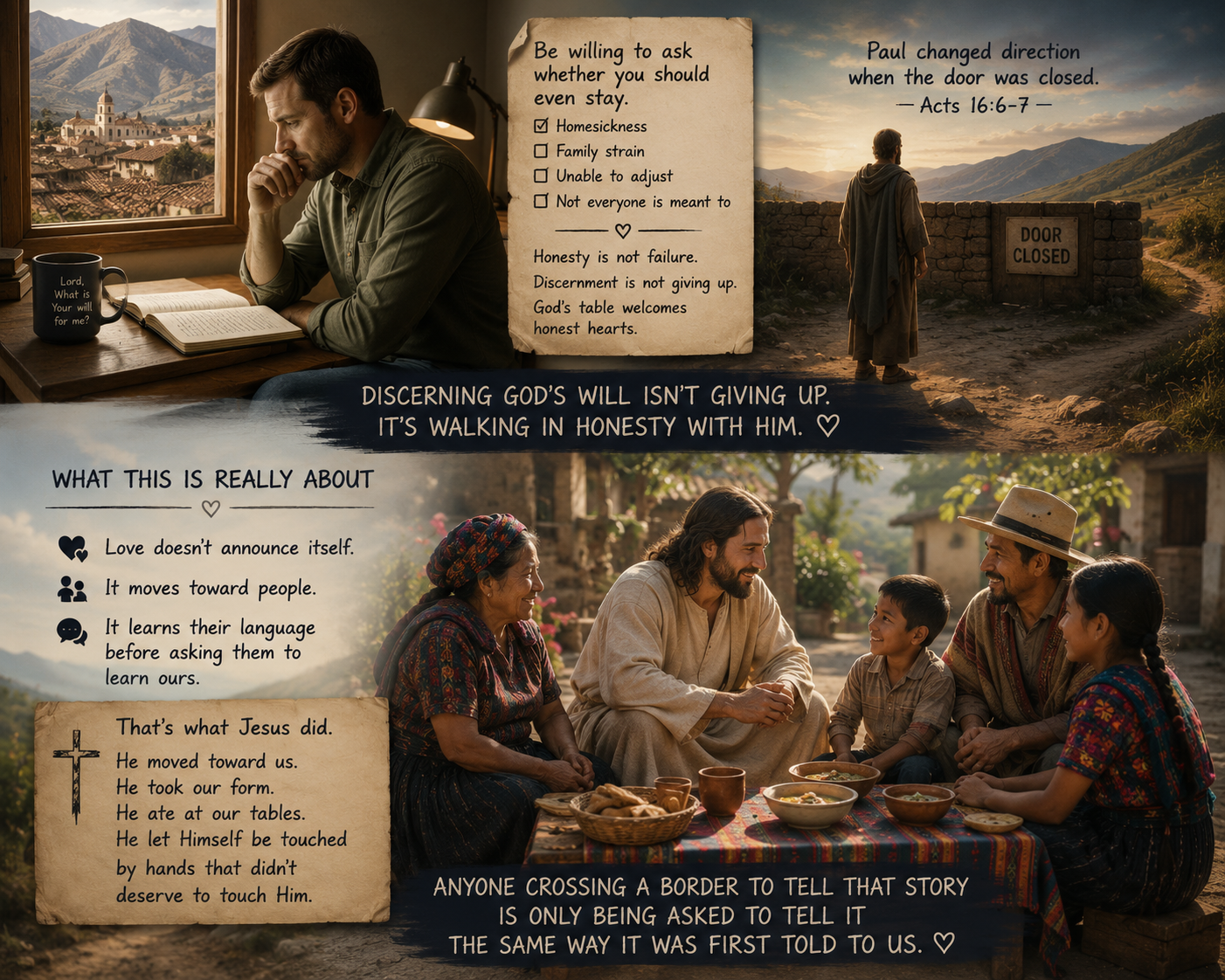
The last suggestion on the list is the bravest one: be willing to ask whether you should even stay. Not everyone is meant to. Homesickness, family strain, an inability to adjust none of that makes a person a failure. Paul himself changed course more than once when a door he expected to walk through simply didn't open (Acts 16:6-7). Discerning that isn't giving up. It's honesty, and honesty has always been welcome at the Father's table.
What this is really about
Strip away the specifics about food and slang and kilometers, and what's left is something every one of us needs to hear, whether we've ever left our own country or not: love doesn't announce itself, and it doesn't insist on being understood on its own terms. It moves toward people. It learns their language before asking them to learn ours.
That's not a missionary strategy. That's just what Jesus did to reach the whole human race. He moved toward us, took our form, ate at our tables, and let Himself be touched by hands that didn't deserve to touch Him. Anyone crossing a border to tell that story is only being asked to tell it the same way it was first told to us.