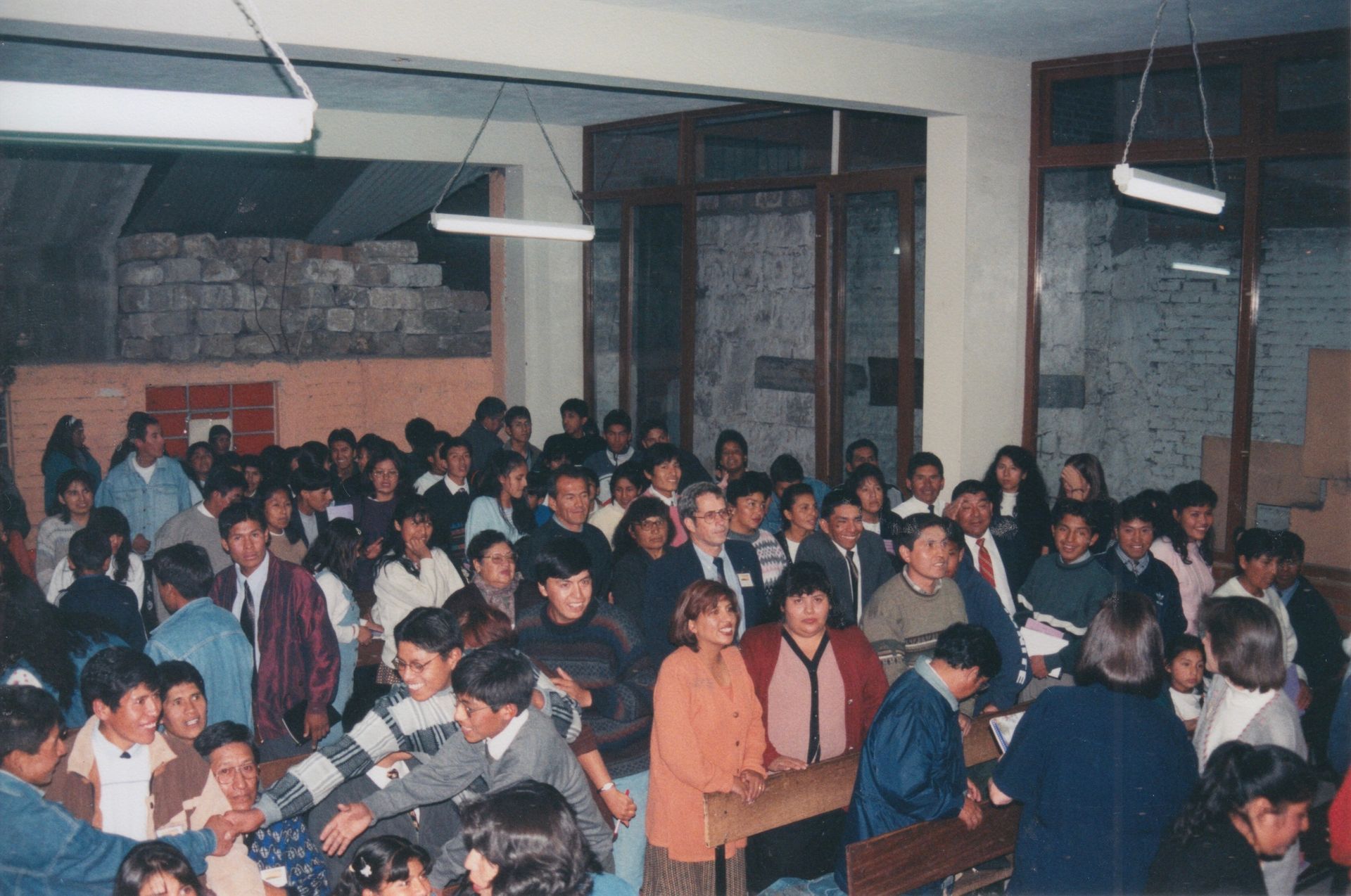
Attitudes
The Single Most Important Area of Ministry
Skill can be learned. Competence can be trained. But attitude is something else entirely; it seeps out through the smallest gestures, the ones that cost almost nothing and yet reveal everything. It shows in whether we notice people, whether we step into their joys and their sorrows, and above all in whether we love them. It is not our fluency in the language or our polish in the work that wins a person's heart. It is our attitude and especially an attitude of love that moves people. The reverse is just as true: inconsiderateness, condescension, criticism, and indifference repel people quietly and completely, and they can undo months of faithful work in a matter of moments.
"The single most important area of your life and ministry will be in the realm of attitudes."
We Are Guests
The first attitude worth adopting is simple to state and hard to hold onto: we are guests in another people's country. Guests are reserved rather than presumptuous. Guests are grateful rather than entitled. Guests are discreet, and they understand that they depend on their host for a great many things they cannot provide for themselves. Above all, guests honor their host rather than correcting or diminishing them. Too often, though, missionaries slip into the opposite posture, acting as though they are schoolmasters and the people they have come to serve are children to be managed rather than hosts to be honored.
Respect
Love, on its own, is not enough. It has to be joined by respect, and respect is not hard to find once we start looking for it. The people we serve usually have high standards of morality and social conduct. They are courteous. They honor their elders. They value family and stay loyal to their community in ways that often put the Western visitor to shame. Their endurance, their hospitality, their friendliness these are not small things, and they deserve to be seen. They carry the same aspirations for their future that we carry for our own.
One of the surest ways to build this respect is to put ourselves in their place. Why do they do the things they do? Could we, honestly, do better in their circumstances? Often the answer is no. Why do people react the way they react to a given loss or hardship? It is worth pausing to imagine what the loss of a single buffalo or goat could mean to a farmer living close to the margin, a loss that might look small from the outside and feel catastrophic from the inside.
Build Trust
A useful question to carry into every interaction is this: is what I am doing, thinking, or saying building trust, or is it quietly undermining it? Trust grows out of genuine acceptance of other people. Given time, the people around a missionary begin to sense whether they are truly welcome in that home, or merely tolerated in it. The people we serve are not inferior, and they are not less valid; they are simply different.
"It is not difficult for others to discern whether or not the missionaries accept them as persons. Their attitudes and actions soon give them away."
Empathy
Empathy is the attitude that finally allows a missionary to step into the lives and feelings of the people not as an outsider observing from a distance, but as an equal and a friend standing beside them. It is the difference between studying a people and actually sharing life with them.
Prayer
None of this the love, the respect, the empathy can be manufactured by willpower alone. The only way to reach it is to pray for it. It is not something we can produce ourselves; it is something He does in us. We need the Holy Spirit to love through us, because our own capacity for love runs out long before the need for it does.
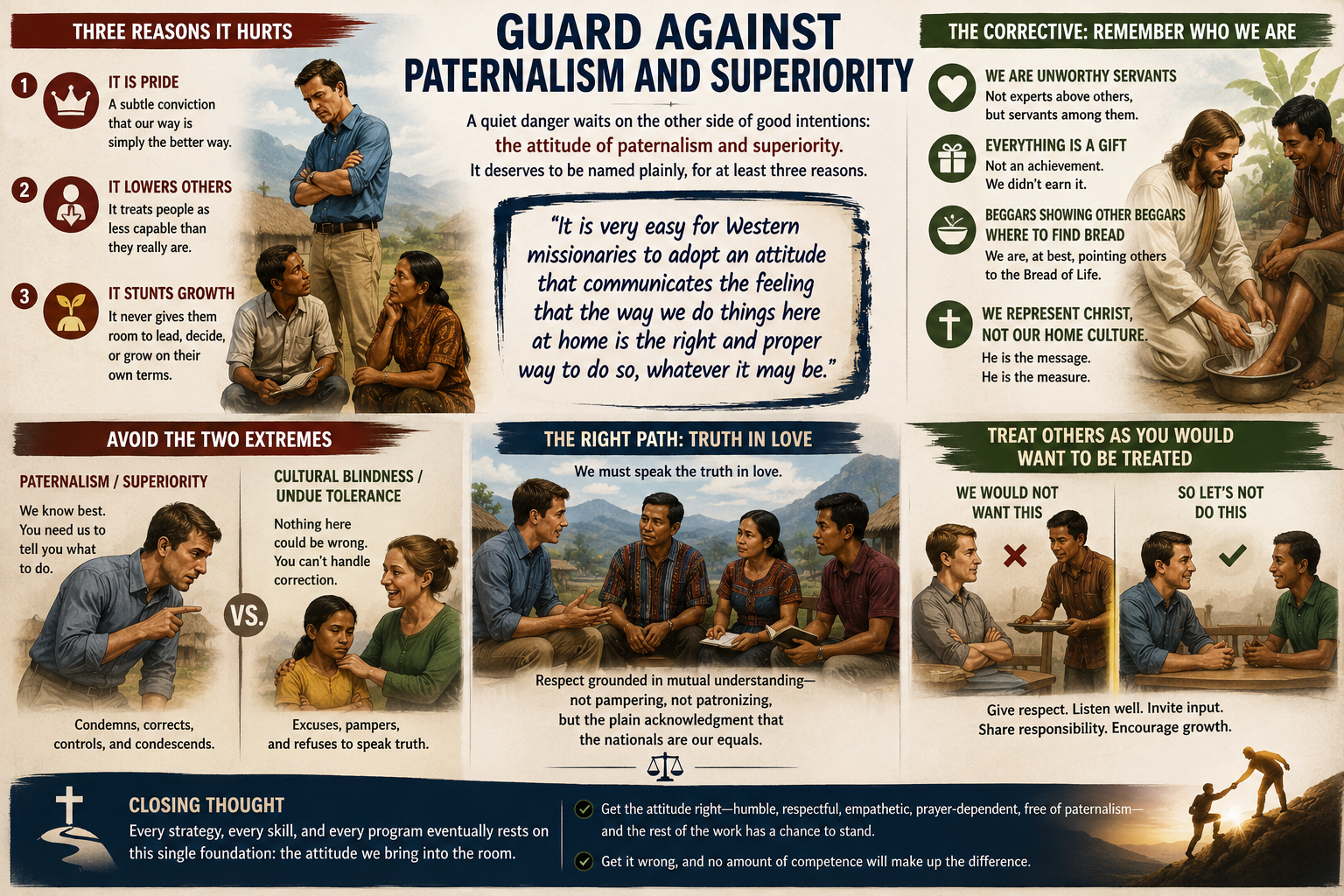
Guard Against Paternalism and Superiority
A quiet danger waits on the other side of good intentions: the attitude of paternalism and superiority. It deserves to be named plainly, for at least three reasons.
- It is a manifestation of pride, a subtle conviction that our way is simply the better way.
- It lowers the person toward whom it is directed, treating them as less capable than they are.
- It prevents that person from developing, because it never gives them room to lead, decide, or grow on their own terms.
The corrective is a certain kind of remembering: we are unworthy servants, and everything we have is a gift, not an achievement. We are, at best, beggars showing other beggars where to find bread. Held onto honestly, that image does most of the work of dissolving paternalism on its own. The missionary must remember, above all, that he represents Christ, not his home culture.
"It is very easy for Western missionaries to adopt an attitude that communicates the feeling that the way we do things here at home is the right and proper way to do so, whatever it may be."
There is an equal and opposite error worth naming: refusing to see anything wrong with the host culture at all, and treating its people like spoiled children who cannot bear correction. Neither extreme serves anyone well. We must speak the truth in love. We owe the people we serve a natural respect grounded in mutual understanding, not pampering, not patronizing, but the plain acknowledgment that the nationals are our equals. Treat them naturally, as you would want to be treated if the positions were reversed.
Closing Thought
Every strategy, every skill, and every program eventually rests on this single foundation: the attitude we bring into the room. Get the attitude right- humble, respectful, empathetic, prayer-dependent, free of paternalism and the rest of the work has a chance to stand. Get it wrong, and no amount of competence will make up the difference.