Becoming a Learner
Why Language Is the Doorway to Belonging
Every person who crosses into a new culture faces the same quiet test: will you remain a visitor, or will you become a learner? The difference is not a matter of good intentions. It shows up in the smaller, harder choices: whether you sit with the discomfort of not understanding, whether you keep showing up when a conversation leaves you behind, and above all, whether you learn to speak in someone else's language rather than expecting them to meet you in yours.
Responding to the inevitable differences between your culture and theirs with humility is the second step of that test, and it is the one that shapes everything after it. Humility does not mean pretending the differences do not exist or that they do not sometimes frustrate you. It means staying teachable in the face of them, treating your confusion as a starting point for learning rather than a verdict on the other culture, or on your own.
Three Dimensions of the Work
Becoming a learner is not a single skill but a discipline that runs in three directions at once.
- Knowledge. You must come to understand the people's culture, its history, its values, its unspoken rules, the logic that holds it together. This is the work of a student: reading, asking, watching, and revising what you thought you knew.
- Participation. Knowledge alone keeps you an observer. You must also participate in their way of life: eat what they eat, keep the hours they keep, join the rhythms of work and rest and celebration that define their days.
- Empathy. The third dimension is the deepest: genuine empathy, the projection of your own personality into another's in order to understand that person more fully, the ability to share, not merely observe, another's emotions, thoughts, and feelings.
Be a Student of Their Culture
It is not enough to study a culture from the outside. Real identification requires becoming a belonger within it, not just a student of it. When that deeper identification never happens, a person's ministry, work, or relationships tend to stay confined to whatever does not require an insider's fluency, the surface-level exchanges anyone could have. If you never truly become one of them, if you never really learn the language, you may never have the kind of impact that only comes from the inside. That kind of belonging has a price, and it must be paid in the currency of time, humility, and effort.
Communication Is the Goal
It is worth being precise about what all this identification is for. The point is not to see how completely you can transform into someone from another culture; that was never the goal, and it is not fully possible anyway. The point is to become able to communicate with the people of that culture profoundly and effectively. Identification is the means. Communication is the end.
Language: The Primary Symbol of Identification
Of all the ways to pursue that goal, language carries the most weight. In a host community, the effort to learn the local language is itself a message, sent before a single sentence is spoken correctly. When you attempt it, people understand something important: you mean business. They understand that they are worth something to you, because you are willing to meet them on their terms rather than requiring them to meet you on yours.
The work itself is unglamorous and cumulative. Learn a little each day, and put it to use immediately. Talk to a new person every day. Say something new every day. Understanding comes gradually, a little more each week until you reach a point where you understand and are understood, even if imperfectly. A great deal is possible in three months of steady effort. The posture that makes it possible is simple to name and hard to hold: I am a learner. Please talk with me and help me.
Three Conditions for Success
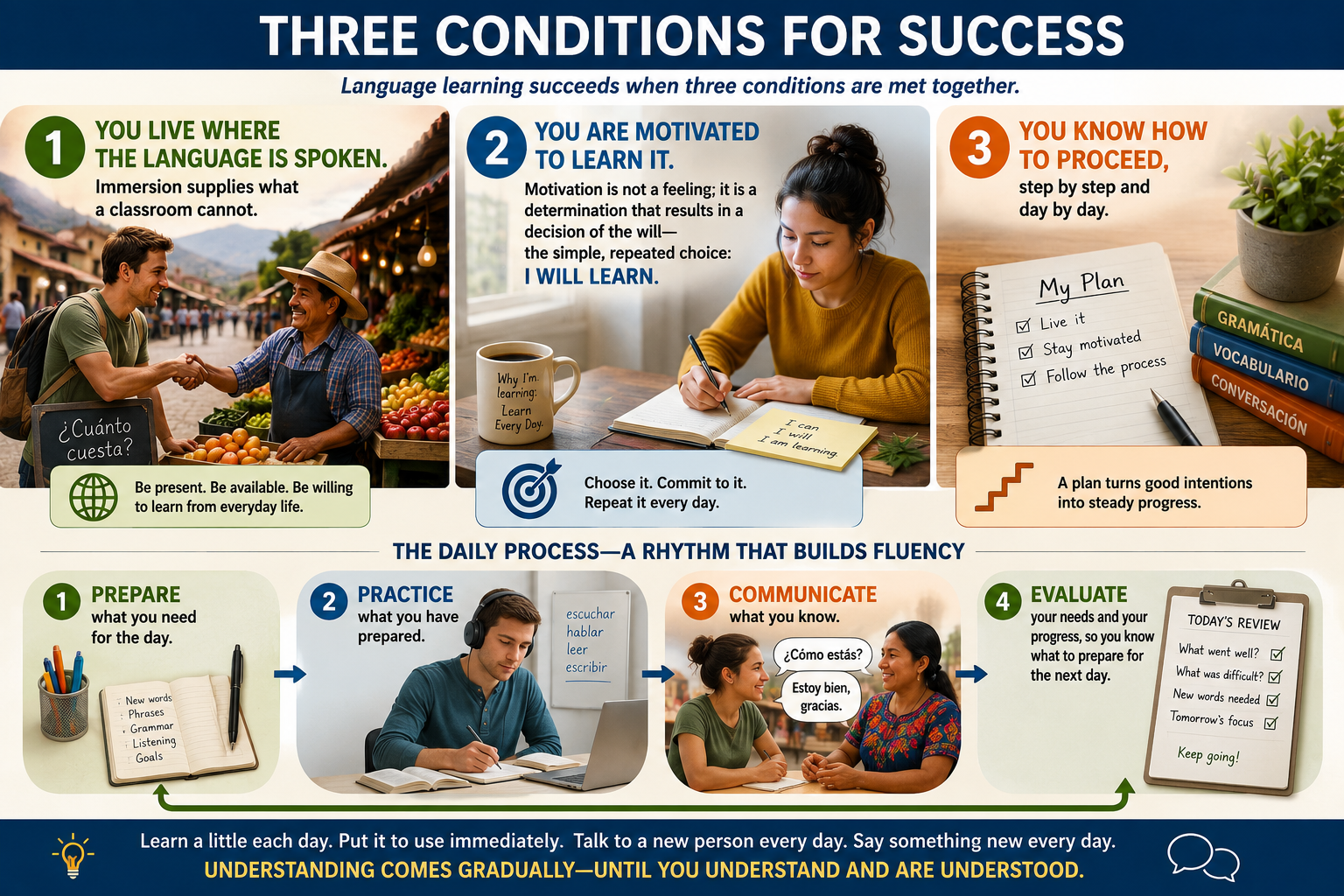
Language learning succeeds when three conditions are met together.
- You live where the language is spoken. Immersion supplies what a classroom cannot.
- You are motivated to learn it. Motivation is not a feeling; it is a determination that results in a decision of the will, the simple, repeated choice: I will learn.
- You know how to proceed, step by step and day by day.
That daily process has its own rhythm:
- Prepare what you need for the day.
- Practice what you have prepared.
- Communicate what you know.
- Evaluate your needs and your progress, so you know what to prepare for the next day.
Practice, Practice, Practice
From the very first day, learners should use what little they have, practicing it, testing it, and interacting with real people rather than waiting until they feel ready. Readiness is not a precondition for practice; it is the result of it.
A Question Worth Sitting With
Being a learner is one of the clearest ways to identify with a people and truly belong among them. And it raises a question closer to home than it might first appear: what is more important than someone's language? How do we regard foreigners who come to a new country and show no interest in learning the language spoken there? The United States was once described as a melting pot; people arrived from every corner of the world, and many kept something of the culture they carried with them, but nearly all of them learned the language that let them find their footing in a new place. That is the same posture asked of anyone entering a culture not their own: to learn what lets you belong, even while you remain, in real ways, yourself.
Thoughts to Carry Into Language Learning
A few statements are worth carrying into the work ahead, as reminders of why the effort matters and what makes it succeed.
"Thinking positively about language learning is a crucial aspect of the learner's approach."
"You can successfully learn another language. Successful language learners, both children and adults, begin with an underlying knowledge that a language is learned rather than taught. And they know how to take advantage of the abundant resources available to them. These resources are the people who speak the language."
"It is motivation that determines ultimate proficiency in a second language."
"Language learning is a social activity, and it must be learned through relationships with people."
"One has to make mistakes in order to learn from his mistakes."
"The problem is not one of ignorance but of cultural isolation."
"Failure to learn foreign languages results primarily from false attitudes toward culture."
"Most adults subconsciously resist the idea of becoming 'childlike' to learn a language... yet this role is unavoidable."
Closing Thought
Learning a language is rarely just about vocabulary and grammar. It is a sustained act of humility, a daily decision to be a beginner in front of other people, to risk mistakes, and to let a community teach you how to belong among them. Approached that way, language learning stops being a technical hurdle and becomes what it was always meant to be: the doorway into genuine relationship, understanding, and impact.