
Bonding or Belonging
How Deep Relationships Turn Strangers into Family
I want to bond with these people the way I bonded with my own family. I want to belong. I do not want to be a stranger among them, or a pilgrim who merely passes through. But it is difficult to be like them. I speak a different language. I am a different color, a different size. I carry a different past and come from a different level of living. If I am going to become one of them, I must work at it.
Bonding and
belonging are two words that describe a further, deeper step in becoming part of another society. They are not accidents that happen to the fortunate few. They are the fruit of deliberate choices made especially in the earliest days of life among a new people.
1. Definitions
Bonding is the development of a close relationship between family members or friends, the kind of attachment that forms almost without our noticing it, through shared meals, shared struggles, and shared time.
Belonging is the experience of having that close relationship: familiarity, camaraderie, the settled feeling of being known and claimed by a group. To belong is to no longer be watched as an outsider but to be waved in as one of the family.
The two words describe a single process from two angles. Bonding is the
doing, the active, sometimes awkward work of attaching oneself to a new people. Belonging is the
fruit, the sense, both felt by the newcomer and confirmed by the community, that he is now one of them. You cannot belong without first bonding, and bonding that never produces belonging has, in some sense, failed to finish its work.
2. Plunge Right In
a. The first days set the course
Your first few days among the target people can determine the course of your ministry for years to come. The way you spend your first couple of weeks in your new country is of critical importance if you hope to establish a genuine sense of belonging with the local people. It is tempting to ease in slowly to keep one foot in the familiar while testing the water with the other. Resist that temptation. It is far better to plunge right in and experience life from the insider's perspective from the very start.
Live with the people. Worship with them. Go shopping with them. Ride their buses, their taxis, their trains. From the very first day, work at developing many meaningful relationships with local people rather than retreating to the company of those who already share your language and habits.
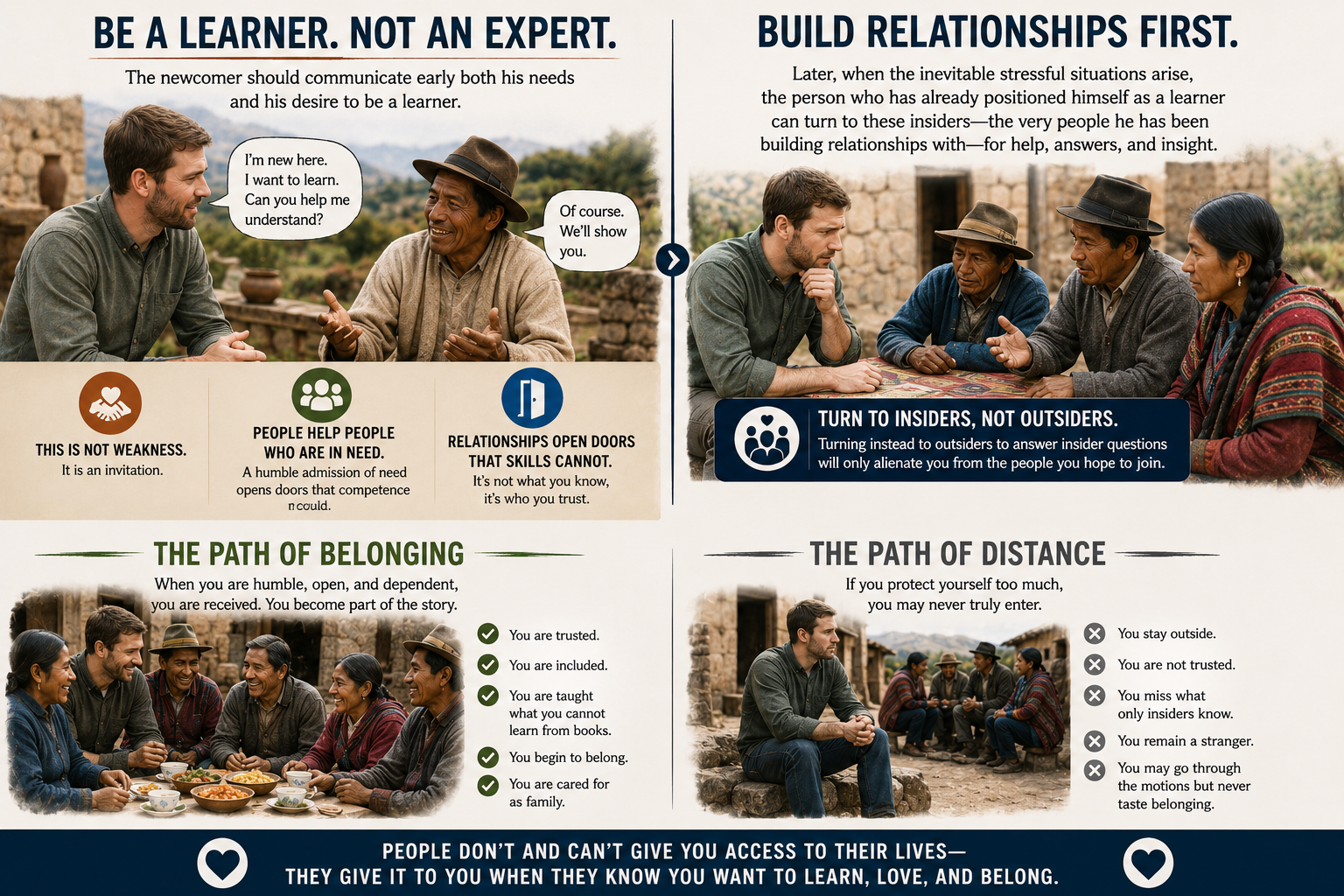
The newcomer should communicate early both his needs and his desire to be a learner. This is not weakness; it is an invitation. People help people who are in need, and a humble admission of need opens doors that competence never could. Later, when the inevitable stressful situations arise, the person who has already positioned himself as a learner can turn to these insiders the very people he has been building relationships with for help, answers, and insight. Turning instead to outsiders to answer insider questions will only alienate you from the people you hope to join.
The individual who hopes to enter another culture gradually, in careful, well-protected stages, will probably fail to enter it at all. He may go through the motions of cross-cultural life for years without ever tasting what it means to belong to the people or to be cared for by them.
b. Immerse yourself
It is essential that from your very first day you immerse yourself in the life of your new community. Worship with the people. Eat what they eat. Learn the rhythms of their days and weeks. Above all, develop local friendships not as a strategy, but because friendship is the soil in which belonging grows. Without local friends, immersion is only geography; with them, it becomes home.
This is, in fact, part of the secret behind the rapid growth of the Mormons around the world. Their international expansion is carried out almost entirely by short-termers, young missionaries who immediately move in with a local family and become belongers in the community rather than observers of it. It is well documented that in many places, the missionaries who learn the language fastest and best are the Mormons, and they are often in the country for only two years. Their method is not more time; it is more immersion.
c. Become bicultural
If you do this well, you will end up neither totally American nor totally a national of your new country. That is not a loss; it is the goal. The moment we were saved, we received a new citizenship in heaven. In much the same way, we are now called to enter a new earthly culture and, in a real sense, to become "one of them."
Bonding and "going native" are not the same thing. Going native generally implies the rejection of one's first culture, a reaction that is rarely seen in practice and is probably not possible for an emotionally healthy person. Nor is becoming bicultural the same as becoming fragmented or schizophrenic. The schizophrenic is a broken, divided self. The bicultural person, by contrast, is not broken but built, developing a new self, a new personality that can move comfortably between two worlds because it has genuinely absorbed both.
One practical suggestion: take on an insider's name. Choose a name that fits the country where you now live. It will become part of the new you, a you that is neither fully American nor fully "national," but something new formed from both. It says to the people around you, without a word being spoken,
I live here. I want to be recognized as one of you.
For most missionaries from North America, North America will always be "home" in some sentimental sense. But you must work at developing a different attitude. Live in your new country. Make it your home in fact, not just in theory. Visit your passport country every fifth year or so, rather than every year; you will find that this single change reshapes nearly all of your attitudes toward where you belong.
d. What happens when bonding fails
When normal bonding is not established, something has to fill the vacuum, and too often what fills it is rejection of the people or even a quiet, corrosive abuse of them. You can hear it in offhand comments that seem harmless at first but reveal a widening distance:
"Oh, these people."
"Why do they always do things this way?"
"Somebody ought to teach them how to live."
"Won't these people ever learn?"
There is nothing sadder than a missionary who is not comfortable with the people he came to serve. And it must be said plainly: many missionaries are not happy. They hide out in their houses. They join every country club and expatriate circle available to them. They surface for church services and disappear again. The local people are not fooled by this. They know when someone is not happy among them, however politely it is disguised.
Why would anyone choose to spend the next four years of life living like that, present in body, absent in spirit? One missionary once admitted that he would lock himself in the bathroom just to keep himself from packing up and returning home before his term was finished. That is not a life of ministry. That is a life of endurance, and it is no way to live, and no way to represent the One who sent him.
e. Why do you want to go to the mission field?
In the end, this comes down to a single, searching question: did you come to give aid, or did you come to give yourself?
Aid can be shipped. Money can be wired. Programs can be run by remote control. But if the giver is giving
himself along with the gift, reaching out, making himself vulnerable, sacrificing comfort and convenience for the sake of relationship, the people will see the difference, and they will respond far more favorably to a person than they ever would to a program.
Bonding is costly precisely because it asks for the giver, not just the gift. But it is the only path that leads, in time, from strangeness to belonging, from being watched as an outsider to being welcomed, at last, as one of the family.