Smart Work Versus Hard Work 2
Part Two: How to Work Smart for the Sake of the Harvest
In Part One, we settled a matter that should never have been up for debate. God expects His servants to work hard, as hard as any layman carrying a full-time job and a full church calendar. We let Solomon's warnings about the slothful man press on us until they stung a little, because they were meant to. If you have not read Part One, go back and let that foundation settle before you read this one, because everything I am about to say assumes you have already agreed to put in the hours.
Now we turn to a different question, and it is just as important. Hard work alone has buried more good men than laziness ever did. I have watched faithful, diligent servants of God work themselves into an early grave, into a ruined marriage, into a burned-out shell of who they used to be, all while genuinely loving the Lord and genuinely working hard. The problem was never their commitment. The problem was that nobody ever taught them how to work smart.
Use Your Work to Build Your People, Not Your People to Build Your Work
Write that sentence on the inside cover of your Bible if you have to. It is easy to flip it backward without ever noticing you have done so. You start out wanting to build people, to see them grow in Christ, to watch them become leaders. But the ministry has needs. The bus needs a driver. The nursery needs workers. The building program needs hands. And slowly, almost without your noticing, the people in front of you stop being the point of the work and start becoming the resources that make the work happen.
A shepherd who has flipped this equation will burn through volunteers like fuel. A shepherd who has it right will burn through tasks in order to grow people.
Ask yourself honestly: when you look at the people serving alongside you, do you see souls being shaped into the image of Christ, or do you see a roster of warm bodies filling slots on a ministry chart? The first question produces patience, training, and long-term investment. The second produces burnout, resentment, and a revolving door of volunteers who feel used rather than loved.
Let Numbers Be the Result of Your Work, Not the Goal of Your Work
Numbers matter. Do not let anyone tell you that counting souls is unspiritual. Heaven counts. The book of Acts counts converts by the thousands without a hint of embarrassment. But there is a vast difference between numbers as the fruit of faithful labor and numbers as the engine that drives your labor.
When numbers become the goal, you will eventually be tempted to manufacture them. You will count decisions instead of disciples. You will measure attendance instead of transformation. You will chase the methods that produce a crowd rather than those that produce maturity, because crowds are easier to count and report to your supporting churches.
When numbers are simply the result of faithful work, something changes in how you operate. You stop asking, "How do I get more people in the room?" and start asking, "How do I make disciples who make disciples?" The numbers still come, often larger than before, but they come as the harvest of a healthy process rather than the forced output of a desperate one.
The Work of Ten Men, or Ten Men at Work?
Here is a question every pastor and missionary needs to sit with for a while. Should you do the work of ten men, or should you put ten men to work?
Our flesh, and frankly our pride, wants to do the work of ten men. It feels noble. It feels sacrificial. Other believers look at you and say, "Look how hard he labors." But a man doing the work of ten is a ceiling on the ministry, not a floor under it. The moment he is gone, sick, or simply worn out, the work stops, because it was never anything but one man's output wearing the costume of a movement.
Putting ten men to work feels less impressive in the short run. It is slower. It requires patience you may not feel you have. It means watching someone do a task less efficiently than you could have done it yourself, and biting your tongue instead of taking it back. But ten men at work, even imperfect work, will outlast and outproduce one man doing the work of ten, every single time, because you have built a structure that survives your absence.
Think Like a General, a Leader, or a Businessman
This may sound strange coming from a preacher, but stay with me. A general does not win a war by personally engaging every enemy soldier. He wins by positioning, training, and deploying an army, by understanding supply lines and strategy, by multiplying his own effectiveness through the effectiveness of the men under his command. A wise businessman does not build a thriving company by personally making every product and closing every sale. He builds systems, trains people, and creates structures that produce far more than his own two hands ever could.
Too many of us were trained to think like craftsmen instead of leaders. A craftsman takes pride in doing the work himself, with his own hands, to his own standard. There is a place for that kind of excellence. But ministry, especially the work of world evangelization, cannot be carried on the back of craftsmen alone. It requires leaders who can see the whole field, deploy laborers across it, and multiply the work far beyond what any one set of hands could accomplish.
Ask yourself what would happen to your ministry if you disappeared for six months. If the honest answer is that everything would grind to a halt, you have been functioning as a craftsman rather than a leader. That is not a condemnation. It is a diagnosis, and diagnoses can be treated.
Learn to Delegate
Delegation is not a modern leadership principle borrowed from the business world and awkwardly grafted onto ministry. It is thoroughly biblical and appears at some of the most critical junctures in Scripture.
Moses Learned It the Hard Way
And I spake unto you at that time, saying, I am not able to bear you myself alone... How can I myself alone bear your cumbrance, and your burden, and your strife? Take you wise men, and understanding, and known among your tribes, and I will make them rulers over you... So I took the chief of your tribes, wise men, and known, and made them heads over you, captains over thousands, and captains over hundreds, and captains over fifties, and captains over tens, and officers among your tribes.
Deuteronomy 1:9-18
Moses did not arrive at delegation through a leadership seminar. He arrived at it through exhaustion. He was carrying the burden of an entire nation on his own shoulders, and the weight of it nearly crushed him before wiser counsel showed him a better way. Notice the structure he put in place: captains over thousands, hundreds, fifties, and tens. That is not a flat structure with everyone reporting to one exhausted man. That is layered leadership, multiplied authority, a system built to bear weight that no single man could carry alone.
If Moses, who spoke with God face to face, needed this structure, none of us are above needing it either.
The Ascended Christ Gave Gifts for This Exact Purpose
And he gave some, apostles; and some, prophets; and some, evangelists; and some, pastors and teachers; For the perfecting of the saints, for the work of the ministry, for the edifying of the body of Christ.
Ephesians 4:11-12
Read that purpose clause carefully. The gifted leaders Christ gave to the church were not given so that they could personally perform the work of the ministry while everyone else watched from the pew. They were given to perfect the saints for the work of the ministry. The work belongs to the body, the whole body, not to a professional class of clergy hired to do it on the congregation's behalf. Your job as a pastor or missionary is not primarily to do ministry. It is to equip others to do it, so that the ministry multiplies far past the limits of your own calendar.
Paul's Strategy for Generational Multiplication
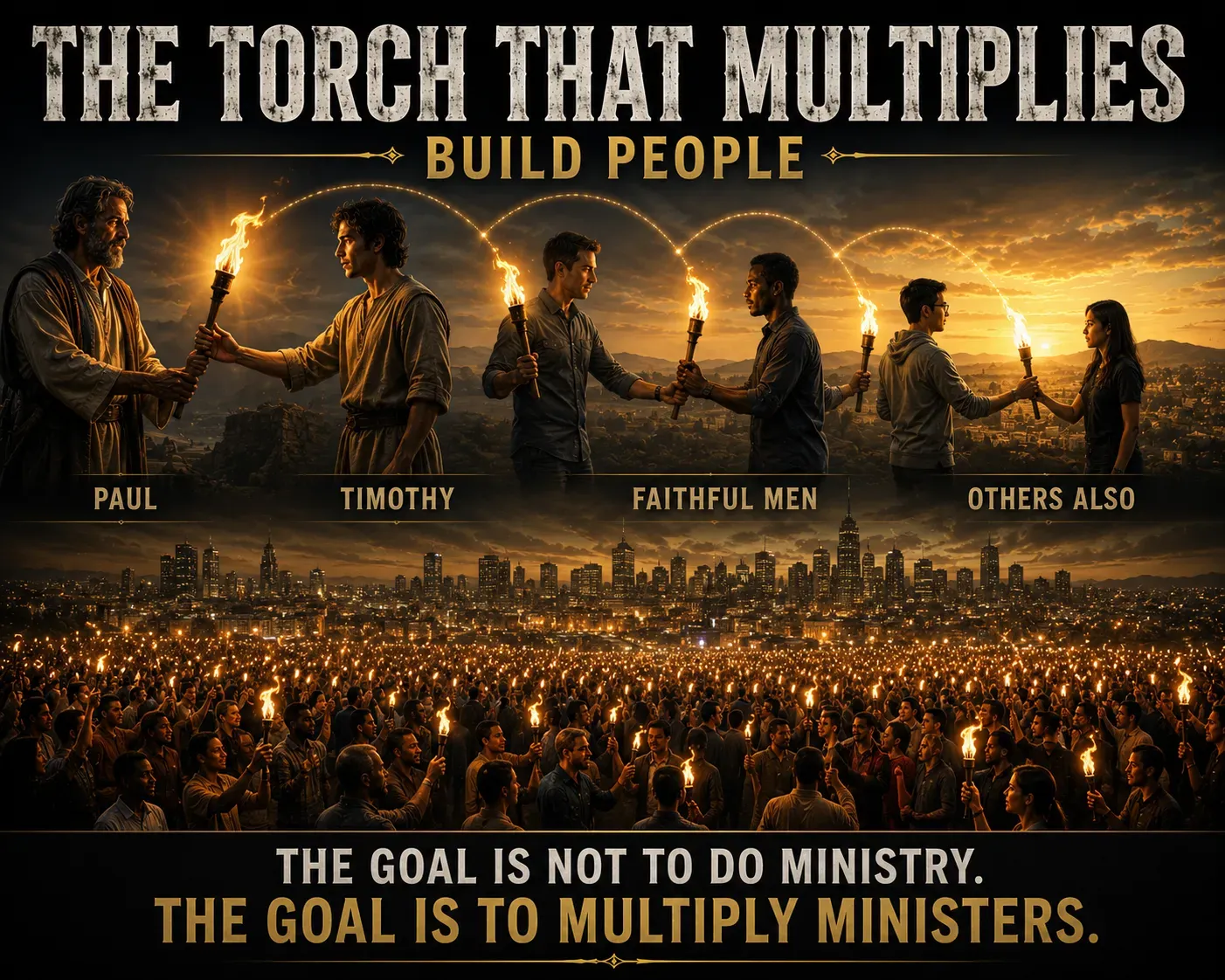
And the things that thou hast heard of me among many witnesses, the same commit thou to faithful men, who shall be able to teach others also.
II Timothy 2:2
Count the generations in that single verse. Paul teaches Timothy. Timothy commits it to faithful men. Those faithful men teach others also. That is four generations of disciples in one sentence, and Paul never personally meets any of generations three or four. This is the multiplication principle that built the early church across a hostile empire without printing presses, without airplanes, without a single mission agency as we would recognize one today. It worked because Paul thought in generations, not in personal output.
If your ministry strategy does not include a clear answer to the question, "Who am I training to do what I do, so they can train someone else to do it after them?" then you are still doing the work of ten men instead of putting ten men to work. You are still a craftsman rather than a general.
The Pastor, the Missionary, the Man of God Should Be Full-Time
I want to close this two-part series with a conviction I hold deeply, one that some will find countercultural in an era that celebrates bivocational hustle as the new spiritual gold standard. There is a place for tentmaking ministry, and Scripture honors it. But the normal, expected pattern for the man called to give himself to the Word and to prayer, to shepherd souls, to plant churches among the nations, is full-time devotion to that calling, supported by the people of God so that he can give his full strength to it.
Do ye not know that they which minister about holy things live of the things of the temple? and they which wait at the altar are partakers with the altar? Even so hath the Lord ordained that they which preach the gospel should live of the gospel.
I Corinthians 9
Paul makes an extended argument across this entire chapter: the ox that treads out the corn, the soldier who does not go to war at his own charges, the husbandman who partakes of the fruit he grows. Every illustration drives toward the same conclusion. The man who labors in the Gospel has a right to be supported by the Gospel, fully, so that the work does not have to compete with a second job for his best hours and his best energy.
And I will very gladly spend and be spent for you; though the more abundantly I love you, the less I be loved.
II Corinthians 12
Paul did, at times, choose not to exercise that right, working with his own hands so as not to burden young churches. But notice the heart behind it in Second Corinthians twelve. He gladly spent and was spent, fully, for the sake of the people he loved. That is the picture of full-time ministry rightly understood, not a man clocking hours to justify a paycheck, but a man fully given, fully available, fully poured out, because the people of God have freed him from other obligations precisely so he can be poured out for them.
When a church or a sending agency expects a man to carry a secular job and still produce full-time results in the ministry, they have created an impossible standard, and they should not be surprised when the work suffers for it. And when a man accepts full support and then fails to give full effort, he has broken the same covenant from the other direction. Both halves of this arrangement, full support and full effort, depend on each other.
Bringing the Two Parts Together
Hard work without wisdom will burn a man out long before the harvest comes in. Wisdom without hard work is nothing more than a clever excuse for the same laziness Solomon warned us about. You need both. Work the fifty or sixty hours. Sow in the morning and do not withhold your hand in the evening, because you do not know which seed will prosper. But sow wisely. Build people instead of using them. Let the numbers be the fruit, not the engine. Put ten men to work instead of trying to be ten men yourself.
Delegate the way Moses, Paul, and the ascended Christ Himself modeled for us. And trust the people of God to support you fully so you can give yourself fully, the way the altar was always meant to work.
You are not laboring to prove your worth to God. You already have that settled in Christ. You are laboring, hard and smart both, because a watching world still has not heard, and because the harvest, in His timing, is still coming in.
Does working smart mean working less?
Not necessarily less, but more strategically directed. Smart work multiplies the output of hard work through delegation and discipleship rather than replacing diligence with cleverness.
How do I know if I am building people or using them?
Ask whether the people serving under you are growing in maturity, gifting, and leadership capacity over time, or whether they are simply filling recurring tasks. If you cannot name what a volunteer has grown into over the past year, you may be using rather than building.
Is full-time support biblical even for missionaries in difficult or restricted fields?
First Corinthians 9 establishes the principle broadly for those who labor in the Gospel. The application of full or partial support will vary by field and circumstance, but the underlying right to be supported by those who send you remains a biblical norm rather than an exception.
#Missions #WorldEvangelism #PastoralMinistry #SmartWork #Delegation #ChurchLeadership #AlignmentMinistries #FollowedByMercy