Smart Work Versus Hard Work
Part One: Why God Expects Us to Work Hard

There is a quiet lie that has crept into ministry circles, and it sounds spiritual enough that most men never question it. It goes something like this: "I am not paid by the hour. I work for the Lord. My schedule is between Him and me." Now there is a kernel of truth buried in there, but men have used that kernel to bury something else, namely, their own laziness.
I have pastored. I have been a missionary. I have sat across the table from young men headed to the field and old men who never should have left it. And I can tell you that one of the quietest killers of Gospel advance is not persecution, and it is not lack of funding. It is the simple, unglamorous sin of not working.
God Expects Us to Work Hard
Let that sink in before we go any further. Hard work is not a regrettable necessity of ministry, something we endure until the supernatural kicks in. Hard work is the will of God for every man and woman who claims the name of Christ, and ministers are not exempted. We are, if anything, more accountable.
Consider what we ask of the people who support us. Somewhere out there is a layman who gets up before the sun, drives to a job he may not love, gives his employer eight or ten honest hours, drives home tired, and then, because he loves Jesus, shows up Wednesday night for choir practice or visitation. He does this week after week, year after year, and a portion of what he earns from that job lands in an envelope marked for your support.
It is wrong, plainly and biblically wrong, to expect that man to sacrifice his time and his money so that you can have your support, and then turn around and work fewer hours than he does. If the regular church member is expected to carry a full secular workload and still show up to serve, you have no biblical ground to claim a lighter standard for yourself.
A Working Standard
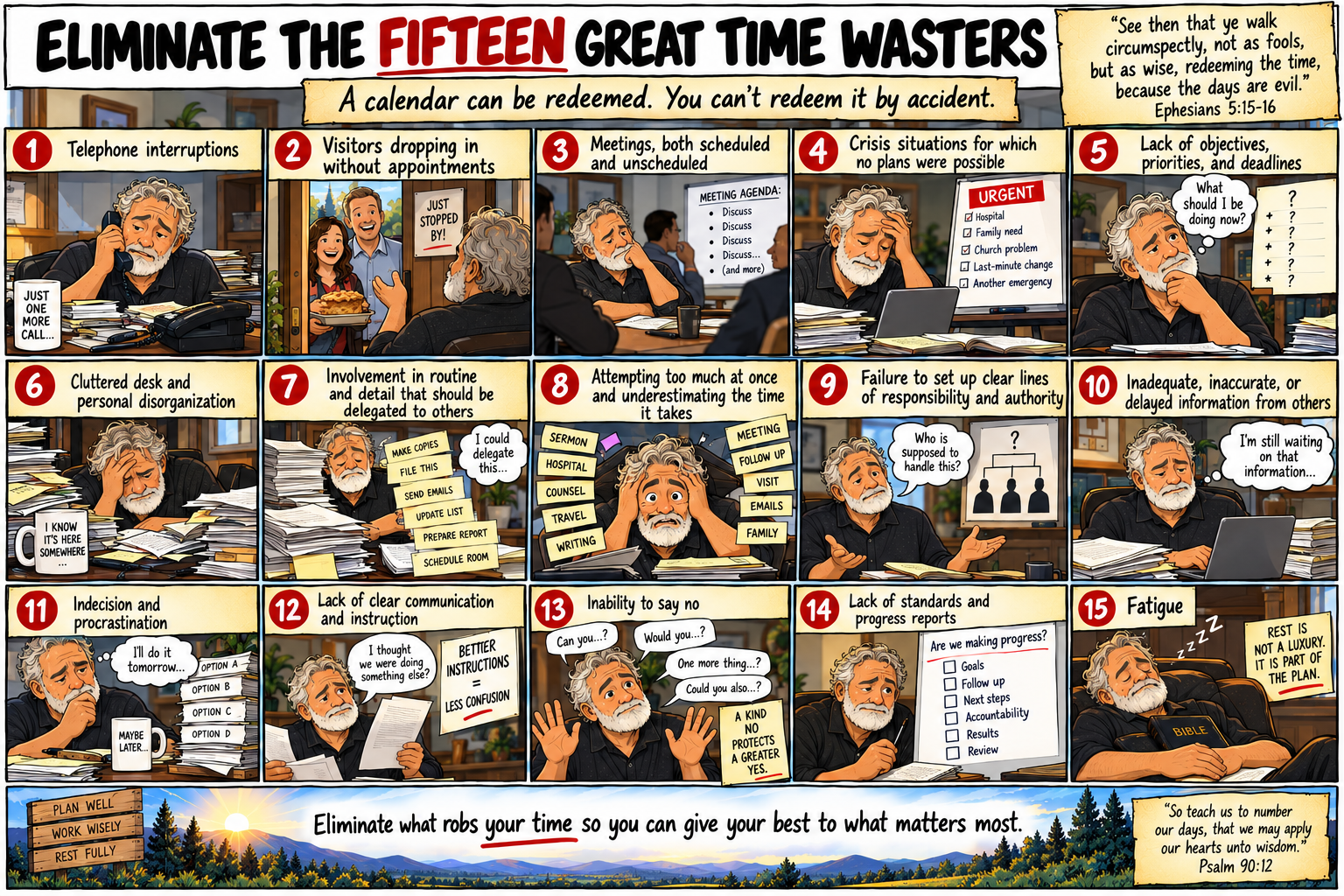
Here is a working number, not a legalistic one, but a standard that has served me and many faithful men well across the decades: at least fifty to sixty hours a week of actual labor, not counting church services, choir practice, or visitation. Those things are additional. They are not padding for a thin work week. A pastor or missionary who counts Sunday morning, Sunday night, and Wednesday prayer meeting as the bulk of his "hours" has not yet begun to understand what the people supporting him are sacrificing to keep him on the field.
And here is the humbling part. When you work a full fifty or sixty-hour week in the ministry, you have not done anything heroic. You have not outgiven the people in the pews. You have simply done what they already do. The applause you may be tempted to expect for your long hours belongs, if it belongs anywhere, to the deacon who works a full shift and still teaches Sunday school, to the mother who manages a household and still drives the visitation route on Tuesday afternoons.
Often the work of God does not go forward, not because the field is hard, not because the people are resistant, not because the enemy is strong, but because we simply do not work. We talk about the work. We plan the work. We post about the work. But the actual sweat-equity hours required to see a church planted, a Bible translated, a disciple trained, those hours go unspent, and we wonder why the harvest is thin.
The Law of the Harvest
Scripture is not silent on this. Paul lays down a principle that governs every field, spiritual and natural alike.
Be not deceived; God is not mocked: for whatsoever a man soweth, that shall he also reap.
Galatians 6:7
That verse is most often quoted as a warning against sin, and rightly so. But read it again in the context of labor. If you sow little, you reap little. If you sow few hours, you reap a thin harvest. The principle does not bend because the field is a mission field rather than a wheat field. The law of the harvest does not know the difference between a farmer and a pastor. It knows only seed, soil, and time.
What Scripture Says About the Slothful Man
The book of Proverbs returns to this theme with a frequency that should arrest our attention. Solomon, under the inspiration of the Holy Spirit, did not consider laziness a minor character flaw. He treated it as a destroyer.
The hand of the diligent shall bear rule: but the slothful shall be under tribute... The slothful man roasteth not that which he took in hunting: but the substance of a diligent man is precious.
Proverbs 12:24, 27
Picture that image for a moment. A man goes out, does the hard work of the hunt, makes the kill, and then will not finish the job by roasting the meat. He has done the exciting part and abandoned the unglamorous part. How many of us have started a ministry initiative with great energy, made the kill, so to speak, secured the vision, gathered the team, and then let the meat rot because we would not do the unglamorous follow-through?
The way of the slothful man is as an hedge of thorns: but the way of the righteous is made plain.
Proverbs 15:19
He also that is slothful in his work is brother to him that is a great waster.
Proverbs 18:9
That verse alone should stop us cold. God does not place the lazy man in a separate category from the destroyer. He calls them brothers. The man who wastes resources through carelessness and the man who wastes time through idleness belong to the same family. We would never knowingly squander mission funds. Yet many of us squander mission hours without a second thought.
A slothful man hideth his hand in his bosom, and will not so much as bring it to his mouth again.
Proverbs 19:24
The desire of the slothful killeth him; for his hands refuse to labour.
Proverbs 21:25
The slothful man saith, There is a lion without, I shall be slain in the streets.
Proverbs 22:13
Notice the excuse-making in that last verse. The slothful man does not simply admit he will not work. He invents a danger. He manufactures an obstacle dramatic enough to justify staying inside. Ministry has its own version of the lion in the street. "The culture is too hostile." "The field is not ready." "I am waiting on the Lord's timing." Sometimes those statements are true. Often they are the lion we have invented so we do not have to go out and labor.
I went by the field of the slothful, and by the vineyard of the man void of understanding; And, lo, it was all grown over with thorns, and nettles had covered the face thereof, and the stone wall thereof was broken down. Then I saw, and considered it well: I looked upon it, and received instruction. Yet a little sleep, a little slumber, a little folding of the hands to sleep: So shall thy poverty come as one that travelleth, and thy want as an armed man.
Proverbs 24:30-34
That field did not fail because the soil was bad. It failed because the man who owned it kept folding his hands. "Yet a little sleep, a little slumber." Not outright rebellion against the work, just a steady accumulation of small delays, until poverty arrived like an armed man, not asking permission. Mission fields go fallow the same way. Not through one dramatic act of unfaithfulness but through a thousand small foldings of the hand.
The slothful man saith, There is a lion in the way; a lion is in the streets. As the door turneth upon his hinges, so doth the slothful upon his bed. The slothful hideth his hand in his bosom; it grieveth him to bring it again to his mouth.
Proverbs 26:13-15
A door swings on its hinges and goes nowhere. It is in motion, but it accomplishes nothing it was not already doing. That is a vivid picture of activity without advancement, the man who is always busy and never productive, always turning and never going anywhere.
Go to the ant, thou sluggard; consider her ways, and be wise: Which having no guide, overseer, or ruler, Provideth her meat in the summer, and gathereth her food in the harvest. How long wilt thou sleep, O sluggard? when wilt thou arise out of thy sleep?
Proverbs 6:6-9
The ant has no supervisor, no accountability meeting, no mission board checking her productivity reports. She works because the work needs to be done. That is the standard. Self-government, not external pressure, should drive the diligence of a man called of God.
As vinegar to the teeth, and as smoke to the eyes, so is the sluggard to them that send him.
Proverbs 10:26
Read that verse as a missionary or a pastor and let it sting the way it should. To them that send him. The people who sacrificed to send you, the church that took up the offering, the small group that prays for you by name, they did not send you out to be vinegar to their teeth. A lazy missionary is not a neutral disappointment to his supporters. He is an irritant, a grief, a wound to the very people who believed in him enough to fund him.
The soul of the sluggard desireth, and hath nothing: but the soul of the diligent shall be made fat.
Proverbs 13:4
The sluggard will not plow by reason of the cold; therefore shall he beg in harvest, and have nothing.
Proverbs 20:4
It was cold. There is always a reason. The field conditions were not ideal; the support was slow to come in; the team was understaffed; the culture was resistant. All of that may be true, and none of it changes the verdict. The man who will not plow because of the cold still begs at harvest. God does not grade on the difficulty of conditions. He measures the fruit.
The sluggard is wiser in his own eyes than seven men that can render a reason.
Proverbs 26:16
This may be the most sobering verse in the entire list, because it describes a man who is not even aware of his condition. He does not see himself as lazy. He sees himself as wise, wiser than seven men who could give him good counsel if he would only listen. Self-deception is the sluggard's final defense. He has rationalized his idleness into a kind of wisdom, and that is precisely what makes it so dangerous.
You Do Not Know Which Labor Will Prosper
Now someone reading this might say, "But Austin, I have worked hard, and I have not seen the fruit." I understand that grief. I have stood in fields in Peru where the work was slow, and the response was thin, and I wondered if my labor mattered at all. Solomon answers that exact uncertainty.
He that observeth the wind shall not sow; and he that regardeth the clouds shall not reap. As thou knowest not what is the way of the spirit, nor how the bones do grow in the womb of her that is with child: even so thou knowest not the works of God who maketh all. In the morning sow thy seed, and in the evening withhold not thine hand: for thou knowest not whether shall prosper, either this or that, or whether they both shall be alike good.
Ecclesiastes 11:4-6
You do not get to see, ahead of time, which sermon will be the one a man remembers on his deathbed. You do not get to know which translated verse will be the one that breaks open a closed heart, which discipleship hour will produce the leader who plants ten more churches after you are gone. The farmer who waits for perfect wind conditions and perfect cloud patterns before he plants will never plant at all. Sow in the morning. Do not withhold your hand in the evening. Work both sides of the day, because you cannot see which seed God has marked for the harvest.
Come On Now, Let's Be Honest
I am not writing this to pile guilt on tired servants of God. Some of you reading this are already working yourselves into the ground, and what you need is not a harder push but the wisdom we will get to in Part Two. But some of you, if you are honest before the Lord, know that the lion in the street is an excuse, and the field has thorns growing in it because your hands have been folded a little more than they ought.
Grace does not mean we get to coast. Grace is what frees us from working to earn God's love, so that we can work hard out of love for the God who already loves us completely. You are not laboring to be accepted. You are laboring because you already are accepted, and that ought to produce more diligence, not less. A son who knows he is loved works differently than a slave who is afraid of the whip. He works harder, not lighter, because the work has become an act of worship instead of a transaction for approval.
In Part Two, we will turn from the question of how hard to work toward the equally important question of how to work smart, how to multiply your labor instead of merely multiplying your hours, and why full-time ministry is not a luxury but a biblical expectation. But we could not get there honestly without first laying this foundation. Before a man learns to work smart, he must first be willing to work hard. There is no shortcut around diligence, only wisdom for how to direct it.
Does working 50 to 60 hours a week mean I will burn out?
Burnout typically comes from working without rest, delegation, or rhythm, not from working hard in itself. Part Two addresses how to multiply your effectiveness so that hard work and sustainable ministry are not opposites.
What if my field genuinely has obstacles that slow the work?
Real obstacles exist, and wisdom accounts for them. The warning in these Proverbs is not against acknowledging difficulty, but against manufacturing excuses to avoid labor we are simply unwilling to do.
Is this list of Proverbs meant to produce guilt?
No. Conviction from the Holy Spirit leads to repentance and renewed diligence. Guilt that has no action attached to it is not from God. Read these verses, examine your own hands honestly, and then get up and work, secure in the fact that you are already loved.
#Missions #WorldEvangelism #PastoralMinistry #HardWork #Diligence #ProverbsWisdom #AlignmentMinistries #FollowedByMercy