The Chicken Way Out
A Parable on Delegation
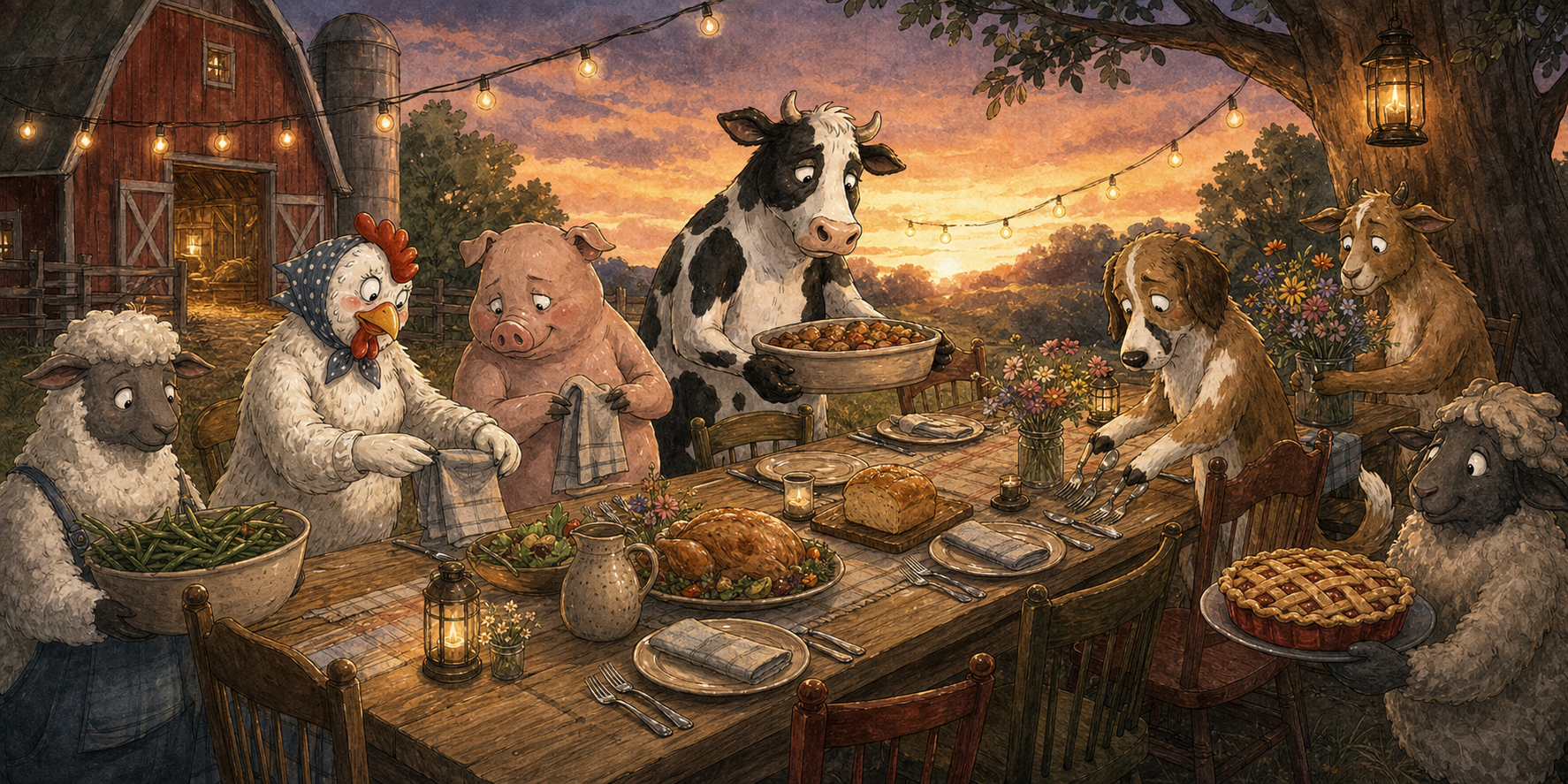
You know the story. Or you think you do.
A hen finds a field of wheat. She asks around the barnyard for help bringing it in. The pig says he was never trained for that kind of work. The cow says she'd only slow things down. The dog says he's got other things on his plate today, but next time, for sure.
So the hen does it herself. Cuts the wheat alone.
Then she needs help grinding it into flour. Same answers, dressed up a little differently. The cow tells her she's more experienced and could do it twice as fast without help getting in the way. The dog says he's tied up with something more urgent. Next time, he promises.
So she grinds the flour alone.
Then the bread needs baking. Same three animals, same three excuses. So she bakes it alone too.
That evening her guests arrive for dinner. And all she has is bread. No main course. No dessert. Not even the silverware set out, because every hour she had gone into wheat and flour and dough. The evening falls apart around her. She goes to bed telling herself the same tired line every over-functioning leader tells themselves: nobody else will get it done right.
The Barnyard Isn't Really the Problem
Most people who tell this story stop at the pig, the cow, and the dog. Lazy help. Excuse-makers. The moral becomes a finger pointed outward: don't be like them.
But sit with the hen a minute longer.
Nobody forced her to cut that whole field alone. Nobody made her grind and bake without asking twice. She heard three “not I's” and quietly decided the only safe hands were her own. That's not a barnyard problem. That's a heart problem, and most leaders know it
.
Why We'd Rather Carry It Than Hand It Off
Here's what nobody tells you when you're the one everyone depends on: the hardest excuse to overcome isn't the one you hear from other people. It's the one you tell yourself.
I'll just do it faster alone. They won't do it the way it needs to be done. If I let this go and it fails, that's on me.
Underneath every one of those sentences is a quieter belief, one most of us never say out loud: my worth is tied to what I produce. If the field doesn't get cut, I'm not sure who I am.
That belief didn't start in the barnyard, and it won't die there either. It dies the moment you actually believe you were loved before you ever lifted a scythe. Not because you're useful. Not because you're the only one who can be trusted with the wheat. Because you're His.
“For we are his workmanship, created in Christ Jesus unto good works, which God hath before ordained that we should walk in them.” Ephesians 2:10
Read that again slowly. The good works come after the workmanship, not before it. You were made and loved first. The field was never supposed to prove that.
Even Moses Had a Father-in-Law Who Loved Him Enough to Say Something
Moses ran the whole camp of Israel by himself for a while. Judged every dispute, settled every fight, carried the weight of over a million people on his own back. His father-in-law watched him do it and didn't applaud his work ethic. He warned him.
“And Moses' father in law said unto him, The thing that thou doest is not good. Thou wilt surely wear away, both thou, and this people that is with thee: for this thing is too heavy for thee; thou art not able to perform it thyself alone.” Exodus 18:17-18
Too heavy. Not able. Alone. God didn't rebuke Moses for that word from Jethro. He confirmed it later with His own plan.
“And the LORD said unto Moses, Gather unto me seventy men of the elders of Israel... and I will take of the spirit which is upon thee, and will put it upon them; and they shall bear the burden of the people with thee, that thou bear it not thyself alone.” Numbers 11:16-17
God's answer to an exhausted leader was never “push harder.” It was “you were never meant to hold this by yourself.” If Moses needed seventy other men, you and I probably need at least a few.
Grace Trains Clumsy Hands
Go back to the pig and the cow and the dog for a second, because there's mercy hiding in their excuses too.
“I don't know how.” “I'm too clumsy.” Untrained hands and clumsy hands aren't disqualified hands. They're hands nobody has taken the time to teach yet.
When the early church started buckling under the weight of feeding widows, the apostles didn't grab an apron and quietly do it themselves to keep the peace. They handed it off, on purpose, to men they trusted to grow into it.
“It is not reason that we should leave the word of God, and serve tables.” Acts 6:2
“...we will give ourselves continually to prayer, and to the ministry of the word.” Acts 6:4
That's not a leader dodging work. That's a leader who knows what only he can carry, and lets go of the rest so someone else has room to grow into theirs.
“And the things that thou hast heard of me among many witnesses, the same commit thou to faithful men, who shall be able to teach others also.” 2 Timothy 2:2
Faithful doesn't mean flawless. It means willing. Every clumsy cow becomes a capable one somewhere between the first try and the fifth, but only if somebody hands her the wheat and stays close enough to help without taking it back.
Nobody Sets a Whole Table Alone
Here's the part of the parable nobody tells you: the hen wasn't punished for asking for help. She was worn out from never getting an answer she could trust.
Every “not I” could have been the start of a conversation instead of the end of one. “I've never done this, will you show me?” “I'm nervous I'll mess it up, will you stay close while I try?” A leader secure in who she is can sit in that conversation all afternoon. A leader still trying to prove something can't afford the time.
“For the body is not one member, but many.” 1 Corinthians 12:14
You were never built to be the whole body. You were built to be part of it, gladly, without apology.
So if tonight's table only has bread on it, that's not a verdict on your worth. It's an invitation to ask again tomorrow, and this time, to actually wait for the answer instead of racing past it into the field by yourself.
You are loved before the wheat is ever cut. Everything else, including who helps you bring it in, flows from that.
If this found you in the middle of carrying too much alone, I'd love to keep sending you words like these. Come subscribe, and let's keep walking through this together, one honest page at a time.
#FollowedByMercy #AudienceOfOne