
The Word Made Flesh
How the Missionary Learns to Relate to the National. The Example of Jesus
And the Word was made flesh, and dwelt among us, (and we beheld his glory, the glory as of the only begotten of the Father,) full of grace and truth. John 1:14
Every missionary eventually faces the same question the national is silently asking: are you here for us, or are you here to be someone among us? The answer is not settled by a sermon. It is settled by the pattern of a life where the missionary lives, how he speaks, whose questions he asks, and whose correction he receives. Scripture already supplies the pattern, and it is the most radical missions strategy ever undertaken: the incarnation of Jesus Christ.
When the Word became flesh, God did not send information about Himself into the world. He sent Himself, and He sent Himself in a form His people could recognize as one of their own. He identified so completely with those He came to reach that He became like them in every way except sin. If the incarnation is the model, then the missionary's task is not to transplant a foreign ministry culture onto a new people, but to enter their world the way Christ entered ours.
A. Jesus Came as a Helpless Infant
He did not arrive as a leader, a teacher, an expert, or a visitor from a superior culture. He arrived unable to speak, unable to walk, unable to feed Himself, entirely dependent on the people He had come to save. This is a hard word for anyone sent out with training, resources, and conviction, because it is tempting to arrive as the answer to a people's problems. Jesus arrived instead as a need to be met.
If we desire to reach a people, we cannot come in as the expert with the solutions, the outsider correcting the insider. We must come in low. The missionary who arrives needing help, needing to be taught, fed, corrected, and welcomed gives the national something Jesus gave His own people: the dignity of being needed rather than merely served.
B. Jesus Was a Learner
He learned language from His parents. He learned to play among His peers. And at twelve years old, the very Son of God was found in the temple sitting among the teachers, listening, and asking questions.
And it came to pass, that after three days they found him in the temple, sitting in the midst of the doctors, both hearing them, and asking them questions. Luke 2:46
What a profound lesson for the missionary. Will you be willing to approach your new people as a learner? Will you humble yourself enough to let them correct you: your grammar, your customs, your assumptions? God Himself spent thirty years studying the language, the culture, and the daily lives of His people before He began a single day of public ministry. He knew their family troubles and their common struggles. He stood beside them as a learner and a coworker long before He stood before them as a teacher. That patient apprenticeship is what earned Him the right to be heard.
And Jesus increased in wisdom and stature, and in favour with God and man. Luke 2:52
He identified Himself so fully with those to whom He was sent that His most common title for Himself was simply "the Son of man." Paul later described the cost of that identification in terms every missionary should sit with:
Let this mind be in you, which was also in Christ Jesus: Who, being in the form of God, thought it not robbery to be equal with God: But made himself of no reputation, and took upon him the form of a servant, and was made in the likeness of men: And being found in fashion as a man, he humbled himself, and became obedient unto death, even the death of the cross. Philippians 2:5-8
"Made himself of no reputation" is the missionary's calling in miniature. Reputation, credentials, and standing in one's home culture count for nothing on the field except as they are laid down. Learning is how that laying-down happens in practice: one corrected word, one misunderstood custom, one patient question at a time.
C. Jesus Was Completely and Legitimately a Jew
He was so fully identified with His own people that, when He returned to His hometown, they could not accept the power of His teaching and ministry; He was simply the carpenter's son, entirely ordinary, one of their own (Matthew 13:54-58).
It is the missionary's goal to live among a people to the same degree not as a permanent foreigner performing a role, but so woven into daily life that the people themselves say, "He is one of us." That kind of belonging is not achieved through a few years of language study. It is built the way Jesus built it: through decades of shared meals, shared work, shared grief, and shared joy.
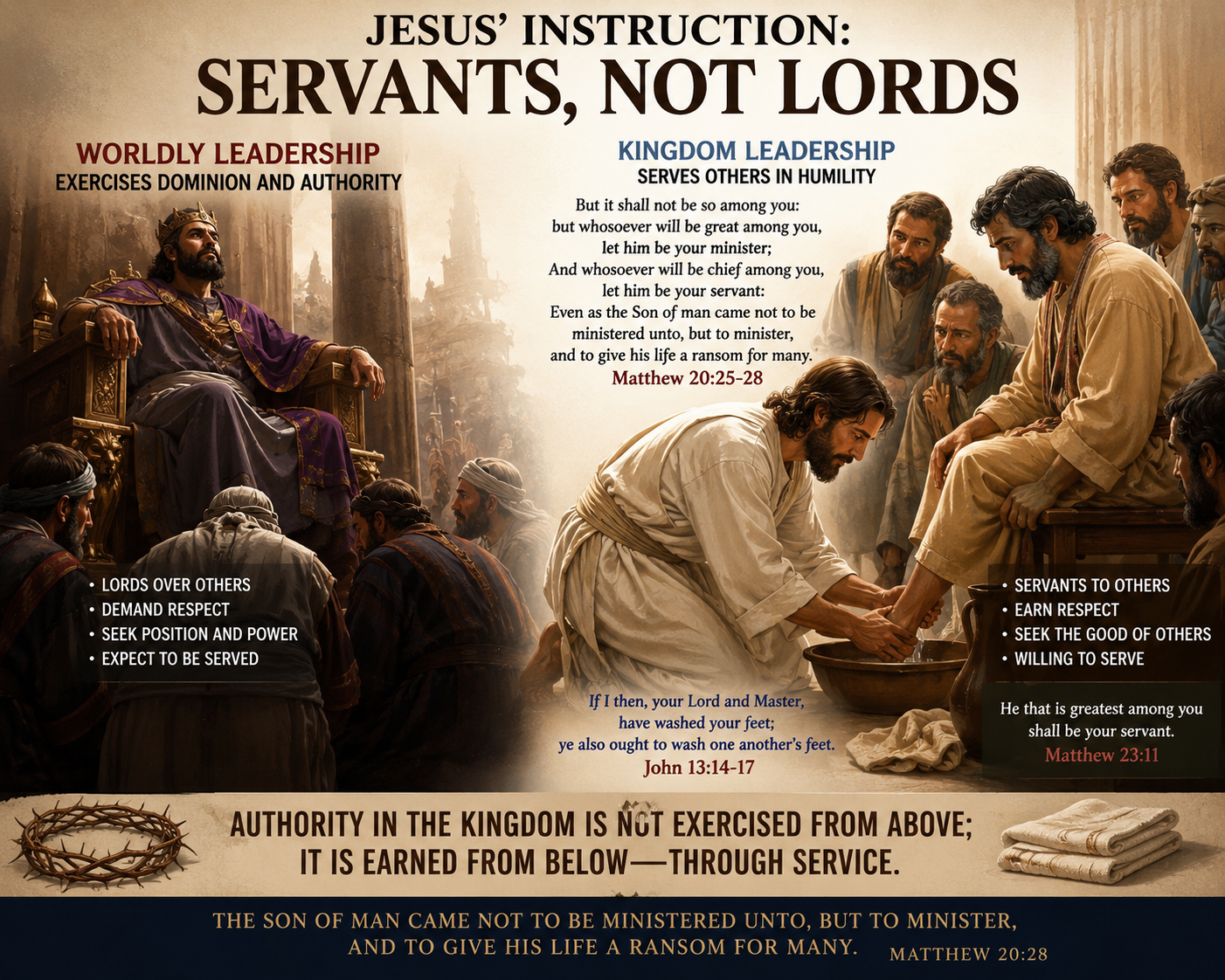
D. Jesus' Instruction: Servants, Not Lords
Jesus was direct about the posture His followers were to take among the people they served. He contrasted worldly leadership, which exercises dominion and authority, with the leadership He required of His own:
But Jesus called them unto him, and said, Ye know that the princes of the Gentiles exercise dominion over them, and they that are great exercise authority upon them. But it shall not be so among you: but whosoever will be great among you, let him be your minister; And whosoever will be chief among you, let him be your servant: Even as the Son of man came not to be ministered unto, but to minister, and to give his life a ransom for many. Matthew 20:25-28
He repeated the same lesson with a basin and a towel, washing feet that His disciples were too proud to wash themselves, and then telling them plainly to do the same for one another (John 13:14-17). Authority in the kingdom is not exercised from above; it is earned from below, through service that the world's leaders would consider beneath them.
Conclusion: Following the Pattern
The missionary who wants to deal rightly with the national has, in Christ, a complete model already laid out: come without status, learn before you teach, identify so fully that the people claim you as their own, and serve rather than rule. None of this happens quickly, and none of it happens comfortably. It cost the Son of God thirty hidden years before three years of public ministry, and it cost Him His reputation, His comfort, and ultimately His life.
The question every missionary must answer is the same one Jesus answered by taking on flesh: will I come to this people as one who must be served, or as one who came to serve? The incarnation gives the answer and the pattern for living it out.
Check out this page to learn about my Ministry Journey