
Relations with Nationals
Learning to Serve with Humility, Honor, and Christlike Love Across Cultures
Maybe the most important aspect of our work as missionaries, outside the strictly spiritual realm, is our relationship with nationals. So many good men and women go to the field and do not accomplish what they could, even though they are very well trained and prepared for the work. It is not enough to have a good education or to be a spiritual man of God. You must also know how to relate to people. You are the visitor to their country. You must learn to think in terms of how they view things and not what you like or want. We must learn to identify ourselves with them.
A. Identification
In order to have an effective cross-cultural ministry, missionaries must first of all be students of culture; in other words, the way a particular people organize their world.
Culture is an integrated system of beliefs (about God or reality or ultimate meaning), of values (about what is true, good, beautiful, normative), of customs (how to behave, relate to others, talk, pray, dress, work, play, trade, farm, eat, etc.), and of institutions which express these beliefs, values, and customs (government, law courts, temples, or churches, family, schools, hospitals, factories, shops, unions, clubs, etc.), which binds a society together and gives it a sense of identity, dignity, security, and continuity.
Effective missionaries identify with the culture. Through intimate knowledge of the people, missionaries see the world as the people see it, and experience life as they do. We have no better example of this identification than Jesus Christ himself. He left His home in glory to become a vulnerable, dependent, human infant. He knew hunger and thirst, poverty and oppression. He experienced rejection, anger, and loss. He wept. His experience of human nature gave Him tremendous insight, which He manifested during His earthly sojourn and provided a relational platform for a powerful ministry.
"Wherefore in all things it behoved him to be made like unto his brethren, that he might be a merciful and faithful high priest in things pertaining to God, to make reconciliation for the sins of the people." Hebrews 2:17
Identification does not mean pretending to be something we are not. Nationals know we are foreigners, and no amount of effort will change that. What identification means is a settled willingness to learn, to be inconvenienced, to eat what is set before us, to sit through what is uncomfortable, and to let go of the assumption that our own culture's way of doing things is the "normal" or "correct" way. The missionary who identifies well is not the one who disappears into the culture, but the one whose respect for it is evident in a thousand small daily choices.
B. Equality, Not Superiority
Nowhere does the missionary do more damage, often without realizing it, than in the unconscious assumption of superiority. It rarely announces itself outright; it shows up instead in tone of voice, in who is consulted before a decision is made, in whose opinion is treated as final, in who sits at the head of the table.
Paul, writing to the Philippians, gave the clearest possible standard:
"Let nothing be done through strife or vainglory; but in lowliness of mind let each esteem other better than themselves." Philippians 2:3
The missionary comes from a sending church with resources, training, and often money that the national believer lacks. That imbalance is real, but it is an imbalance of resources, not of worth, giftedness, or spiritual insight. National believers frequently understand their own people, their own Scriptures, and the working of the Holy Spirit in their setting with a depth the missionary will never fully reach, however long the term of service. A missionary who cannot receive correction, teaching, or rebuke from a national believer has not yet understood what equality in Christ means.
C. Partnership Rather Than Paternalism
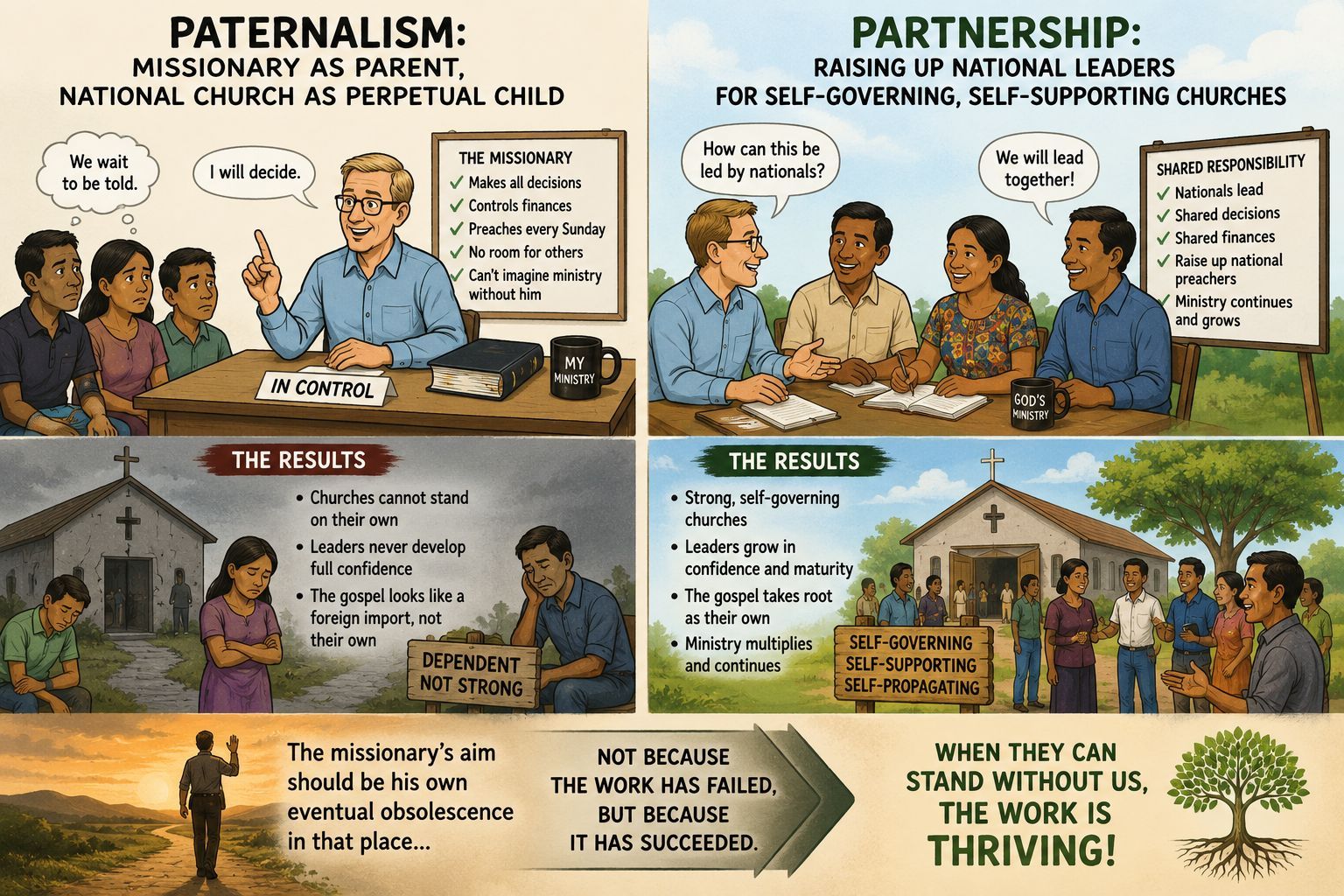
One of the most common and most damaging patterns in missions history is paternalism: the missionary as parent, the national church as perpetual child. It is often well-intentioned. It grows out of genuine love and a genuine desire to help. But it produces churches that cannot stand on their own, leaders who never develop full confidence, and a gospel that, in the eyes of the community, looks like a foreign import rather than something that belongs to them.
Paternalism shows up in practical ways: the missionary who always makes the final decision, who controls the finances entirely, who preaches every Sunday instead of raising up national preachers, who cannot imagine the work continuing without him.
Partnership looks different. It asks, from the earliest possible day, "How can this be led by nationals?" rather than "How long until I can trust them to lead this?" It hands over responsibility before it feels entirely safe to do so, because a national leader who has never been trusted with responsibility will never grow into it. Roland Allen's century-old observation remains true: churches planted with an eye toward permanent foreign dependence rarely become strong; churches planted with an expectation of self-government, self-support, and self-propagation from the beginning generally do.
The missionary's aim should be his own eventual obsolescence in that place -- not because the work has failed, but because it has succeeded.
D. Genuine Friendship
Nationals can often tell within minutes whether a missionary sees them as friends or as a project. Ministry built on friendship endures; ministry built only on strategy does not.
This means eating in homes even when the food is unfamiliar. It means attending weddings, funerals, and celebrations that have nothing directly to do with "ministry." It means learning family names, remembering birthdays, asking about the harvest or the exam results or the sick relative. It means being present when there is nothing to be gained from it.
Jesus was accused by His critics of being "a friend of publicans and sinners" (Matthew 11:19). He did not treat this as an insult to defend against; He simply continued to be a friend to the people around Him. Missionaries who cultivate real friendship, and not merely professional courtesy, find that trust follows naturally, and trust is the currency in which almost all effective ministry is transacted.
E. Communication and Language
Nothing communicates respect or its absence more directly than a missionary's effort with the local language. A missionary who insists on operating exclusively through translators for years, when fluency was attainable, sends an unmistakable message about how much effort he was willing to invest in the relationship.
Language learning is slow, humbling, and often embarrassing. That is precisely its value. The missionary who stumbles over verb tenses in front of the very people he hopes to lead has already begun to dismantle the pedestal that separates him from them. Few things build rapport with nationals faster than watching a foreigner struggle earnestly, and without pride, to speak their language.
Beyond vocabulary, missionaries must also learn the indirect, relational, and nonverbal patterns of communication common in many cultures: how disagreement is expressed, how requests are made, how "no" is often not said outright. Communicating in words a national can technically understand is not the same as communicating in a way a national can actually receive.
F. Handling Criticism and Conflict
Conflict is inevitable in cross-cultural work, and the way a missionary handles it shapes the national church's overall understanding of Christian character. Criticism that would be delivered directly in the missionary's home culture may need to be delivered privately, gently, and indirectly elsewhere, lest it produce shame that shuts down the relationship entirely.
"A soft answer turneth away wrath: but grievous words stir up anger." Proverbs 15:1
Missionaries should also expect to be criticized themselves, sometimes unfairly, and should receive it the way they would want a guest in their own home to receive correction: without defensiveness, and without letting the sting of it curdle into resentment against the very people they came to serve.
G. Money and Resources
Few issues damage relationships with nationals as quickly, or as permanently, as the mishandling of money. The missionary typically comes from a position of relative wealth, and nationals know it, whether or not it is ever discussed.
Indiscriminate giving creates dependency and, in time, resentment; it can also create suspicion that the gospel itself is simply a transaction. Withholding all material help, on the other hand, can look like indifference dressed up as principle. Wisdom lies in giving that empowers rather than fosters dependence, for instance, funding a national-led initiative rather than personally running it, and in transparency about finances so that suspicion has no place to take root. National believers should generally be full partners in financial decisions that affect their own church, not simply recipients of decisions made elsewhere.
H. Raising Up and Releasing National Leadership
The clearest test of everything above is whether national leaders actually emerge, are actually trusted, and are actually released to lead. Mission work can look impressive for years and still fail this test if every meaningful decision is still made by the missionary.
Barnabas offers a model worth studying. Having gone to Antioch and seen the grace of God at work, his response was not to consolidate control but "he was glad, and exhorted them all, that with purpose of heart they would cleave unto the Lord" (Acts 11:23). He went on to fetch Paul, and later, when the moment came, he stepped back and let Paul take the lead in ministry that had originally been his own. A generation later, Paul himself appointed elders in every church "in every city" (Titus 1:5) and then left, trusting the Holy Spirit and the local leaders rather than his own continued presence.
Missionaries do well to ask regularly: Who among the nationals could do this if I were gone tomorrow? If there is no answer, the work is not yet finished, however many years have been invested, and however full the pews may be.
Conclusion
None of this diminishes the missionary's calling; if anything, it raises the bar. A well-trained, theologically sound, deeply spiritual missionary can still fail on the field if he never learns to lay aside his own cultural assumptions and genuinely honor, befriend, and empower the people he has come to serve. Christ's own pattern was to empty Himself, take the form of a servant, and be made in the likeness of men (Philippians 2:6-7). Missionaries who follow that pattern in their relations with nationals will find doors open that no amount of technique or training could open on its own.