How Could Paul Start Churches So Quickly?
The Jewish Diaspora Prepared the Way Long Before Paul Arrived
Paul's missionary journeys read like a whirlwind. In a matter of weeks or months, he could arrive in a city as a stranger, preach the gospel, and leave behind a functioning church with elders, converts, and a growing reputation. How was this possible in a world without mass communication, printing presses, or any prior Christian presence? The answer lies not with Paul alone but with a foundation the Jewish Diaspora had spent centuries building across the Greco-Roman world. By the time Paul walked into a city, much of the groundwork for receiving his message was already in place.
The Jews had been scattered across the Mediterranean for hundreds of years, and wherever they settled, they carried with them institutions and habits that, without intending to, prepared the Gentile world for Christianity. Six features of Diaspora Jewish life in particular gave Paul an audience, a vocabulary, and a moral framework he could build on immediately, rather than starting from nothing.
The synagogue as a ready-made platform
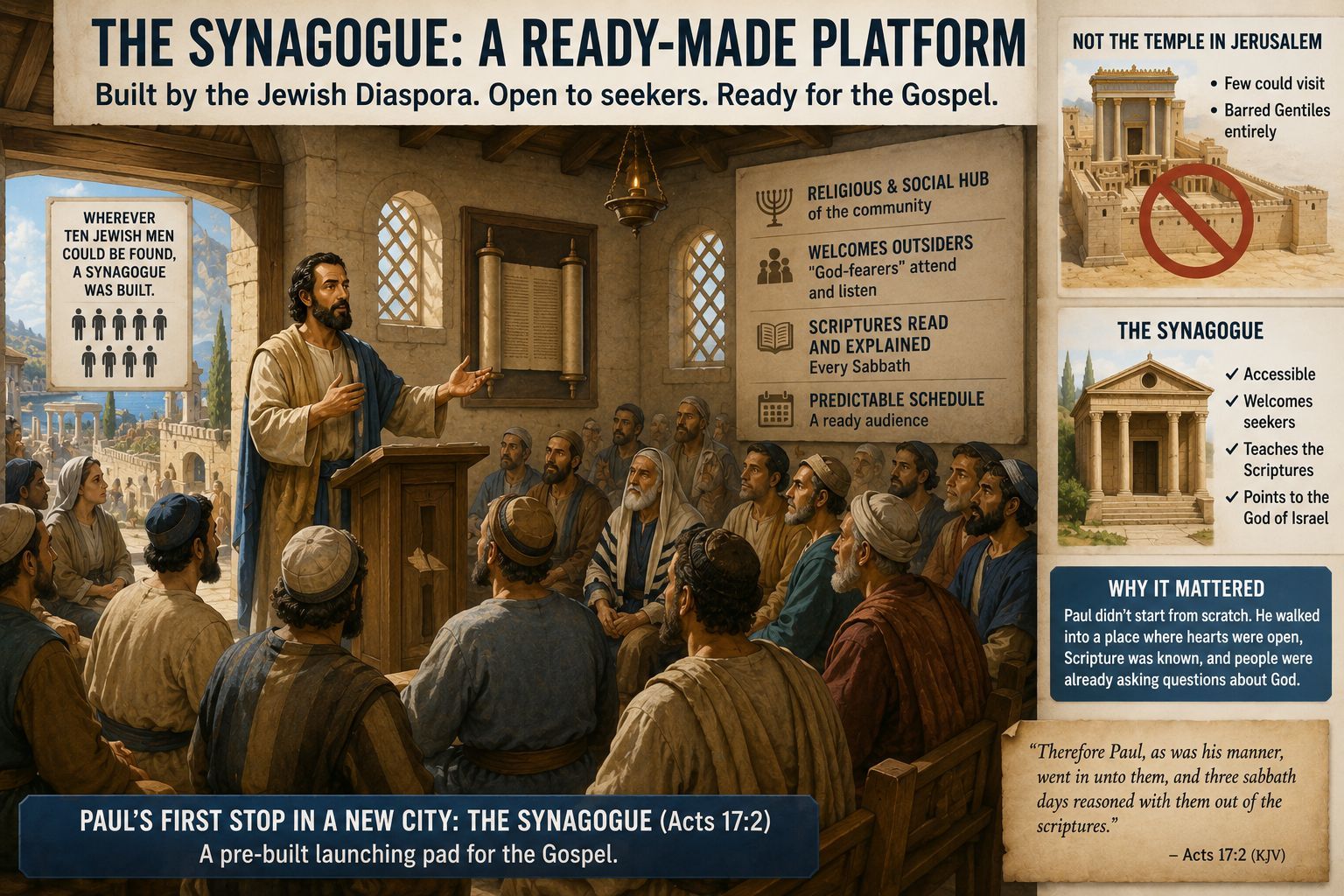
Wherever ten Jewish men could be found, a synagogue was built, and it quickly became the community's religious and social hub. Unlike the Temple in Jerusalem, which few Diaspora Jews could ever visit and which barred Gentiles entirely, the synagogue welcomed outsiders. Gentiles who were drawn to Jewish belief and ethics, but unwilling to fully convert, attended synagogue services as "God-fearers." This gave Paul something invaluable: a standing room with an audience already interested in the God of Israel, already literate in the Scriptures, and already gathered on a predictable schedule. When Paul entered a new city, his first stop was almost always the synagogue (Acts 17:2), because it was, in effect, a pre-built launching pad for his message.
A public example of devotion
The Jewish observance of the Sabbath was famously uncompromising. Jews would suffer death rather than fight on the Sabbath, and this level of public, unembarrassed devotion left a deep impression on the surrounding pagan culture. In a world full of casual, transactional religion, this kind of visible seriousness stood out. It meant that when Paul spoke of a God worth taking seriously, worth reordering one's life around, he wasn't introducing a foreign concept. The Diaspora Jews had already demonstrated, for generations, in public that such devotion was possible and admirable.
A Bible everyone could already read
By Paul's time, most Diaspora Jews no longer spoke Hebrew; Greek was their daily language. This necessity produced the Septuagint (LXX), a Greek translation of the Old Testament completed centuries earlier in Alexandria. It was read aloud in synagogues every Sabbath and had become the Bible of Jesus and the apostles. For Paul, this was enormous. He didn't need to translate Scripture or explain it to an audience encountering it for the first time. The Hebrew Scriptures, in Greek, had already been in the ears of God-fearing Gentiles for years. Paul could simply open to a text, as he did in synagogue after synagogue, and reason from Scripture his listeners already recognized.
A God who made intellectual sense
The Greco-Roman world was crowded with gods, most of them petty, immoral, and unworthy of respect. Thoughtful Greeks, especially those exposed to philosophy, had grown skeptical of the Olympian pantheon and were searching for something more coherent. Judaism offered exactly that: one God, Creator of heaven and earth, both transcendent and personal, both just and merciful. Diaspora Jews, and scholars like Philo of Alexandria, had spent generations making this monotheism intellectually respectable to a Greek audience. Paul walked into cities where educated people had already been primed to consider the idea of one true God as a serious alternative to polytheism, rather than an alien notion he had to introduce cold.
A visible model of a different way to live
Roman society, as Paul himself describes in Romans 1, was marked by rampant immorality, broken families, and casual cruelty, including widespread divorce and infanticide. Against this backdrop, Jewish family life stood in sharp contrast: low divorce rates, strong father-led instruction in the Law, valued children, and severe consequences for adultery. Gentiles disillusioned with the moral decay around them had a living example, in the Jewish community next door, that a different, more stable way of life was possible. When Paul preached a gospel that came with ethical transformation attached, he was pointing to something people had already seen work.
A
hope people were already waiting for
Perhaps most significantly, the Greco-Roman world was gripped by a widespread longing for a deliverer. Neither Greek philosophy nor Roman statecraft had managed to fix society's deep problems, and ordinary people were left waiting for someone who could offer real hope. Judaism had, for centuries, proclaimed the coming of a Messiah: a Prophet, Priest, and King who would establish a kingdom of justice and peace. This expectation wasn't vague. It was clearly outlined in Scriptures the Diaspora had already been publicizing for generations. When Paul arrived proclaiming that this Messiah had come, he wasn't introducing a new hope. He was answering a question the ancient world was already asking.
The real explanation
Put together, these six factors explain why Paul could move so fast. He never had to build an audience, translate a Bible, invent a moral vision, or manufacture a longing for salvation. The Diaspora synagogue system had already assembled interested Gentiles in one place; the Sabbath had already modeled public devotion; the Septuagint had already put Scripture in their hands and ears; centuries of apologetic work had already made monotheism intellectually credible; Jewish family life had already demonstrated a livable moral alternative to pagan corruption; and messianic expectation had already primed people to hope for exactly the kind of deliverer Paul proclaimed.
Paul didn't start from zero in any city he entered. He walked into communities that Judaism had spent hundreds of years quietly preparing, and he simply proclaimed that the long-awaited answer had arrived in Jesus Christ. That, more than any strategy or personal gift of Paul's, is why churches could spring up so quickly across the Roman world.
Based on: J. Herbert Kane
Christian Missions in Biblical Perspective, pp. 30-33