The Strategy Tyrants Cannot Stop
Reaching Creative Access Countries Through
Discipleship and Multiplication
Voices from the Front Lines
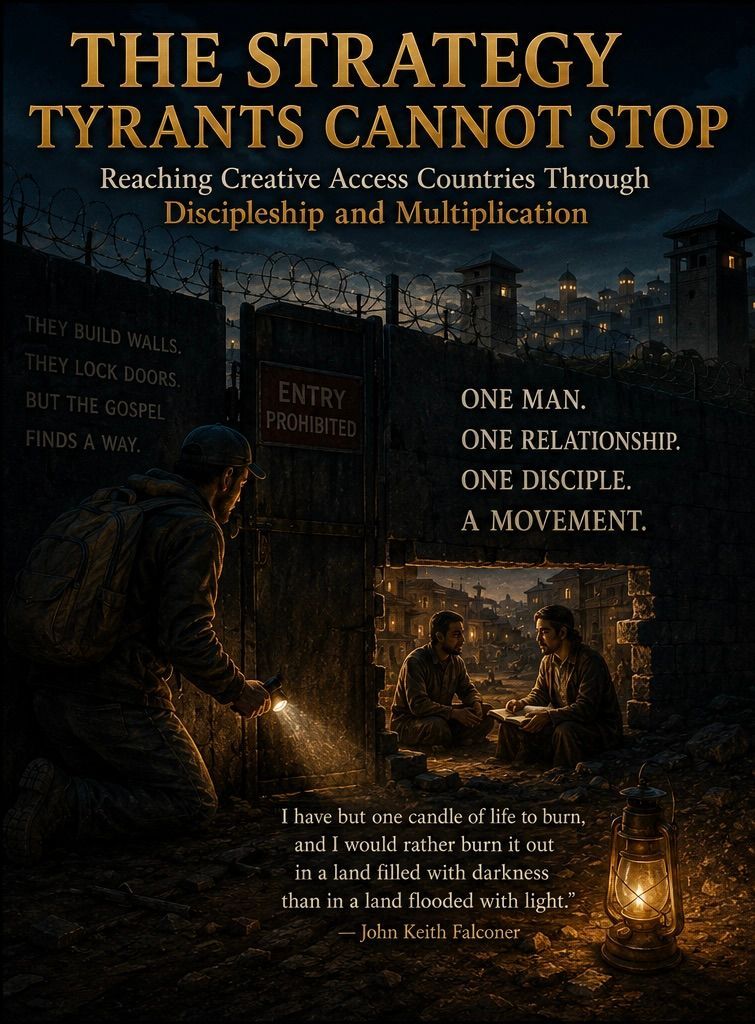
I have but one candle of life to burn, and I would rather burn it out in a land filled with darkness than in a land flooded with light. John Keith Falconer
If Jesus Christ be God and died for me, then no sacrifice can be too great for me to make for Him.
C.T. Studd
And people who do not know the Lord ask why in the world we waste our lives as missionaries. They forget that they too are expending their lives... and when the bubble has burst they will have nothing of eternal significance to show for the years they have wasted. Nate Saint
The more obstacles you have, the more opportunities there are for God to do something. Clarence W. Jones
We who have Christ's eternal life need to throw away our own lives. George Verwer
Some wish to live within the sound of church and chapel bell. I wish to run a rescue mission within a yard of hell. C.T. Studd (1862–1931)
When the Door Is Locked, Look for a Window
They call them Creative Access Countries now. Governments close borders, ban missionaries, and pass laws against conversion. Tyrants build walls and congratulate themselves on keeping Christ out. But they have never been able to stop what God started on a hillside in Galilee with twelve ordinary men.
The terminology may be new, but the situation is ancient. Closed doors have always been part of the missionary reality. What missionaries face today in restricted nations is not a new problem. It is an old problem that demands a return to an old strategy, the very strategy Jesus used to turn the world upside down.
Here is the truth that changes everything: a closed country does not require a different strategy. It requires the same strategy executed with greater wisdom and deeper commitment. Jesus never built His mission on mass meetings. He built it on men.
The Greatest Missionary and His Method
The greatest missionary who ever walked this earth was Jesus Christ Himself. And He did not storm Jerusalem with stadiums full of people, though He could have. He did not build an empire on public spectacle, though crowds followed Him everywhere. He chose twelve men. He poured Himself into them. He lived with them, ate with them, corrected them, taught them, and then sent them out to do what He had done.
Eleven of those men shook the entire world when He left. One betrayed Him. The math still speaks for itself.
Read what Mark records: "And he ordained twelve, that they should be with him, and that he might send them forth to preach."
The order matters. First, with Him. Then, sent out. The training preceded the sending. The relationship preceded the results. Jesus did not mass-produce disciples. He made them, one at a time, up close and personal.
In a Creative Access Country, that method is not a limitation. It is your greatest advantage. A missionary slipping quietly into a relationship with one man draws far less attention than a crowd of a thousand singing in an open field.
Closed Countries Are Not New
Do not let the phrase Creative Access Country fool you into thinking this is a modern dilemma requiring a modern solution. Israel itself was a fairly closed country in the days of the early church. Rome was hostile. Asia Minor was unpredictable. The Roman government imprisoned Paul. The Jewish leaders stoned Stephen. Herod killed James.
And the Gospel spread anyway. Not because the missionaries found a loophole in Roman law. It spread because one person told another, and that person told another, and the chain of witness ran underground through homes and workshops and prison cells and marketplaces until it reached the emperor's own household.
Tyrants have always underestimated the Gospel precisely because they think in terms of armies, borders, and declarations. The Gospel travels in relationships. You cannot sanction a friendship. You cannot deport a faith that lives in a man's chest.
The Answer Has Always Been Discipleship
"And the things that thou hast heard of me among many witnesses, the same commit thou to faithful men, who shall be able to teach others also." II Timothy 2:2
Paul wrote those words to Timothy from a Roman prison. He was not writing from a position of success and comfort. He was writing from chains. And what he gave Timothy was not a marketing strategy or a church growth plan. He gave him a multiplication principle.
Four generations live in that one verse. Paul to Timothy. Timothy to faithful men. Faithful men to others also. That is how the Gospel outruns every border patrol and every government crackdown that has ever existed.
The missionary who enters a Creative Access Country does not need a pulpit. He needs a friend. Find one man. Invest in him deeply, the way Jesus invested in the Twelve. Not a nominal Christian who attends a service and shakes your hand. A faithful man, someone capable of leading a ministry for the Lord, someone who will carry what you pour into him and pour it into others.
That is not settling for less. That is the highest form of missionary work there is.
We Have Been Measuring the Wrong Things
Here is a hard truth. Our goals have been wrong.
We have wanted the great crowds. We have wanted the big churches, the impressive numbers, the reports that make the mission board newsletter look exciting. We have measured success in thousands when Jesus measured it in twelve. And then in eleven, because one chose silver over the Son of God.
But look at what those eleven accomplished. They carried the Gospel to the edges of the known world. They wrote documents we still read two thousand years later. They died for what they believed because they had seen the risen Christ and nothing could make them unsee Him.
Jesus did not want to reach a crowd and move on. He wanted men who would keep moving after He was gone. That is the difference between addition and multiplication. Addition adds. Multiplication compounds. A missionary who leads a hundred people to Christ and disciples none of them may leave behind less lasting fruit than a missionary who pours three years into one faithful man who then pours three years into another faithful man who then does the same.
In a Creative Access Country, this is not just the preferred strategy. It is the only viable one. You cannot build a mega-church behind closed borders. But you can build a movement.
Multiplication Is the Mathematics of the Kingdom
The early church understood something that we keep having to relearn. One becomes two. Two becomes four. Four becomes sixteen. The math that feels slow at the beginning becomes unstoppable at the end.
A missionary entering a restricted nation with the mindset of a disciple-maker asks different questions than one focused on public proclamation. He asks: Who is open? Who is hungry? Who has influence in his community? Who will still be here when I have to leave?
He is not looking for a crowd. He is looking for a Timothy. And when he finds a Timothy, he gives him everything. Not just theology. Not just Bible knowledge. But the whole life of faith, the wrestling with God, the learning to hear His voice, the discovery of what it means to live as a son who is loved, not as a servant earning wages.
That Timothy will train another faithful man. And the chain Paul described from a Roman prison will run through a Creative Access Country until the day Christ returns, and no tyrant born of woman will be able to stop it.
Practical Wisdom for Difficult Places
None of this means throwing caution to the wind. Jesus Himself told His disciples to be wise as serpents and harmless as doves. In a Creative Access Country, discretion is not cowardice. It is wisdom that protects the people you love and the work God has called you to build.
The missionary in a restricted nation must think carefully about how to put discipleship into practice without painting a target on himself or his disciples. But the strategy itself does not change. One to one. Faithful to faithful. Generation to generation. The container must adjust to the context. The contents remain the same: the Gospel that turned the Roman Empire inside out from a handful of Galilean fishermen.
Clarence Jones was right. The more obstacles you have, the more opportunities there are for God to do something. A closed door has never been the end of the story. It has always been the beginning of a better chapter.
One Candle Is Enough
John Keith Falconer wanted to burn his one candle in the darkest place he could find. That is the heart of the missionary calling, and it has not changed because a government stamped a visa denied on a passport application.
Tyrants close countries. God closes nothing. He simply changes the method of entry.
Find your Timothy. Pour your life into him. Teach him to do the same. And trust that the same God who walked out of a sealed tomb can walk through any border He chooses.
The darkness does not extinguish the candle. The candle exposes the darkness.
Followed by Mercy