The Men Who Learned to Sound Like Their Teacher
Passing the Torch: How God Multiplies Ministry Through Relational Discipleship
Here's something I've noticed after more than fifty years in ministry. God rarely does His best work through one man standing alone. He almost always does it through a man and the men walking beside him.
Look back through the Bible, and you'll see it again and again. A leader doesn't just do the work. He carries someone with him while he does it. That younger man watches, learns, fails sometimes, gets back up, and eventually steps into the work himself. The leader passes. The work doesn't.
That's not an accident. That's the pattern.
A Pattern Older Than Any of Us
Moses didn't train Joshua with a seminar. He trained him by keeping him close for forty years.
While Moses spoke with God face to face,
"as a man speaketh unto his friend,"
Joshua was there too. Scripture says Moses would return to the camp,
"but his servant Joshua, the son of Nun, a young man, departed not out of the tabernacle" (Exodus 33:11).
Joshua didn't just hear about the presence of God. He stayed in it, long after everyone else had gone home.
By the time Moses laid his hands on him, nothing about leading Israel was new to Joshua. He had already been living it.
"Joshua the son of Nun was full of the spirit of wisdom; for Moses had laid his hands upon him: and the children of Israel hearkened unto him" (Deuteronomy 34:9).
Moses died. The work didn't miss a step.
The Boy Who Grew Up in the Temple
Samuel's story starts even younger. His mother brought him to the temple as a small child and left him there to grow up under Eli, learning to serve the Lord before he could have explained what that even meant.
"The child did minister unto the LORD before Eli the priest" (1 Samuel 2:11).
Eli wasn't perfect, and his own sons broke his heart. But the boy who grew up watching him minister became the prophet who led Israel through one of its hardest transitions, from the days of the judges into the days of kings.
Nobody handed Samuel a manual. He learned by being there.
Ask for a Double Portion
Elisha followed Elijah so closely that Scripture describes him as the one who
"poured water on the hands of Elijah" (2 Kings 3:11)
the ordinary, unglamorous posture of a servant staying near his master.
When the day came for Elijah to be taken up, Elisha didn't ask for a title. He asked for something far bigger.
"I pray thee, let a double portion of thy spirit be upon me" (2 Kings 2:9).
He had walked with Elijah long enough to know exactly what he wanted more of.
When the mantle fell, and Elisha picked it up, the sons of the prophets watching from a distance said,
"The spirit of Elijah doth rest on Elisha" (2 Kings 2:15).
The prophetic work didn't belong to one man. It moved through the schools of prophets who trained under both of them, generation after generation.
He Called Them to Be With Him
Then Jesus came, and He did the very same thing, only in person, in the flesh, for three years.
"He ordained twelve, that they should be with him" (Mark 3:14).
Before anything else, before preaching, before miracles, before sending them out, He wanted them with Him. He ate with them, walked dusty roads with them, explained the parables to them in private, let them watch Him pray, let them watch Him weep, let them watch Him love people the religious crowd had given up on.
When He left, the church was small. A handful of frightened, ordinary men in an upper room. But the foundation was laid, because those men had lived close enough to Jesus to know how He did things. What began with twelve men in Jerusalem eventually reached the whole world, not because the strategy was clever, but because the pattern held. Someone poured into them. They poured into others.
Why Was Paul Never Alone?
You'd expect the great apostle Paul, of all people, to eventually work alone. He didn't. It's almost impossible to find him by himself.
Look at how many of his letters open:
"Paul, called to be an apostle of Jesus Christ through the will of God, and Sosthenes our brother" (1 Corinthians 1:1).
"Paul, an apostle of Jesus Christ by the will of God, and Timothy our brother" (2 Corinthians 1:1).
"Paul and Timotheus, the servants of Jesus Christ" (Philippians 1:1).
"Paul, and Silvanus, and Timotheus" (1 Thessalonians 1:1).
Eight of his letters begin this way: Paul's name, and then someone else's, standing right beside him. He calls Timothy his "workfellow" (Romans 16:21). Not his assistant. Not his intern. His fellow laborer.
Paul understood something we forget. The work God gives us was never meant to be carried by one set of shoulders.
The Son He Could Send
Of everyone who traveled with Paul, no one is mentioned more than Timothy at least seventeen times by name. Paul calls him
"my dearly beloved son" (2 Timothy 1:2),
and he knew Timothy's family well enough to remember his grandmother Lois and his mother Eunice by name (2 Timothy 1:5).
From the moment Paul met him in Lystra, the two of them were rarely apart (Acts 16:1-4). And when they were apart, it was only because Paul had sent Timothy somewhere on his behalf. The word Scripture uses for "sent" means something specific to send a person off with authority to do exactly what the sender would have done himself.
That's why Paul could write to the
Corinthians,
"I have sent unto you Timotheus, who is my beloved son, and faithful in the Lord, who shall bring you into remembrance of my ways which be in Christ, as I teach every where in every church" (1 Corinthians 4:17).
Timothy had lived close enough to Paul, long enough, that watching Timothy work reminded people of Paul.
That's also what Paul meant when he told the
Corinthians,
"If Timotheus come, see that he may be with you without fear: for he worketh the work of the Lord, as I also do" (1 Corinthians 16:10).
As I also do. Timothy wasn't imitating a performance. He had genuinely absorbed the way Paul lived and served, the way a son picks up his father's mannerisms without ever trying to.
Isn't That Making Too Much of a Man?
Maybe that unsettles you a little. Maybe you're thinking, shouldn't we only look to Jesus? That instinct is right. Paul thought so too.
But notice what Paul told young Timothy to do with his own life:
"Be thou an example of the believers, in word, in conversation, in charity, in spirit, in faith, in purity" (1 Timothy 4:12).
And Peter said the same thing about Jesus Himself: He left us
"an example, that ye should follow his steps" (1 Peter 2:21).
The word translated "example" there is rich. It carries the idea of an impression left by a strike or a stamp the mark that shows exactly what made it, the pattern someone else can be shaped by. Paul wanted Timothy to carry that kind of impression of Christ, so plainly that when people watched Timothy, what they were really seeing, underneath it all, was Jesus.
That's not putting a man in Christ's place. That's what it looks like when a man has walked with Christ long enough for the resemblance to show.
What This Means for You
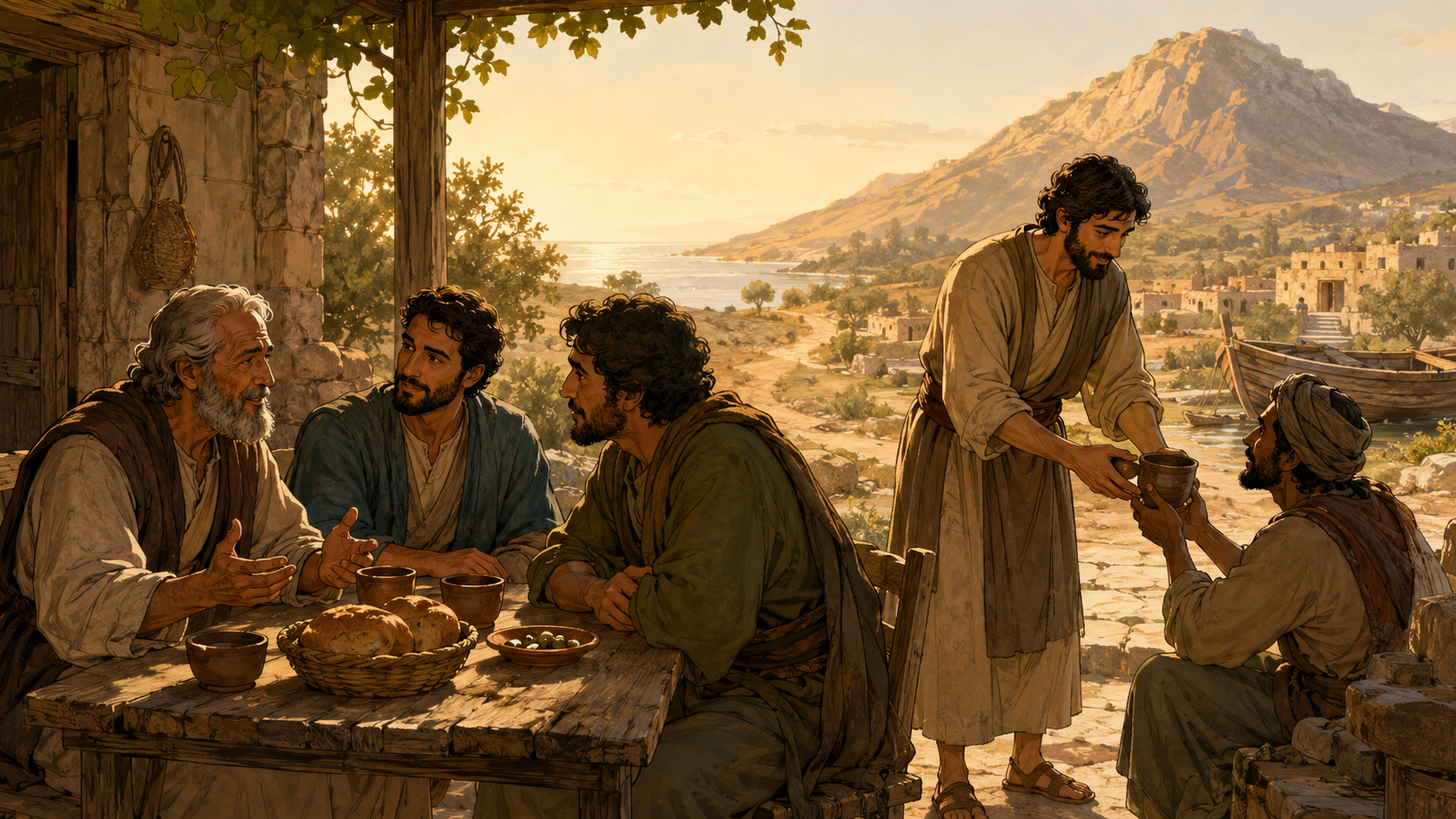
None of this happened through a class, a conference, or a curriculum. It happened around a table. On a road. In a boat. Waiting in a temple. Standing near a mountain. Watching someone else do the work faithfully, long enough for it to start to grow in you too.
That's still how God works. He rarely drops His calling on you out of nowhere and leaves you to figure it out alone. More often, He puts a few people in your life someone a little further down the road than you, and maybe someone a little further behind and something passes between you that no class could ever teach.
You don't have to force that. You don't have to go manufacture a mentor or an apprentice by Friday. Just stay close to the people God has already put near you. Watch how they love others. Let them watch you. Somewhere in that ordinary nearness, without either of you trying very hard, the Father does what He's always done: He hands His work from one loved son to the next.