
Wanted: Men!
What Elisha's Call Teaches Us About God, Discipleship, and Disciple-Making
There's a story told about a mission society in South Africa that wrote to David Livingstone: "Have you found a good road to where you are? If so, we want to know how to send other men to join you." Livingstone answered: "If you have men who will come ONLY IF THEY KNOW THERE IS A GOOD ROAD, I don't want them. I want men who will come if there is NO road at all."
That's the kind of man God went looking for in 1 Kings 19:19-21. He found him behind a plow.
The Setting
Elijah has just come off Mount Carmel, then collapsed under a juniper tree wanting to die. God meets him not with a rebuke but with food, rest, and a whisper, and then with an assignment: go anoint Elisha to take your place. Elijah finds him plowing with twelve yoke of oxen, throws his mantle over him, and walks on. What happens next, in three short verses, is a case study in how God makes a man of God.
What It Shows About God
God doesn't build His work on the exceptional man He plucks from nowhere; He builds it on the willing man He calls out of an ordinary field. Elisha wasn't a prophet-in-training or a temple servant. He was a farmer, and by the size of his herd, a wealthy one. God doesn't need talent as much as He needs availability. He is still, today, walking through ordinary fields, dropping a mantle on ordinary shoulders.
Notice too what God does
not do. He doesn't explain the whole plan. He doesn't promise comfort, credit, or an easy road. He simply calls, and lets the man decide what he's willing to leave behind. That's how God has always worked with Abraham, with the disciples at the seaside, with Elisha at the plow. The call is clear; the cost is not concealed.
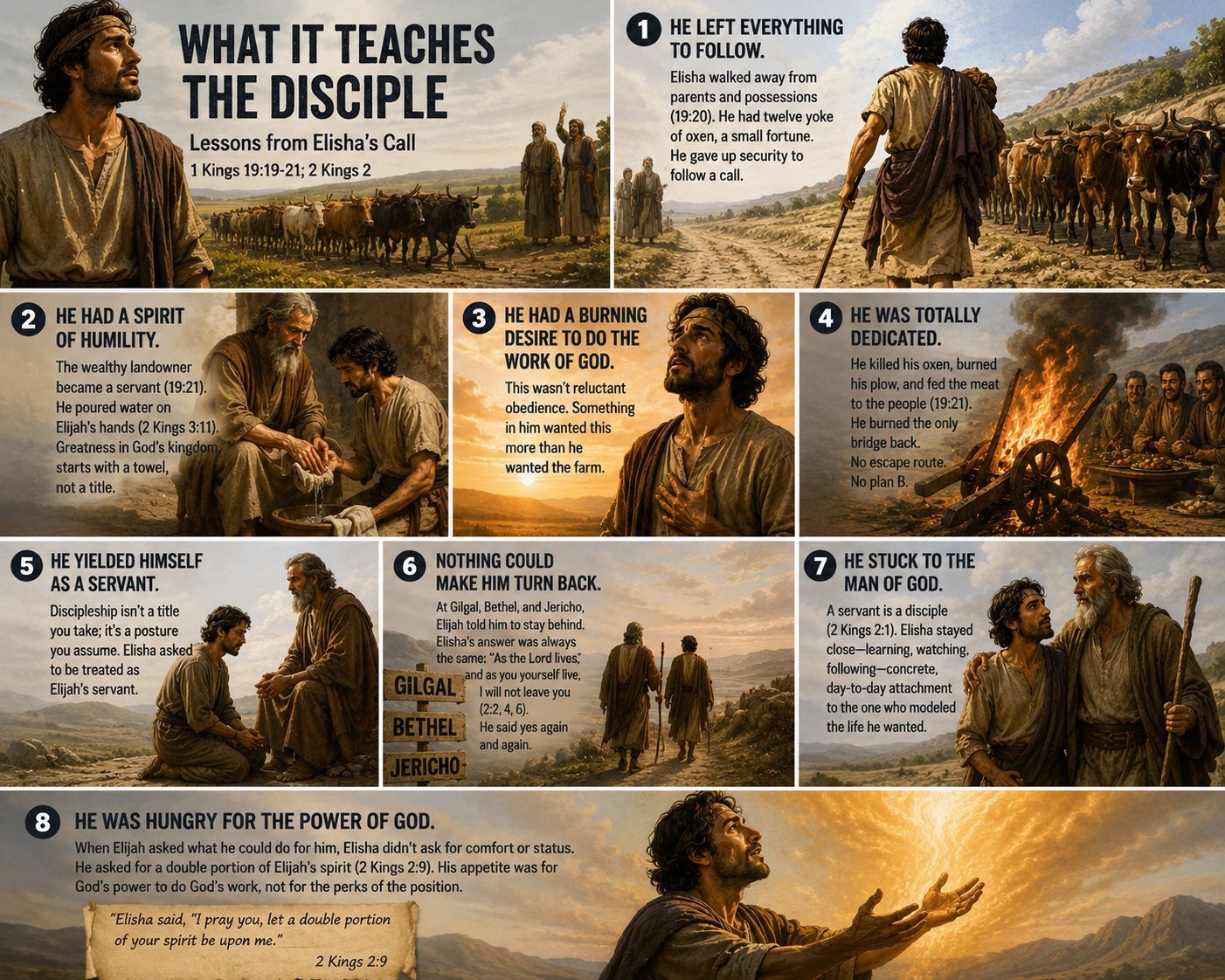
What It Teaches the Disciple
He left everything to follow. Elisha walked away from parents and possessions (19:20). This wasn't a man with nothing to lose; he had twelve yoke of oxen, a small fortune in that economy. He gave up security to follow a call.
He had a spirit of humility. The wealthy landowner became a servant. Verse 19:21 says he "ministered" to Elijah, the same word used later in 2 Kings 3:11, where he's described as the one "who poured water on the hands of Elijah." The man who owned twelve yoke of oxen was now washing another man's hands. Greatness in God's kingdom starts with a towel, not a title.
He had a burning desire to do the work of God (19:20). This wasn't reluctant obedience. Something in him wanted this more than he wanted the farm.
He was totally dedicated. He killed his oxen, burned his plow, and fed the meat to the people (19:21). That's not a man hedging his bets; that's a man burning the only bridge back. No escape route. No plan B. When he said yes, he meant it with everything he owned.
He yielded himself as a servant (19:21). Discipleship isn't a title you take; it's a posture you assume. Elisha didn't demand to be treated as Elijah's successor. He asked to be treated as his servant.
Nothing could make him turn back. Later, in 2 Kings 2, when Elijah repeatedly tells Elisha to stay behind at Gilgal, Bethel, and Jericho, Elisha's answer is the same each time: "As the Lord lives, and as you yourself live, I will not leave you" (2:2, 4, 6). Persistence under repeated testing is the real proof of a call. It's easy to say yes once. Elisha said yes again and again.
He stuck to the man of God. A servant is a disciple (2 Kings 2:1). Elisha's discipleship wasn't abstract devotion to an idea; it was concrete, day-to-day attachment to a person who modeled the life he wanted.
He was hungry for the power of God. When Elijah finally asked what he could do for him before being taken up, Elisha didn't ask for comfort or status. He asked for a double portion of Elijah's spirit (2 Kings 2:9). His appetite was for God's power to do God's work, not for the perks of the position.
What It Teaches the Disciple-Maker
Elijah's side of this story matters just as much. He didn't recruit Elisha with a sales pitch. He threw a mantle on him and kept walking — leaving Elisha to count the cost and choose. A disciple-maker's job isn't to make the road look easy; it's to make the call clear and then let the mantle do its work.
Elijah also let Elisha serve him for years before Elisha ever led anything. Discipleship has a shape: it starts with pouring water on someone else's hands. Elijah tested him too at Gilgal, Bethel, and Jericho not to discourage him, but to let his commitment prove itself. And in the end, Elijah gave what he had: not just information, but his presence, his example, and eventually his mantle.
The Result
By the time we reach 2 Kings, the outcome of that faithfulness is unmistakable. Elisha lived in the presence of God (3:14) — his life was marked by nearness to the Lord, not just knowledge about Him. And it was obvious to everyone around him that he carried God's power (2:15): when the sons of the prophets saw him part the Jordan, they said, "The spirit of Elijah rests on Elisha." Nobody had to argue the point. The evidence spoke for itself.
The Call Still Stands
God is still looking for the same kind of man He found at the plow: one who will leave what's comfortable, serve before he leads, burn the bridges behind a real decision, refuse to turn back when tested, and hunger for God's power more than God's position. Livingstone had it right: God isn't looking for men who need a good road. He's looking for men who will come even when there isn't one.
Wanted: men.