The Church Owns the Commission
Why Every Local Church Must Carry the World on Its Heart
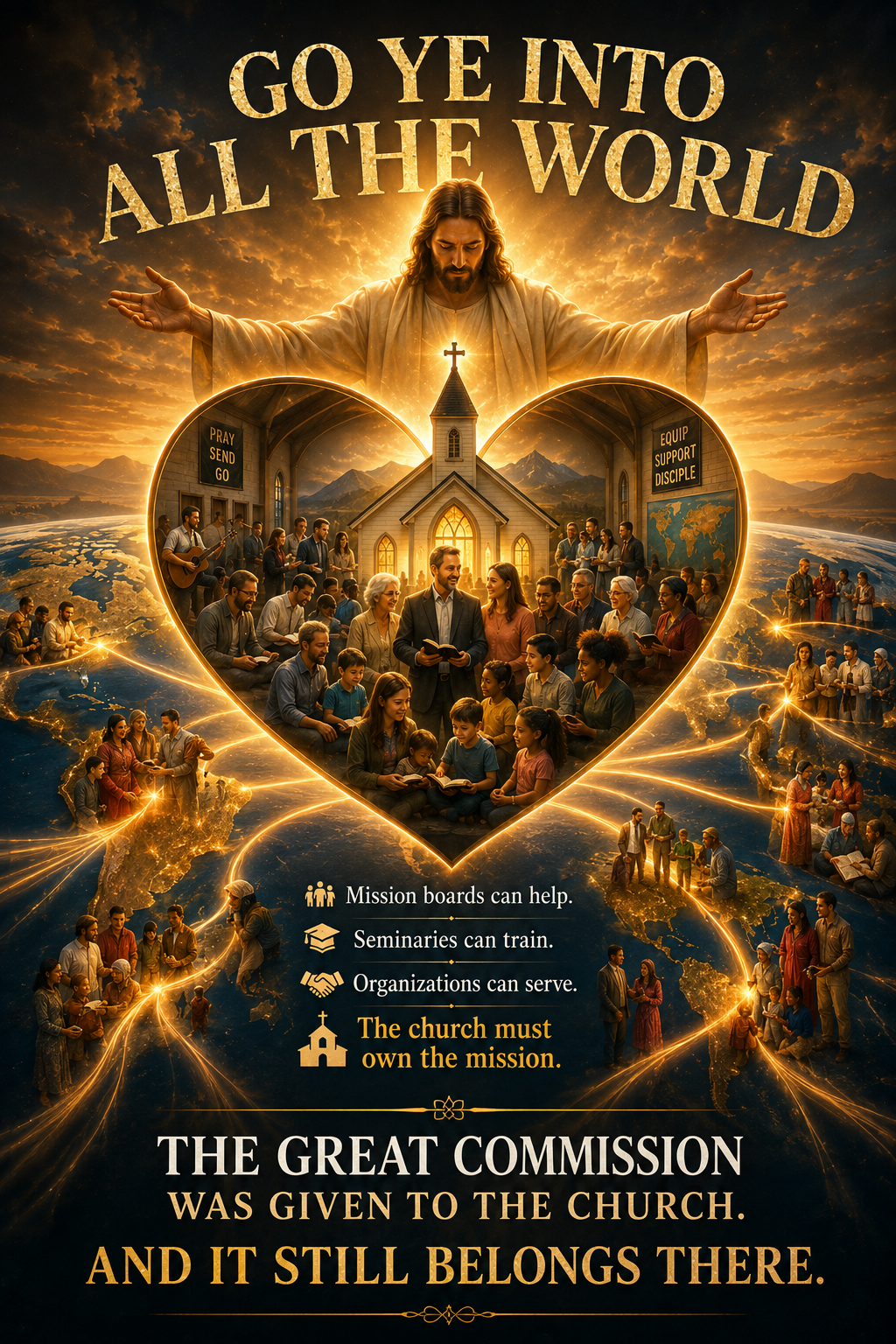
Say amen if you have ever assumed that world missions is somebody else's job.
We have handed the Great Commission to mission boards. We have delegated it to denominations. We have enrolled it in Bible colleges and sent it off with a tuition check. And somehow, in all that delegation, the local church has stepped back from the very assignment Jesus placed directly in its hands.
That assignment has never changed. And it was never transferred.
"Go ye therefore, and teach all nations, baptizing them in the name of the Father, and of the Son, and of the Holy Ghost: Teaching them to observe all things whatsoever I have commanded you: and, lo, I am with you alway, even unto the end of the world." Matthew 28:19-20
Jesus spoke those words to His church. Not to a board. Not to an organization. Not to an institution. To His people, gathered together, bearing His name. That means you. That means your church. That means now.
The Commission Belongs to the Church
Here is a truth every pastor and congregation must come to grips with: God did not give the Great Commission to the mission board. He did not give it to the denomination. He did not give it to the seminary or the Bible college. He gave it to the church.
Mission boards, denominations, and training institutions can serve the church in this great task. They are tools. They are resources. But they are not the owner of the Commission. The church is.
That distinction matters more than most of us realize. When a church treats world missions as something happening over there, managed by someone else and funded by a line item in the budget, the heart of the Commission has already been lost. When the church wakes up and says, 'This is our responsibility,' everything changes.
Every pastor must get a world vision. Every congregation must feel the weight of the world. Not as a burden that crushes, but as a calling that defines who you are as the people of God.
"But ye shall receive power, after that the Holy Ghost is come upon you: and ye shall be witnesses unto me both in Jerusalem, and in all Judaea, and in Samaria, and unto the uttermost part of the earth." Acts 1:8
Jesus did not say the denomination would be His witnesses. He said you would be. Come on. That is not a metaphor. That is a mandate.
What a World-Vision Church Actually Does
So what does it look like when a local church takes this seriously? It looks different from what many of us have practiced. It is not merely mailing support checks and praying over a missionary bulletin board. It is intentional, strategic, and personal.
A church with genuine world vision does several things.
First, it prepares missionaries and sends them out from its own people. Not just supports missionaries sent by someone else; it identifies, trains, commissions, and sends from within its own congregation. That is the New Testament model. The church at Antioch did not apply to a mission board. They fasted, prayed, and sent Paul and Barnabas from their own fellowship.
Second, it develops its own strategy for reaching the world. Every church is different. Every congregation has unique gifts, relationships, financial capacity, and calling. A one-size-fits-all approach does not exist. The church that takes the Commission seriously sits down, prays hard, and asks: 'How can we, with what God has given us, reach the nations?'
Third, it thinks in terms of key men in key cities with key materials. Reach the cities, and you reach the regions. Reach the regions, and you reach the nations. Strategic thinking is not unspiritual -- it is faithful stewardship of the opportunity God has given.
Fourth, it structures for the task. This might mean identifying a key director for each continent, then a leading man in each country, then a plan for that man to reach his country with the support, supplies, and freedom he needs to get the job done. A church willing to think this way can accomplish what mission boards have accomplished. Do not let anyone tell you otherwise.
And fifth, and this part matters: it stays out of the way and lets God use the man. Micromanagement kills mission work. Send the right person, supply what he needs, pray without ceasing, and trust God to do what only God can do.
The Burden Must Pass to Every Pew
Here is the part that cannot be shortcut. A world vision does not live only in the pastor's study. It must be breathed into every member of the congregation until every person feels personally responsible for the world.
The pastor who carries this alone will eventually burn out or give up. But the church where every believer understands that they are accountable to God for the world that church becomes unstoppable.
How does that happen? It happens through preaching that keeps eternity in view. It happens through testimonies that put faces on the nations. It happens through prayer meetings where people cry out for countries they have never visited. It happens when missions is not a department of the church but the DNA of the church.
"The harvest truly is plenteous, but the labourers are few; Pray ye therefore the Lord of the harvest, that he will send forth labourers into his harvest." Matthew 9:37-38
Jesus said pray for laborers. Not staff positions. Not organizational charts. Laborers. Men and women set on fire by God and sent into the harvest. That is what your church should be producing.
The Picture That Should Keep Us Awake
In his book 'Wanted: World Christians,' author J. Herbert Kane paints a picture that every believer in a comfortable church needs to see. He describes a painting in two parts.
On one side, a large round table with three place settings: father, son, daughter. The table overflows with food. Every kind of meat and vegetable. Fried, baked, and mashed potatoes. Pastries, pies, ice cream, fresh fruit. Cokes, Sprites, Mountain Dews, coffees, and cocoa. A feast.
On the other side, another table with nine place settings: mother and eight children. At each place: a glass of water, a bowl of soup, and a crust of bread.
Kane calls this painting 'The American Family at Dinner.' And then he says, "You would walk up to that picture and shake your head." 'That is a lie,' you would say. 'No American family combines that kind of wealth and that kind of poverty. Rich families share their riches. Poor families share their poverty. But not this.' And you would be right. The picture is a lie about the American family.
But Kane says he would simply change the title. Call it 'The Human Family at Dinner.' And suddenly the picture is not a lie at all. That is precisely how the human family lives: part in poverty that beggars description, part in wealth that borders on the obscene.
Friend, that picture should do something to you.
We sit at tables loaded with spiritual food. We have Bibles in multiple translations. We have churches on every corner. We have Christian radio, television, podcasts, and apps. We have access to more gospel content than any generation in human history.
And there are still billions at a table with a crust of bread.
God will not ask the mission board what it did with the world. He will ask the church. He will ask you.
The Grace That Sends
Here is what I want you to understand about all of this. A church that truly knows what God has done for it in Jesus Christ cannot keep that to itself. You cannot know the grace of the cross, the staggering reality that God loved the world enough to give His only Son and then live as though the world outside your church does not matter.
Mission is not a guilt trip. It is a grace response.
When you know who you are in Christ fully loved, fully forgiven, fully accepted, full of His life and His Spirit, you do not serve the world to earn something. You go to the world because the God who sent His Son to you is the same God who loves every nation, tribe, tongue, and people. And you carry His name.
"For God so loved the world, that he gave his only begotten Son, that whosoever believeth in him should not perish, but have everlasting life." John 3:16
The word 'world' in that verse is not an abstraction. It is people. Real people. Hungry people. Lost people. People at a table with a crust of bread and no knowledge of the One who called Himself the Bread of Life.
Your church can do something about that. Not everything. But something. And the God who multiplied five loaves and two fish to feed thousands is still in the business of doing more with less than anyone thought possible.
What to Do This Week
Let this land somewhere practical. Here are a few steps any church can take to begin living out this responsibility.
Pray. Start with a serious, sustained prayer meeting for the nations. Get a map. Put up names. Get on your knees. Let the Spirit of God break your heart for what breaks His.
Look in your own congregation. Who among your people has a burden for a particular country or people group? Who has skills, languages, relationships, or gifts that could be deployed for the kingdom? You may already have missionaries sitting in your pews who just need someone to call them out.
Build a strategy. It does not have to be complicated. Start with one country. One person. One plan. One support structure. Grow from there.
Teach the Commission from the pulpit. Preach it until every member feels it. Until the missions offering is not an obligation but an act of worship. Until the missionary prayer letter is not junk mail but a lifeline connecting your congregation to the front lines of the kingdom.
And then do this: stay responsible. Do not delegate away what God gave you. The mission board can help. The denomination can support. The Bible college can train. But the church must own it.
Frequently Asked Questions
Q: Our church is small. How can we take on world missions?
Start where you are. One missionary, one country, one consistent partnership. The church at Antioch was not the largest church in the world. It was the most obedient. God honors faithfulness, not size.
Q: Should we stop giving to mission boards?
No. Mission boards can be wonderful partners and resources. The point is stewardship and ownership. Use every tool available -- but never forget that the responsibility belongs to you, not to the tool.
Q: What if our pastor does not seem interested in missions?
Pray for him. Ask God to give him the world vision. Then find ways to bring the world into his line of sight -- invite missionaries to speak, share reports, pray openly for the nations. Vision is often caught before it is taught.
Q: How do we keep missions from feeling like guilt?
Root it in grace. The church goes to the world not to earn God's approval but because it already has it. You do not support missionaries because God will love you more if you do. You support them because you love the God who sent His Son for every nation, and you want to join what He is doing.
#GreatCommission #WorldMissions #LocalChurch #ChurchResponsibility #MissionaryCall #GraceAndMissions #EveryNation #ChristianLiving #GospelToTheWorld #WaustinGardner