THE PASTOR'S RESPONSIBILITIES
Building the Model the World Will Follow
Everything Falls on the Pastor
If we are local church people and truly believe that God has ordained the local church as His chosen instrument to evangelize the world, then we cannot escape a sobering conclusion: the great weight of world evangelism rests on the shoulders of the pastor. Not the mission board. Not the denomination. Not the Bible college. The pastor.
This is not a popular thought in an age that prefers shared responsibility and diffused accountability. But Scripture consistently places the burden of the flock, and the flock's mission, on the man God has called to shepherd it. If the pastor does not carry the vision for world evangelism, his church will not carry it either. Committees do not create passion. Programs do not create burden. A pastor's own conviction does.
The Home Church Is the Standard for the Field
Every missionary who leaves a church carries that church with him. He does not invent a new definition of “church” once he arrives on the field; he reproduces what he already knows. If his home church was passive about the lost, he will be passive. If his home church prized comfort over sacrifice, he will prize comfort over sacrifice. If his home church knew little of prayer, evangelism, and discipleship, he will plant churches that know little of these things.
This is the same principle Moses received on the mountain: build according to the pattern shown to you, for the earthly tabernacle was to be a faithful copy of the heavenly one (Exodus 25:40; Hebrews 8:5). The pastor must build the model at home. The missionary will follow that model on the field. Whatever the pastor is, multiplied, will be what the mission field becomes
.
The Pastor Must Think Like a General
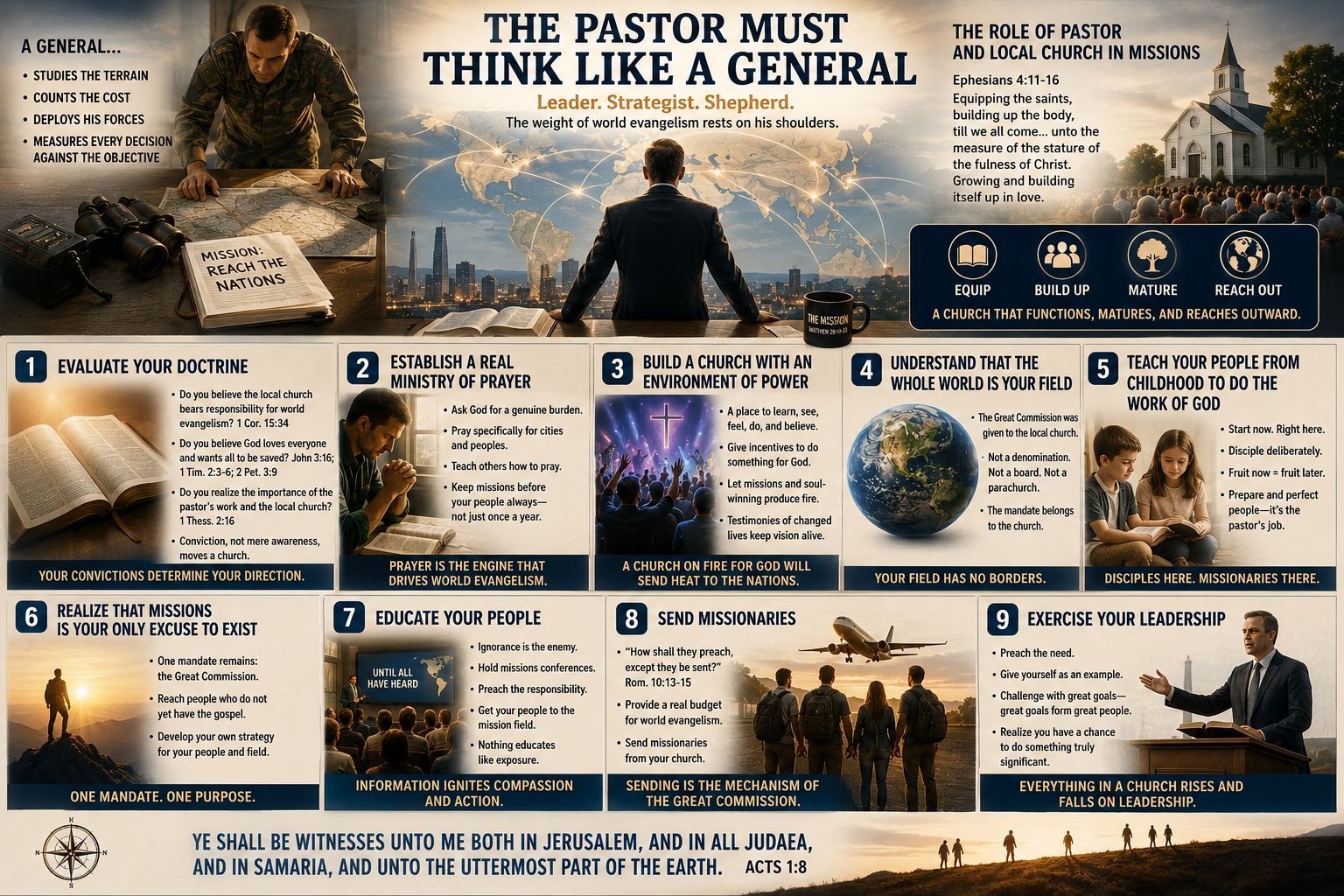
A general does not wander into battle hoping something good happens. He studies the terrain, counts the cost, deploys his forces with purpose, and measures every decision against the objective. In the same way, the pastor must think less like a caretaker and more like a strategist — even a head of state — responsible for the whole scope of his church's mission. He must have a plan, a strategy, so that his church actually fulfills the purpose for which it exists rather than drifting through decades of activity that never reaches the nations.
The Role of the Pastor and the Local Church in Missions
Ephesians 4:11-16 describes a church equipped by gifted men and built up “till we all come... unto the measure of the stature of the fulness of Christ,” growing and building itself up “in love” as every part does its work. This is the pastor's assignment: to equip a body that functions, matures, and reaches outward. What follows are the specific responsibilities that flow out of that calling.
1. Evaluate Your Doctrine
“As he thinketh in his heart, so is he” (Proverbs 23:7). A pastor's actions will never rise above his convictions. Before any strategy or program, he must honestly examine his beliefs.
Do you really believe that the local church bears responsibility for world evangelism? Paul did not treat this as an abstract theological position; he told the Corinthians plainly, “I speak this to your shame” when their grasp of spiritual things was lacking (1 Corinthians 15:34).
Do you really believe that God loves everyone and wants all to be saved? Scripture leaves no room for hedging here. “God so loved the world” (John 3:16). God's grace “hath appeared to all men” (Titus 2:11). God our Savior “will have all men to be saved” (1 Timothy 2:3-6). Christ tasted death “for every man” (Hebrews 2:9). He is “the propitiation... for the sins of the whole world” (1 John 2:2). He is “not willing that any should perish” (2 Peter 3:9). “Look unto me, and be ye saved, all the ends of the earth” (Isaiah 45:22). If a pastor believes these texts, world evangelism is not optional; it is the only logical outcome of his theology.
Do you realize the importance of the pastor's work and the local church? Paul described those who hindered the spread of the gospel as men who “please not God, and are contrary to all men: forbidding us to speak to the Gentiles that they might be saved” (1 Thessalonians 2:16) language strong enough to show how seriously heaven regards obstruction of the gospel's advance.
Are you convinced of the need? Conviction, not mere awareness, moves a church.
Completely surrender to the Spirit of God and the Word of God. Really believe that the Bible is our only rule of faith and practice. Do not try to follow what men do, or what is customary and accepted among the brethren; tradition and peer pressure make poor substitutes for obedience.
Seek the power of the Holy Spirit to carry the gospel to the entire world. Christ told His disciples to wait in Jerusalem “until ye be endued with power from on high” (Luke 24:49), and promised, “ye shall receive power... and ye shall be witnesses unto me... unto the uttermost part of the earth” (Acts 1:8).
Is the Great Commission really your reason for being in the ministry? And what does the word “both” mean in Acts 1:8 — “ye shall be witnesses unto me both in Jerusalem, and in all Judaea, and in Samaria, and unto the uttermost part of the earth”? “Both” removes the false choice between local ministry and global vision; the two are not competitors, they are one calling with an ever-widening circle.
Remember, too, that all of Scripture is, in one sense, a biography of how God used the life of a man — Abraham, Moses, David, Paul. Do you really think you can make a difference? Get rid of fatalistic attitudes that assume God's work will happen whether or not you make an effort. It will not happen without you. He has chosen to work through called, willing men.
2. Establish a Real Ministry of Prayer
“Ye ask, and receive not, because ye ask amiss” (James 4:2) — but the verse also warns that we often simply do not ask at all: “Ye lust, and have not... ye have not, because ye ask not.” A pastor must ask God to give him a burden, a genuine passion, not a borrowed one. He should pray specifically over his own city and over the cities of the world, naming places and peoples before God. He must teach his people how to pray for missionaries, for missions, and for the world at large; prayer is a skill that must be taught, not assumed. And he must always, consistently, keep world evangelism and missions before his people, refusing to let it become an annual event rather than a constant atmosphere.
3. Build a Church with an Environment of Power
A congregation should be a place where members can learn, see, feel, do, and believe that reaching the world is genuinely possible, not merely hear a sermon about it once a year. The pastor should give his people real incentives to do something for God and allow missions and soul-winning to kindle an actual fire in the church rather than a passing warmth. The missionary on the field needs this kind of church behind him: one alive with testimonies of changed lives, because a church that has stopped seeing conversions at home will struggle to sustain vision for conversions abroad.
4. Understand That the Whole World Is Your Field
The pastor must see beyond the walls of his church and beyond his own salary and security. The Great Commission was given to the local church — not to a denomination, not to a mission board, not to any parachurch structure. Those organizations may assist, but they do not carry the mandate. The mandate belongs to the church; therefore, it is the pastor's personal responsibility to steward it.
5. Teach Your People from Childhood to Do the Work of God
Start now. The people already in your congregation need to be doing the work of God right where they are — not waiting for some future mission field to activate them. Disciple them deliberately. If they will not produce fruit now, in familiar surroundings with every support available, they will not produce it later in a harder place. Let them prove themselves where they are; let them become soul winners in their own church before they are commissioned to win souls somewhere else. Preparing and perfecting people is the pastor's job. It is not the job of the Bible college — the Bible college trains; the local church disciples.
6. Realize That Missions Is Your Only Excuse to Exist
Strip away every secondary purpose and one mandate remains: the Great Commission, getting the gospel to the world. A church exists to reach people who do not yet have the gospel. Each pastor must develop his own strategy, suited to his people and his field, for accomplishing that purpose rather than borrowing someone else's plan wholesale.
7. Educate Your People
Ignorance is enemy number one. Most churches do not lack compassion; they lack information. Communication changes that. Hold missions conferences that open eyes and raise vision beyond the familiar. Preach the congregation's responsibility toward missions and world evangelism directly, not as an aside. Preach that the local church has an obligation to reach the entire world, not merely its own neighborhood. And get your people to the mission field itself when possible; let them see the needs firsthand and realize personally how they can make a difference. Nothing educates like exposure.
8. Send Missionaries
“How shall they hear without a preacher? And how shall they preach, except they be sent?” (Romans 10:13-17). Sending is not incidental to the Great Commission; it is the mechanism by which it is fulfilled. This requires a real budget for world evangelism, not a token line item, but a meaningful commitment of the church's resources, and it requires actually sending missionaries out from your own church rather than only supporting missionaries sent by others.
9. Exercise Your Leadership
Leading a church into world evangelism is both a privilege and a responsibility, and it will not happen by accident. The pastor must prepare himself to lead his people, because everything in a church ultimately rises and falls on leadership. He must preach the need plainly and repeatedly. He must give himself as an example, modeling the sacrifice and vision he asks of others. He must challenge his people with great goals, because great goals form great people; small goals form small people. And above all, he must realize that he has been given a genuine chance to do something truly significant with his life and ministry.
Conclusion
None of this happens by accident, and none of it happens without the pastor. The local church was never meant to be a way station on the road to somewhere else; it was designed by God to be the very engine of world evangelism. Every missionary sent, every soul won, every nation reached traces back to a pastor who first decided that the Great Commission was not someone else's job. It is his. May God give His under-shepherds the courage to build the model, carry the burden, and lead their churches to the ends of the earth.