
Ask God for Leaders
A Word to Ministry Leaders on Raising Up Men
Every ministry leader eventually runs into the same wall: there is more work than there are hands, and no one seems ready to carry it. It's tempting to make excuses to complain that the church lacks capable men, that the congregation is too small, too young, too untrained. But Scripture points in a different direction entirely. Leaders are not found; they are formed, and the forming begins with a request to God rather than a survey of the room.
You will not stumble across ready-made leaders. And if you did, they would not fit the leadership you are called to give, because they would be shaped by someone else's vision, not yours. The work of raising leaders starts on your knees.
Ask God for a Band of Men Whose Hearts He Has Touched
I Samuel 10:26
When Saul returned home as newly anointed king, he was not accompanied by seasoned statesmen or proven soldiers. He was joined by “a band of men, whose hearts God had touched.” That phrase describes the whole strategy: God does the touching, we do the asking. Before you scan the congregation for talent, ask the Lord directly for these men. Leadership candidates are not identified by resumé; they are given by God in answer to prayer.
Be on the Lookout for Men You Can Call to Yourself and Train
I Samuel 14:52
Saul “saw any strong man, or any valiant man, he took him unto him.” Prayer does not replace watchfulness; it sharpens it. As you go about ministry, keep your eyes open for men showing early signs of strength, courage, or faithfulness, even in small things. When you spot one, don't wait for him to volunteer. Call him to yourself and begin investing in him personally. Leadership development is intentional, not accidental.
It Is More Caught Than Taught
I Corinthians 16:10–11; 4:17
Paul sent Timothy to Corinth not primarily to lecture but to “bring you into remembrance of my ways which be in Christ.” Leadership is transmitted by proximity. The men you are training will absorb far more from watching how you handle pressure, conflict, disappointment, and success than from anything you say from a podium. Bring them close enough to watch you work.
Take Them Forward at the Speed They Are Able to Go
Genesis 33:13–14
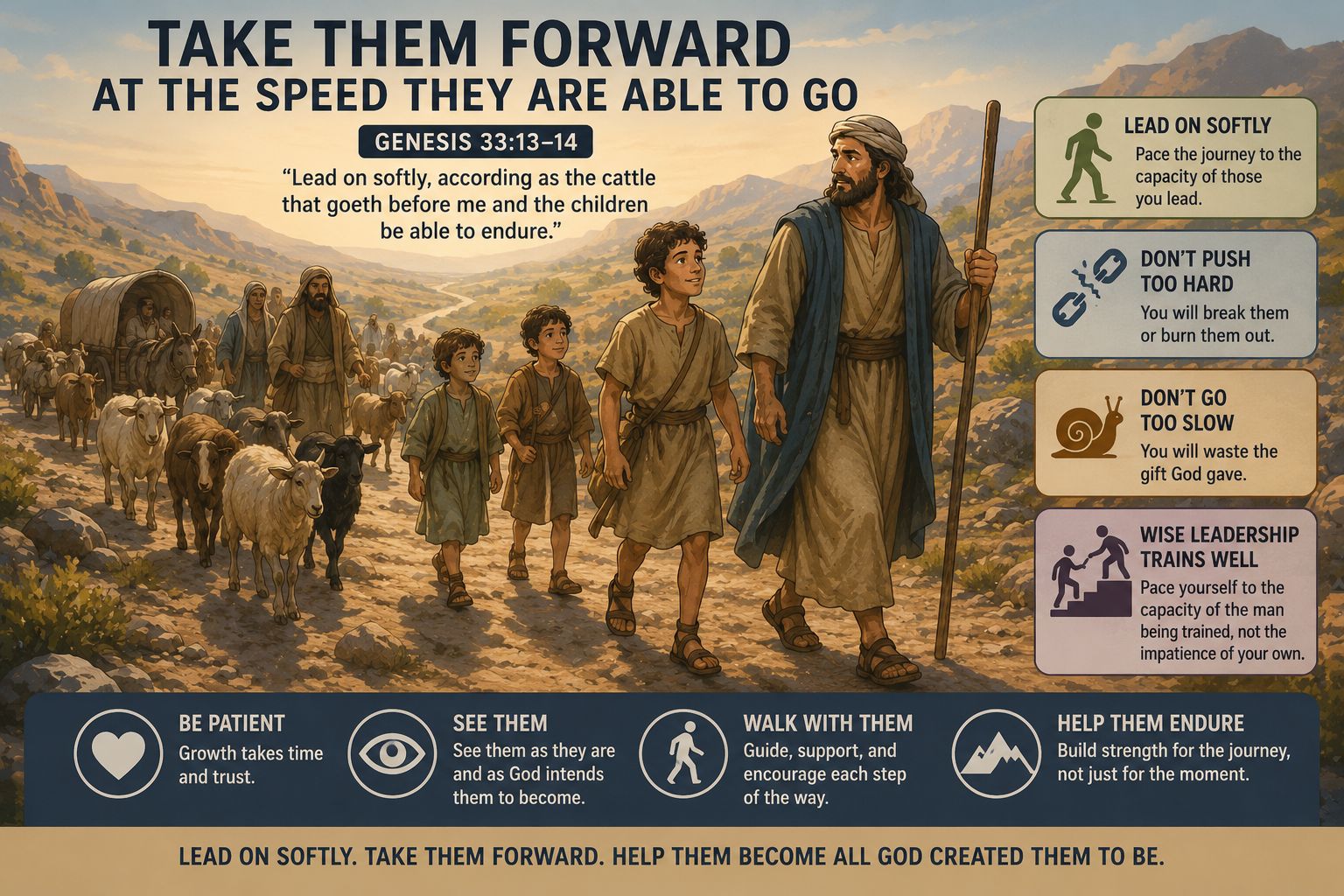
Jacob refused to drive his flocks and children faster than they could bear, choosing instead to “lead on softly, according as the cattle that goeth before me and the children be able to endure.” The same principle applies to developing leaders. Push too hard, and you will break them or burn them out; move too slowly, and you waste the gift God gave. Wise leadership training paces itself to the capacity of the man being trained, not the impatience of the one training him.
Have Double Vision
Judges 6:13–18
When the angel of the Lord addressed Gideon, He called him a “mighty man of valor” while Gideon was hiding in a winepress, threshing wheat in fear. God saw two things at once: who Gideon was and who Gideon would become. Effective leaders learn to do the same with the men they train. See a man honestly, as he currently is, weaknesses included. Then see him as God intends him to be. Lead him from the first vision toward the second.
You Cannot Lead Them Where You Have Not Been
Leadership training carries an integrity requirement. You cannot take men to a place you have not already gone yourself, nor call them to a discipline you are not practicing. Character, sacrifice, and spiritual maturity in a leader are not optional extras; they set the ceiling on what any leader can reproduce in someone else.
Teach Them to Be Mighty Men
II Timothy 2:1–5; I Samuel 10:26; II Samuel 23:8–39; I Chronicles 11:10–47
Scripture gives a full portrait of what a “mighty man” looks like, drawn from David's inner circle. As you train leaders, aim to produce men marked by five qualities:
- Men who strengthen themselves with their pastor (I Chronicles 11:10), loyal and unified with leadership rather than working against it.
- Men who are willing to be helpers (I Chronicles 12:1) content to serve in supporting roles, not only positions of visible authority.
- Men who are worthy of the battle (I Chronicles 12:8) prepared and capable when real conflict and difficulty come.
- Men who are willing to pay the price (II Timothy 2:3–4) able to endure hardness as good soldiers, undistracted by the affairs of this life.
- Men of compassion (Hebrews 5:1–4) able to deal gently with the ignorant and wayward, because they know their own weakness.
The leaders your ministry needs are not missing. Stop making excuses, and start asking. Watch for the men God is already touching, call them close, let them watch you, be patient with their pace, see them as they are and as God means for them to become, live out what you want them to reproduce, and shape them into mighty men. That is how leadership is raised up not found, but formed.