Discipleship: Life on Life
Building believers from new birth to reproducing ministry
Discipleship Begins the Moment Someone Is Saved
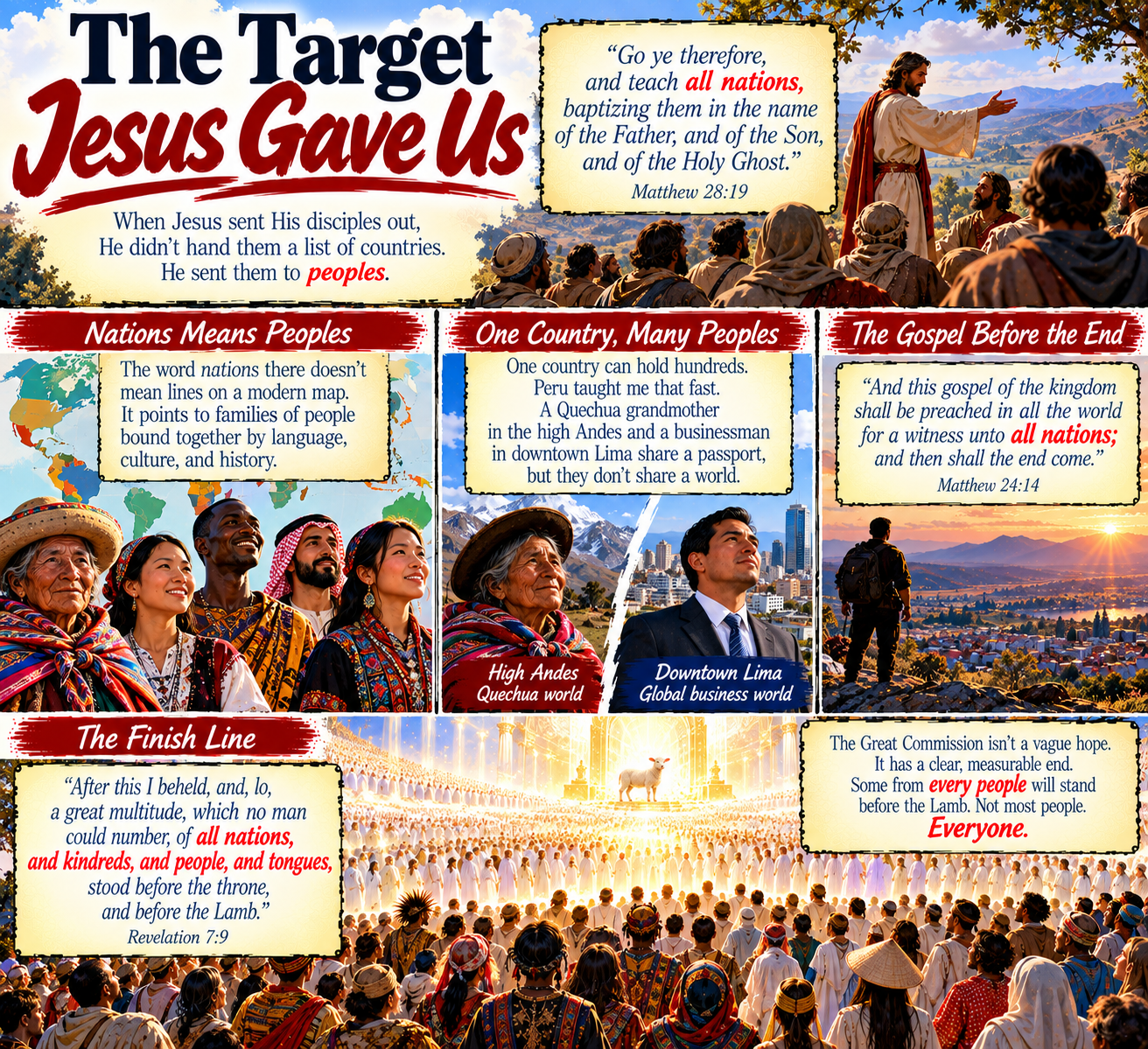
Discipleship isn't a program a Christian signs up for once they've matured enough, or a class reserved for the especially motivated. It begins the instant a person is saved. The Great Commission does not say "make converts"; it says "make disciples." The moment someone trusts Christ, they step into a lifelong process of becoming like Him, and that process starts immediately, not eventually.
"Go ye therefore, and teach all nations, baptizing them in the name of the Father, and of the Son, and of the Holy Ghost: teaching them to observe all things whatsoever I have commanded you..." Matthew 28:19–20
Too many churches treat evangelism and discipleship as separate departments: one team leads people to Christ, another team (sometimes no team at all) is supposed to grow them up afterward. But the two were never meant to be separated. The person who leads someone to Christ carries a responsibility to walk with them into growth. A newborn believer needs the same thing a newborn baby needs: immediate, hands-on care, not a waiting period.
We Take Them as Far as They Want to Go
Not every believer will end up in the same place. Discipleship isn't a factory line that produces identical output; it's a relationship that goes as deep as the disciple is willing to let it go. Some Christians will grow in private character and stop there. Others will go on to win souls, disciple others, lead a ministry, or plant a church. The discipler's job isn't to force someone further than they're willing to go — it's to make sure the door is always open, and the next step is always within reach.
"His lord said unto him, Well done, thou good and faithful servant: thou hast been faithful over a few things, I will make thee ruler over many things..." Matthew 25:21
The parable of the talents makes this plain: God doesn't judge every servant by the same yardstick, but He does expect every servant to be faithful with what he's been given. A disciple-maker's role is to keep opening doors, not to keep score of who walked through them and who didn't.
Life on Life, Not a Series of Lessons
Discipleship is often reduced to a curriculum, a workbook, a video series, a twelve-week class. There's nothing wrong with good material, but material was never meant to replace a relationship. Paul didn't hand the Thessalonians a syllabus and check back in a few months. He lived among them.
"So being affectionately desirous of you, we were willing to have imparted unto you, not the gospel of God only, but also our own souls, because ye were dear unto us." 1 Thessalonians 2:8
That's the model: impart your own life, not just information. Real discipleship happens in the car on the way to visit someone, over a meal, during a hard week, in the middle of a crisis — the places where character actually gets formed and tested. Lessons can inform a disciple. Only life on life can shape one.
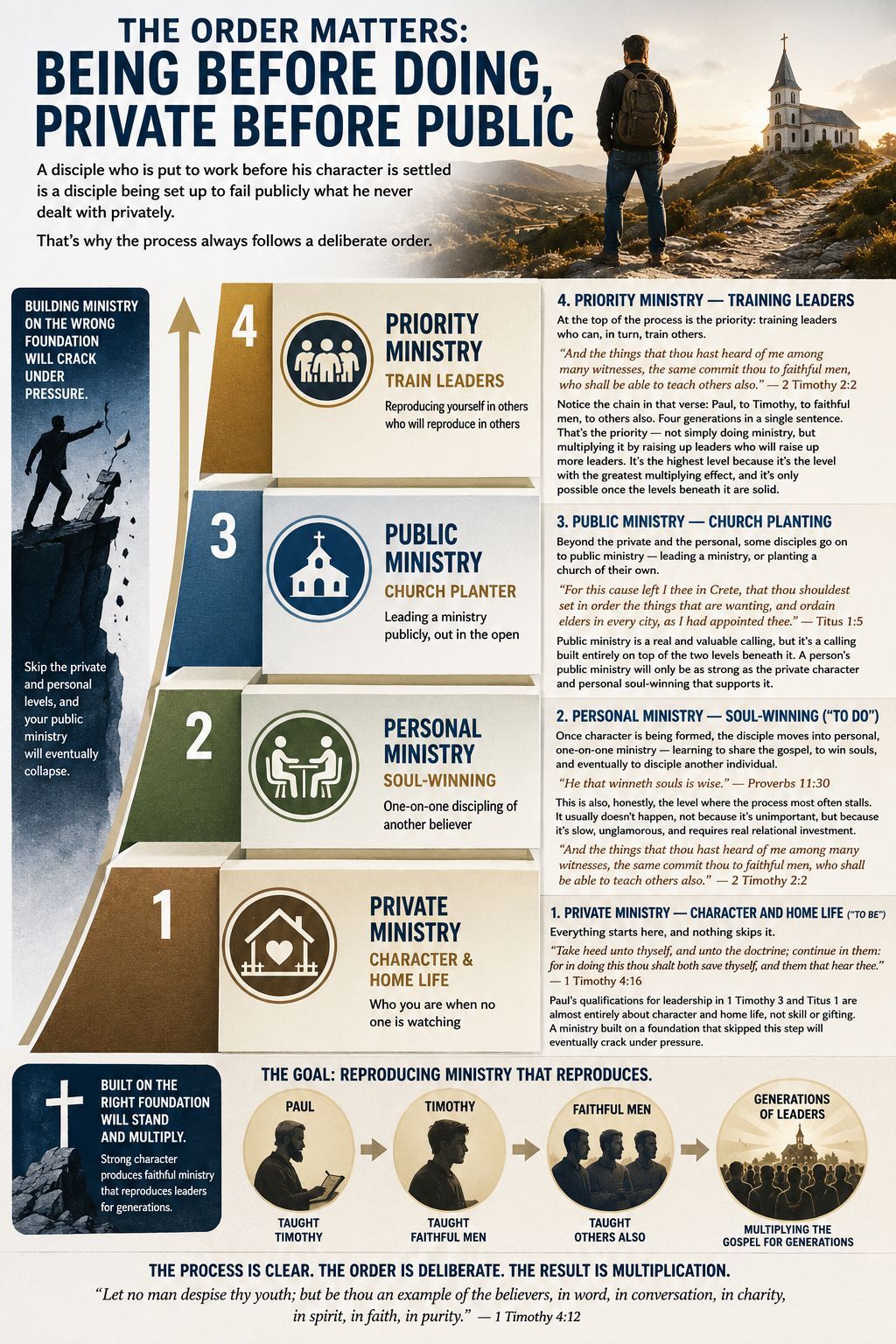
The Order Matters: Being Before Doing, Private Before Public
A disciple who is put to work before his character is settled is a disciple being set up to fail publicly what he never dealt with privately. That's why the process always follows a deliberate order:
PRIORITY MINISTRY
train leaders
Reproducing yourself in others who will reproduce in others
PUBLIC MINISTRY
church planter
Leading a ministry publicly, out in the open
PERSONAL MINISTRY
soul-winning
One-on-one discipling of another believer
PRIVATE MINISTRY
character & home life
Who you are when no one is watching
1. Private Ministry Character and Home Life ("To Be")
Everything starts here, and nothing skips it. Before a believer is ever asked to do anything for God publicly, the foundational work is on who they are becoming, their walk with God, their integrity, their marriage and home, their private habits when no one is watching. This is the "to be" stage, and it's the one stage every single disciple goes through regardless of how far they eventually go.
"Take heed unto thyself, and unto the doctrine; continue in them: for in doing this thou shalt both save thyself, and them that hear thee." 1 Timothy 4:16
Paul's qualifications for leadership in 1 Timothy 3 and Titus 1 are almost entirely about character and home life, not skill or gifting. That's not incidental; it's the pattern. A ministry built on a foundation that skipped this step will eventually crack under pressure.
2. Personal Ministry Soul-Winning ("To Do")
Once a character is being formed, the disciple moves into personal, one-on-one ministry — learning to share the gospel, win souls, and eventually disciple another individual the same way they were discipled. This is the "to do" stage: putting hands and feet to what's been built inwardly.
"He that winneth souls is wise." Proverbs 11:30
This is also, honestly, the level where the process most often stalls. Groups can be led, sermons can be preached, programs can run, but sitting down with one individual and walking them, personally, through their own growth is harder to sustain and easier to neglect. It usually doesn't happen, not because it's unimportant, but because it's slow, unglamorous, and requires real relational investment. It's exactly why it has to be intentional rather than assumed.
"And the things that thou hast heard of me among many witnesses, the same commit thou to faithful men, who shall be able to teach others also." 2 Timothy 2:2
3. Public Ministry Church Planting
Beyond the private and the personal, some disciples go on to public ministry, leading a ministry, or planting a church of their own. This is worth sitting with for a moment, though, because the title "church planter" can be claimed too easily. If a man plants a single church and stays there the rest of his life, is he a church planter, or simply a pastor? A true planter is one who reproduces someone who plants, hands off, and plants again, the same way a personal soul-winner reproduces disciples rather than just making one.
"For this cause left I thee in Crete, that thou shouldest set in order the things that are wanting, and ordain elders in every city, as I had appointed thee." Titus 1:5
Public ministry is a real and valuable calling, but it's built entirely on the two levels beneath it. A person's public ministry will only be as strong as the private character and personal soul-winning that supports it.
4. Priority Ministry Training Leaders
At the top of the process is the priority: training leaders who can, in turn, train others. This is the level Paul describes when he tells Timothy to commit the truth not just to one generation but to men who will teach the next generation.
"And the things that thou hast heard of me among many witnesses, the same commit thou to faithful men, who shall be able to teach others also." 2 Timothy 2:2
Notice the chain in that verse: Paul, to Timothy, to faithful men, to others also. Four generations in a single sentence. That's the priority, not simply doing ministry, but multiplying it by raising up leaders who will raise up more leaders. It's the highest level because it's the level with the greatest multiplying effect, and it's only possible once the levels beneath it are solid.
Preparing Everyone, Choosing With Everyone
Put together, the picture is simple: every believer gets discipled from day one, life on life rather than lesson by lesson. Character comes before conduct, and private faithfulness comes before any public platform. From there, the process is meant to move a disciple all the way up through personal soul-winning, into public ministry, and ultimately toward training the next generation of leaders.
The goal is not to force everyone to the top of the pyramid. The goal is to prepare every single believer to serve God at whatever level they're willing to go, while making sure none of them are ever left to figure it out alone. That's the whole aim of discipleship: not information transferred, but a life poured into another life, again and again, generation after generation.