
Training Leaders
Multiplying Leaders Who Will Lead Long After You Are Gone
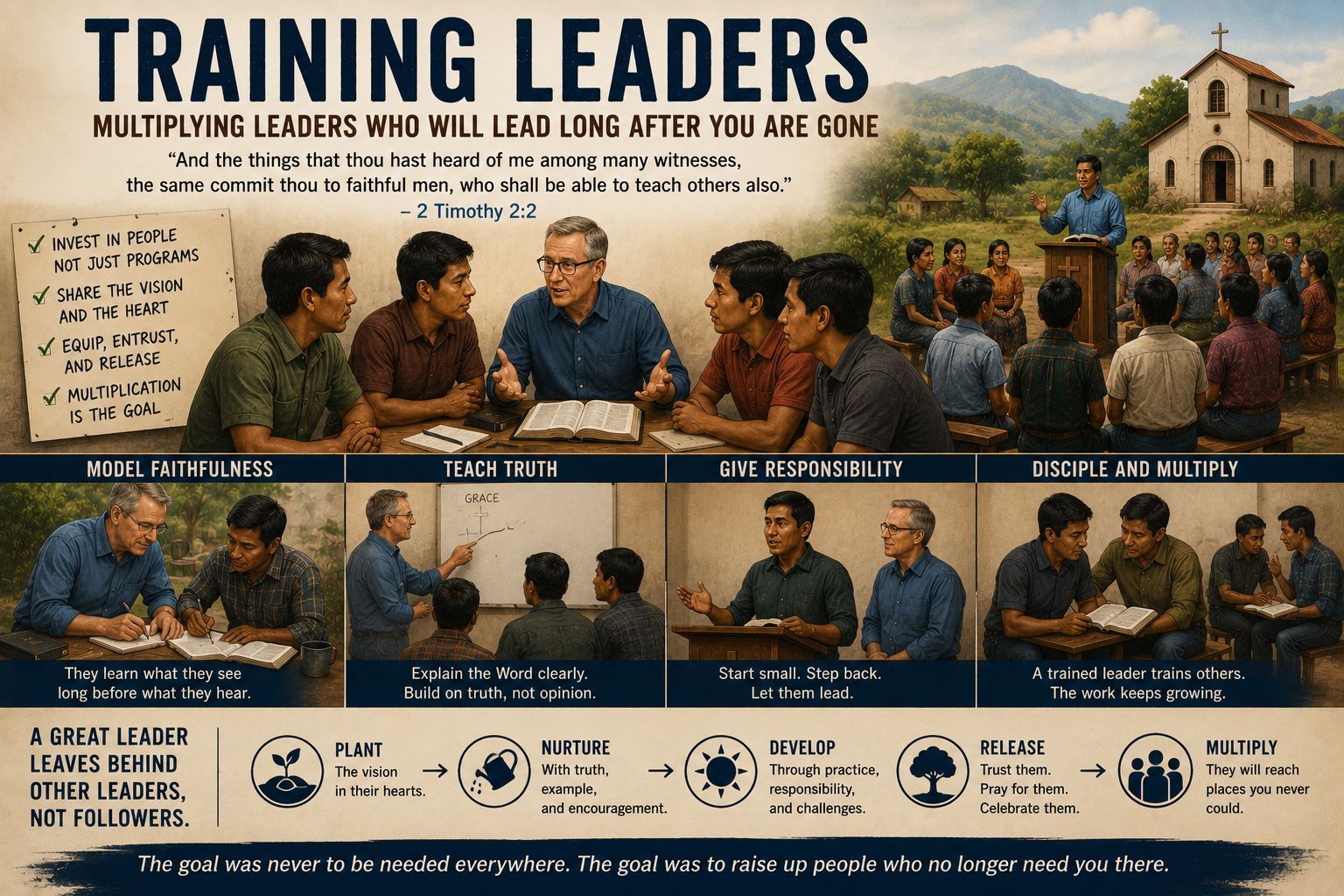
There is an old sorrow that runs through the history of missions, and it is worth naming plainly before we try to fix it. For generations, faithful men and women left home, learned a language, buried friends on foreign soil, and gave their whole lives to a work, and when they were gone, so was the work. A building might remain. A memory might remain. But a living, reproducing church, able to stand and grow and send on its own, often did not. The weakness was never a lack of love. It was that no one had been trained to carry it forward.
We have not entirely escaped that sorrow; we have only given it a new shape. The pattern today is subtler: one missionary, one church, one term of service, sometimes more. A gifted, hardworking servant of God gives years of his life, and at the end of it, there is a congregation of a dozen or so people who love him and love the Lord. It is real fruit. No one should despise it. But it raises an honest question, and it deserves an honest answer rather than a defensive one: if the outcome of a life poured out is a single church, wouldn't it be simpler, and kinder to the budget, to support a national believer who could do roughly the same work for a fraction of the cost?
That question only stings if the goal was ever "how many people can I personally shepherd." It stops stinging the moment the goal changes to something else entirely, something Jesus modeled long before we had mission boards and budget lines.
What We Mean by a Leader of Leaders
A leader of leaders is not a more efficient version of a leader of people. It is a different calling altogether. It is someone who looks at the men and women around him not primarily as people to serve, but as people to release. In the same years another might spend building one congregation with his own hands, a leader of leaders is finding a handful of others, giving himself to them, and putting the work into their hands instead of his own. At the end of that same span of time, he does not have one church. He has several planted, pastored, and reproducing through people he trained, most of whom he may never take credit for.
This is not a technique for getting more done. It is a way of seeing people. It asks a different question at the outset: not "what can I build," but "who can I build," and everything else follows from that.
You Will Need to Change Your Mind Before You Change Your Method
There are a few thoughts that live quietly in most of us who have ever done a work well. They are not confessions of sin. They are simply the assumptions we carry, usually without examining them, and they are worth gently and honestly bringing to light.
No one else will do it as well as I can. This is almost always true, and it was never meant to be the point. Joshua did not lead the way Moses led. He didn't need to. God was not looking for a second Moses; He was making a Joshua, with Joshua's own courage and Joshua's own voice, fit for the specific ground Joshua alone would cross. When we insist that the work be done our way, we are usually not protecting quality; we are protecting familiarity. God multiplies through difference, not through duplicates of us.
It takes longer to train someone than to just do it myself. In the short run, this is simple arithmetic, and the arithmetic is correct. But it is the arithmetic of addition, and God has always worked by multiplication. A season spent sowing into a person feels slower than a season spent producing a result until you notice that the result stays a result, while the person becomes a source. Elisha asked for a double portion, and got it, and became the source of far more than Elijah alone ever was. That did not happen quickly. It happened because Elijah was willing to be slow.
They will never do it as well as we can. Perhaps not in the same way. But Jesus told His own disciples plainly that they would do greater works than His not identical works, greater ones, because there would be many of them scattered where He alone could not go. A trained son need not outperform his father to fulfill his father's purpose. He needs to go where his father cannot.
There are no good nationals I can't find any. This is worth examining more than any of the others because it is rarely about the absence of people and much more often about the height of the bar we unconsciously hold them to. We tend to look for someone already equipped to do what we do, and then wonder why we can't find them. Paul told Timothy to look for faithful men, not finished ones, men who could be entrusted with what they'd received, not men who had already arrived. Faithfulness is common. Finished polish is not, and was never the qualification.
This is not a new idea we are imposing on Scripture; it is simply how God has always worked. Moses had his Joshua. Eli had his Samuel, even though Eli himself had failed as a father. Elijah had his Elisha, and Elisha in turn stood at the head of whole communities of the sons of the prophets, men we barely know by name because their teacher had made room for them to carry the work forward. Jesus, with the whole of Israel available to Him, spent the great weight of three years on twelve men not because the crowds didn't matter, but because the crowds could not be trusted with the future the way twelve trained men could. Paul planted churches across the Roman world in roughly a decade, and the secret was never his own tirelessness. It was Timothy. It was Titus. It was elders appointed in every town before Paul had even left it. This is not a strategy borrowed from modern leadership theory. It is the way the Father has always built His house through sons who become fathers, not through a single indispensable man.
The Biblical Basis for This Kind of Ministry
The Great Commission was never a call to win converts and leave. Christ told His disciples to make disciples of the nations, teaching them to obey everything He had commanded, which necessarily includes His own pattern of pouring life into a few so that many could follow (Matthew 28:19–20).
Paul told the Ephesians something that quietly overturns how most of us picture ministry. The gifts of apostle, prophet, evangelist, pastor, and teacher were not given so that these men would do the work of the ministry themselves. They were given to equip the saints to do it, until the whole body, every joint, every part, is building itself up in love (Ephesians 4:11–16). Paul could say to the Ephesian elders that he had not shrunk from declaring the whole counsel of God to them precisely because he expected them, not himself alone, to shepherd what came after him (Acts 20:27). A leader who does all the ministry himself has, without meaning to, kept the body from becoming what it was made to be.
To Timothy, Paul gave what might be the clearest single verse on this whole calling: the things Timothy had heard from Paul, in the presence of many witnesses, he was to entrust to faithful men who would be able to teach others also (2 Timothy 2:2). Read it slowly and count the generations already contained in that one sentence Paul, Timothy, faithful men, and the others they will teach. Four generations, in one verse, because Paul was already thinking two generations past the disciple standing in front of him.
And none of it happens without someone going. Faith comes by hearing, and hearing by the word of Christ — but how are they to hear without a preacher, and how is a preacher to be sent unless someone sends him (Romans 10:13–17)? The whole chain depends on multiplication continuing past any one of us, because the field is larger than any one life can cover.
Perhaps the gentlest word of all belongs to James, and it is the one that keeps this whole calling from becoming another burden to carry. He does not tell us to manufacture growth in the people we train. He tells us to receive the implanted word with meekness, because it is able to save our souls; the word already has its own life in it (James 1:21). Our part is to plant it faithfully and get out of its way. The growth is not produced by our striving over the people we train. It is grown, the way all living things are grown, by the word already at work in them.
A Closing Word
None of this is meant to sit on you as a new obligation. If it lands as another thing you are failing to do, something has gone wrong in the reading of it. This is simply how a father thinks about sons, not counting what he can accomplish alone, but delighting in what will still be growing long after he is no longer the one doing it. The invitation is not to work harder. It is to look at the people around you differently, and let a few of them become what you became.