Bloody Hands and a Broken Heart
Our Responsibility to a Lost World
There is a weight that should sit on every believer's chest.
Not the weight of guilt. Not the crushing pressure of performance. But the steady,
sobering weight of responsibility before a holy God who has entrusted us with the greatest news in the history of the universe, while billions of people have never heard a single word of it.
The question is not whether the world needs the gospel. The question is whether we feel it.
The Blood on Our Hands
God said something terrifying to Ezekiel the watchman. He said that if the watchman saw the sword coming and did not warn the people, the blood of those who perished would be required at the watchman's hand. Bloody hands. Not the hands of the enemy. Not the hands of the dying. The hands of the one who knew and said nothing.
"But if the watchman see the sword come, and blow not the trumpet, and the people be not warned; if the sword come, and take any person from among them, he is taken away in his iniquity; but his blood will I require at the watchman's hand." (Ezekiel 33:6)
That verse should stop us cold.
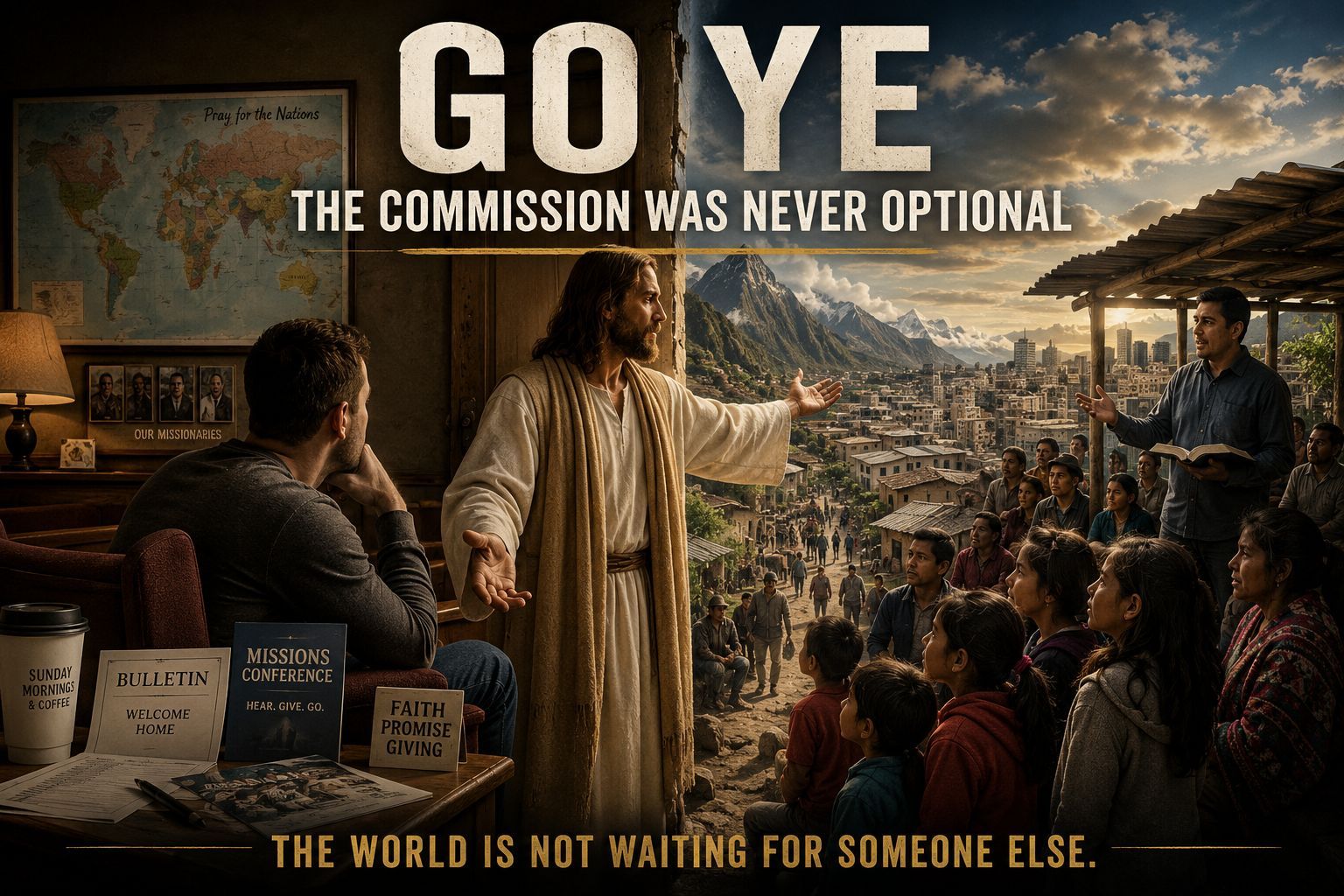
We are the watchmen. We have seen the sword. We hold the trumpet. And every day that passes with the trumpet silent is another day of blood on our hands.
Paul understood this. It is why he stood before the elders of Ephesus and declared with confidence,
"Wherefore I take you to record this day, that I am pure from the blood of all men. For I have not shunned to declare unto you all the counsel of God." (Acts 20:26-27)
Paul could say he was free from the blood of all men because he had spent himself getting the message out. He had preached in homes and synagogues, open-air markets, and prison cells, and before governors and kings. He had gone until they stopped him, and then he went some more.
Can we say the same?
Our Shame
Paul wrote something to the Corinthian church that stings.
"Awake to righteousness, and sin not; for some have not the knowledge of God: I speak this to your shame." (I Corinthians 15:34)
Read that again slowly. If there is anyone in this world who lacks knowledge of God, it is our shame.
Not their misfortune. Our shame.
We have carried this gospel for two thousand years. We have Bibles stacked on shelves, sermons streaming from our phones, and churches on every corner of our cities. And still there are people on this earth who have never once in their entire lives heard the name of Jesus spoken as Savior.
That is not a statistic. That is a scandal.
The Sorrow We Should Carry
Paul did not speak about the lost world from a detached theological standpoint. He talked about it from a broken heart.
"Brethren, my heart's desire and prayer to God for Israel is, that they might be saved." (Romans 10:1)
And then earlier, even more raw:
"I say the truth in Christ, I lie not, my conscience also bearing me witness in the Holy Ghost, that I have great heaviness and continual sorrow in my heart. For I could wish that myself were accursed from Christ for my brethren, my kinsmen according to the flesh." (Romans 9:1-3)
Continual sorrow. Those are the words. Not occasional concern. Not periodic compassion. Continual sorrow.
Paul would have taken the judgment himself if it could have saved his people. That is not hyperbole. That is a man whose heart had broken open to match the heart of God.
Peter wept after he denied the Lord.
"And the Lord turned, and looked upon Peter. And Peter remembered the word of the Lord, how he had said unto him, Before the cock crow, thou shalt deny me thrice. And Peter went out, and wept bitterly." (Luke 22:61-62)
One look from Jesus. That is all it took to collapse a man into brokenness. Imagine what it would do to us to look full into the face of Christ and then look out at the billions dying without him.
There is a reunion coming. "Then we which are alive and remain shall be caught up together with them in the clouds, to meet the Lord in the air: and so shall we ever be with the Lord." (I Thessalonians 4:17)
That reunion will be glorious beyond words. But between now and then, there is a world that has not heard. And that should break us.
The Horrible Condition of Man
We soften this too much.
We talk about people being lost the way we talk about someone misplacing their keys. But the Bible does not soften it. The Bible stares straight into the horror of man's condition and names it without flinching.
Dead in sin.
"And you hath he quickened, who were dead in trespasses and sins." (Ephesians 2:1)
Not sick. Not struggling. Dead. A dead man cannot help himself. He cannot reach upward. He cannot make better choices. He is dead. Every person without Christ is walking through this world in a condition of spiritual death, regardless of how successful or moral or religious they appear.
Deceived by religion. This is the one that haunts me most. There will be people at the final judgment who were absolutely certain they were right with God.
"Not every one that saith unto me, Lord, Lord, shall enter into the kingdom of heaven." (Matthew 7:21)
They prophesied. They cast out devils. They did wonderful works in his name. And Jesus will say plainly, "I never knew you: depart from me." Religion is the most dangerous deception in the world because it gives a man confidence he is not entitled to.
Facing the Great White Throne. John saw it.
"And I saw a great white throne, and him that sat on it, from whose face the earth and the heaven fled away; and there was found no place for them. And I saw the dead, small and great, stand before God; and the books were opened: and another book was opened, which is the book of life: and the dead were judged out of those things which were written in the books, according to their works. And whosoever was not found written in the book of life was cast into the lake of fire." (Revelation 20:11-12, 15)
Every name matters. Every person who stands before that throne without Christ is a tragedy beyond calculation.
A literal, burning, eternal hell. Jesus told the story himself. A rich man in hell, in torment, lifting up his eyes. Begging for a drop of water. Unable to cross the great gulf. Pleading for someone to go to his brothers so they would not come to the same place. (Luke 16:19-31) Jesus was not using this story to make a theological point about the afterlife. He was using it to break the heart of anyone listening toward the reality of eternal suffering. Hell is not a metaphor. It is a place. And the people we pass on the street, the people we work beside, the people in unreached villages in the mountains of Asia and the plains of Africa, are headed there without the gospel.
The Compassion of God
And yet. And yet.
This is where the story turns.
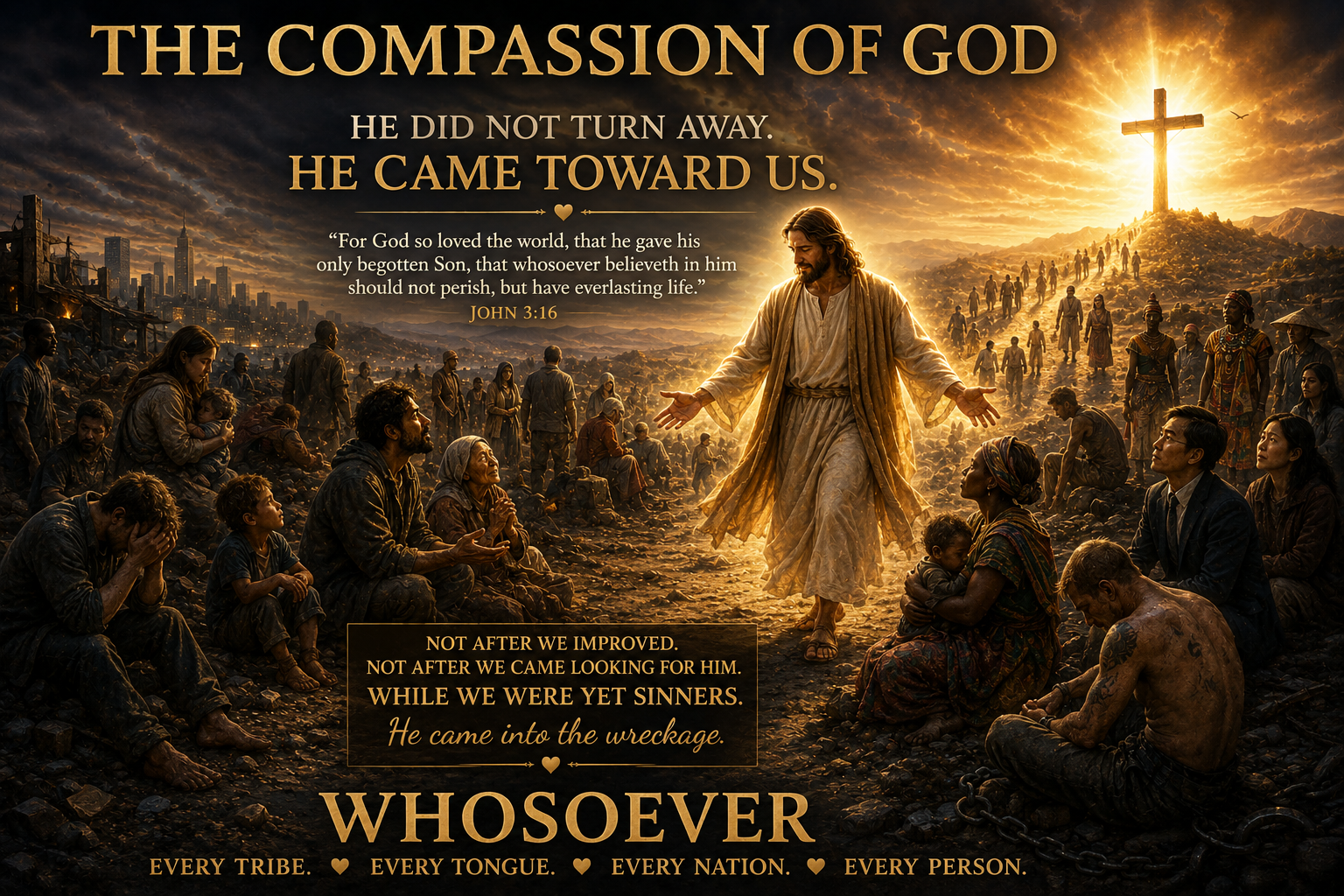
God did not look at the horrible condition of man and turn away. He did not close the books and wash his hands of us. He ran toward us.
"For God so loved the world, that he gave his only begotten Son, that whosoever believeth in him should not perish, but have everlasting life." (John 3:16)
That word whosoever changes everything. Not the religious. Not the deserving. Not the ones who have their lives together. Whosoever. Every tribe, every tongue, every nation. The person you think is too far gone. The people group that has never heard. Whosoever believes.
"But God commendeth his love toward us, in that, while we were yet sinners, Christ died for us." (Romans 5:8)
Not after we improved. Not after we came looking for him. While we were yet sinners. God did not wait for us to find our way to him. He came to us in the wreckage.
He is not willing that any should perish. "The Lord is not slack concerning his promise, as some men count slackness; but is longsuffering to us-ward, not willing that any should perish, but that all should come to repentance." (II Peter 3:9)
He desires all men to be saved. "Who will have all men to be saved, and to come unto the knowledge of the truth. For there is one God, and one mediator between God and men, the man Christ Jesus; who gave himself a ransom for all." (I Timothy 2:4-6)
He tasted death for every man. "But we see Jesus, who was made a little lower than the angels for the suffering of death, crowned with glory and honour; that he by the grace of God should taste death for every man." (Hebrews 2:9)
He is the propitiation for the whole world. "And he is the propitiation for our sins: and not for ours only, but also for the sins of the whole world." (I John 2:2)
He is the Good Shepherd who goes after the lost ones. "I am the good shepherd, and know my sheep, and am known of mine... And other sheep I have, which are not of this fold: them also I must bring, and they shall hear my voice." (John 10:14, 16)
The other sheep. The ones not yet in the fold. The ones who have not yet heard the shepherd's voice. He must bring them. He is determined to bring them. And he has chosen to do it through us.
What Will You Do With This?
There is a moment coming when the tears will be wiped away. "And God shall wipe away all tears from their eyes." (Revelation 21:4) John saw that promise in the context of having also seen the Great White Throne. He had watched the judgment. He had seen the books opened and the names not found written there. And he wept. And God promised to wipe those tears away.
But the wiping comes after. Right now we are still in the middle of the story. Right now the world is still dying. Right now the trumpet is still in our hands.
The question is simple and brutal: What will we do about it?
You may not go. Not everyone goes. But every believer can pray with the weight of Romans 9 pressing on their chest. Every believer can give sacrificially to those who do go. Every believer can open their mouth to the person sitting next to them who has never truly heard.
The watchman has seen the sword.
The trumpet is in our hands.
God help us to blow it.
"Awake to righteousness, and sin not; for some have not the knowledge of God: I speak this to your shame." - I Corinthians 15:34
#GreatCommission #Missions #Gospel #Evangelism #LostWorld #BiblicalStewardship #WatchmanOnTheWall #FollowedByMercy